Department of Evolution, Ecology & Organismal Biology, The Ohio State University, Columbus, OH 43210, USA.
J Chem Ecol. 2012 Jul;38(7):873-81. doi: 10.1007/s10886-012-0150-6. Epub 2012 Jun 19.
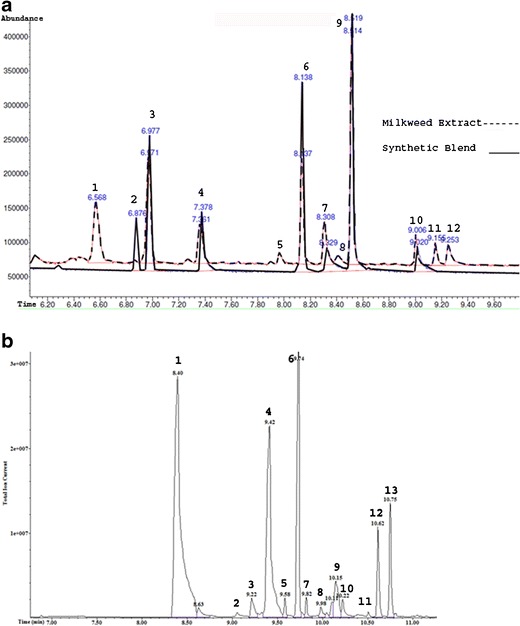
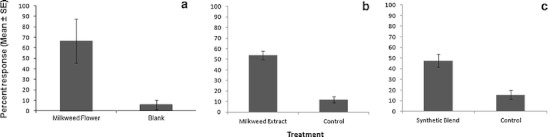
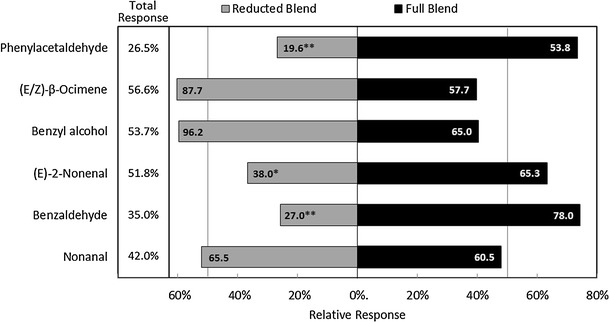
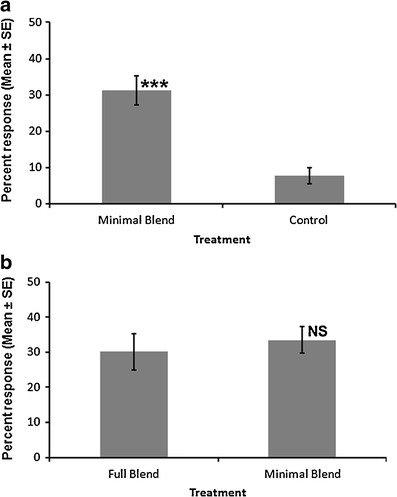
A pentane extract of flowers of common milkweed, Asclepias syriaca (Asclepiadaceae), elicited significant orientation from both male and female Culex pipiens in a dual-port flight olfactometer. Analysis of the extract by gas chromatography-mass spectrometry revealed six major constituents in order of relative abundance: benzaldehyde, (E)-β-ocimene, phenylacetaldehyde, benzyl alcohol, nonanal, and (E)-2-nonenal. Although not all were collected from the headspace profile of live flowers, a synthetic blend of these six compounds, when presented to mosquitoes in the same levels and proportions that occur in the extract, elicited a response comparable to the extract. Subtractive behavioral bioassays demonstrated that a three-component blend consisting of benzaldehyde, phenylacetaldehyde, and (E)-2-nonenal was as attractive as the full blend. These findings suggest the potential use of synthetic floral-odor blends for monitoring or control of both male and female disease-vectoring mosquitoes.
普通乳草(夹竹桃科)花的戊烷提取物在双端口飞行嗅觉计中引起了雄性和雌性库蚊的显著定向反应。通过气相色谱-质谱分析,提取物中按相对丰度顺序显示出六种主要成分:苯甲醛、(E)-β-罗勒烯、苯乙醛、苯甲醇、壬醛和(E)-2-壬烯醛。尽管并非所有化合物都从活花的顶空谱中收集,但当以与提取物中相同的水平和比例呈现给蚊子时,这六种化合物的合成混合物会引起与提取物相当的反应。减法行为生物测定表明,由苯甲醛、苯乙醛和(E)-2-壬烯醛组成的三组分混合物与全混合物一样有吸引力。这些发现表明,合成花卉气味混合物有可能用于监测或控制雄性和雌性病媒传播蚊子。