Tripodaki Elli-Sophia, Tasoulis Athanasios, Koliopoulou Antigoni, Vasileiadis Ioannis, Vastardis Leonidas, Giannis Giorgos, Argiriou Mihalis, Charitos Christos, Nanas Serafim
First Critical Care Department, Evangelismos Hospital, National and Kapodistrian University of Athens, Ypsilantou 45-47, 106 75 Athens, Greece.
Crit Care Res Pract. 2012;2012:654381. doi: 10.1155/2012/654381. Epub 2012 Jun 5.
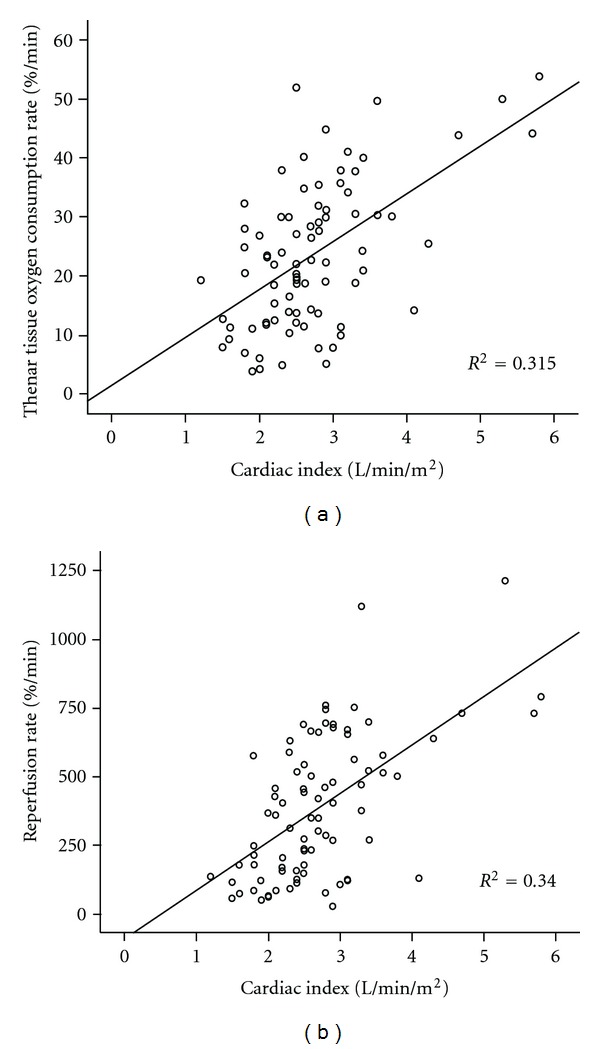
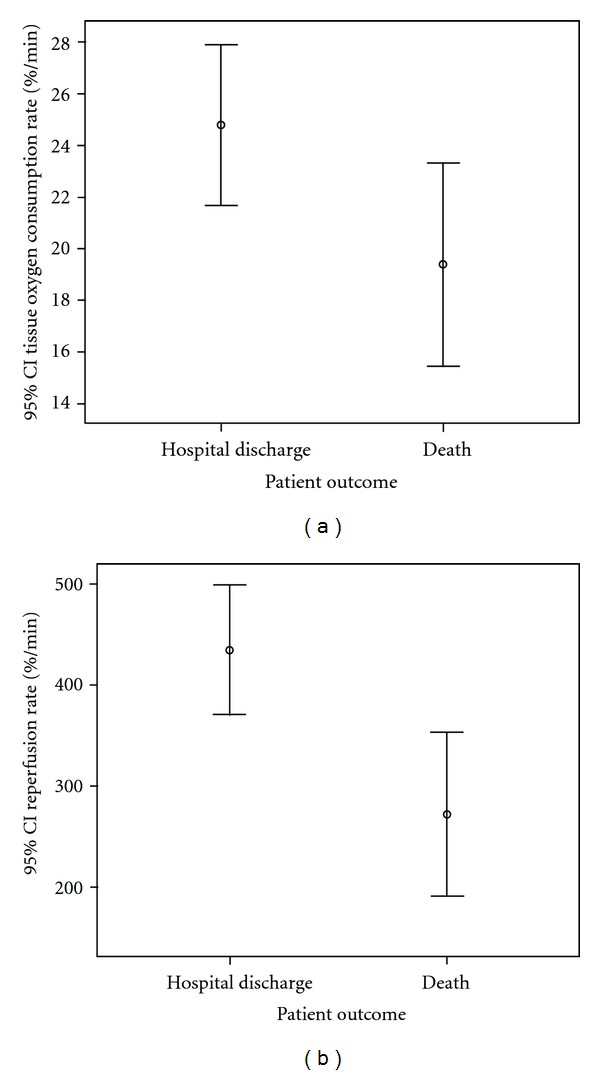
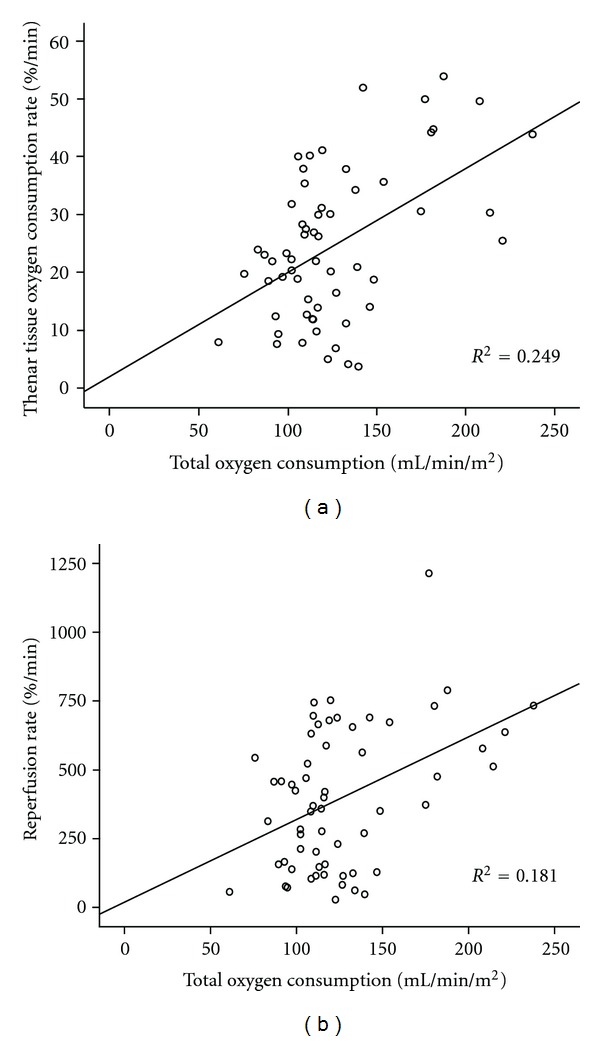
Background. The aim of our study was to investigate the relationship between microcirculatory alterations after open cardiac surgery, macrohemodynamics, and global indices of organ perfusion. Methods. Patients' microcirculation was assessed with near-infrared spectroscopy (NIRS) and the vascular occlusion technique (VOT). Results. 23 patients undergoing open cardiac surgery (11 male/12 female, median age 68 (range 28-82) years, EuroSCORE 6 (1-12)) were enrolled in the study. For pooled data, CI correlated with the tissue oxygen consumption rate as well as the reperfusion rate (r = 0.56, P < 0.001 and r = 0.58, P < 0.001, resp.). In addition, both total oxygen delivery (DO(2), mL/min per m(2)) and total oxygen consumption (VO(2), mL/min per m(2)) also correlated with the tissue oxygen consumption rate and the reperfusion rate. The tissue oxygen saturation of the thenar postoperatively correlated with the peak lactate levels during the six hour monitoring period (r = 0.50, P < 0.05). The tissue oxygen consumption rate (%/min) and the reperfusion rate (%/min), as derived from the VOT, were higher in survivors compared to nonsurvivors for pooled data [23 (4-54) versus 20 (8-38) P < 0.05] and [424 (27-1215) versus 197 (57-632) P < 0.01], respectively. Conclusion. Microcirculatory alterations after open cardiac surgery are related to macrohemodynamics and global indices of organ perfusion.
背景。我们研究的目的是调查心脏直视手术后微循环改变、宏观血流动力学和器官灌注整体指标之间的关系。方法。采用近红外光谱法(NIRS)和血管闭塞技术(VOT)评估患者的微循环。结果。23例接受心脏直视手术的患者(11例男性/12例女性,年龄中位数68岁(范围28 - 82岁),欧洲心脏手术风险评估系统(EuroSCORE)评分为6分(1 - 12分))纳入本研究。对于汇总数据,心脏指数(CI)与组织氧消耗率以及再灌注率相关(分别为r = 0.56,P < 0.001和r = 0.58,P < 0.001)。此外,总氧输送量(DO₂,mL/min per m²)和总氧消耗量(VO₂,mL/min per m²)也与组织氧消耗率和再灌注率相关。术后大鱼际的组织氧饱和度与6小时监测期内的乳酸峰值水平相关(r = 0.50,P < 0.05)。对于汇总数据,幸存者的血管闭塞技术得出的组织氧消耗率(%/min)和再灌注率(%/min)高于非幸存者[分别为23(4 - 54)对20(8 - 38),P < 0.05]和[424(27 - 1215)对197(57 - 632),P < 0.01]。结论。心脏直视手术后的微循环改变与宏观血流动力学和器官灌注整体指标相关。