Institute of Molecular Immunology; Helmholtz Zentrum München; German Research Center for Environmental Health; Munich, Germany.
Oncoimmunology. 2012 Mar 1;1(2):129-140. doi: 10.4161/onci.1.2.18216.
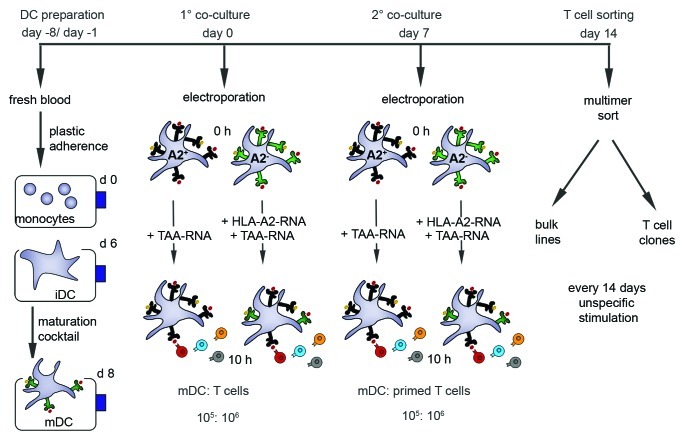
Designer T cells expressing transgenic T cell receptors (TCR) with anti-tumor specificity offer new treatment options for cancer patients. We developed a three phase procedure to identify T cells of high avidity based on the fact that T cells recognizing peptides presented by allogeneic MHC efficiently kill tumor cells. Autologous dendritic cells (DC) are co-transfected with ivt-RNA encoding an allogeneic MHC molecule and a selected antigen to allow them to express allogeneic MHC-peptide complexes that activate allo-restricted peptide-specific T cells. This approach provides great flexibility for obtaining high-avidity T cells as potential sources of TCR for adoptive T cell therapy.
表达具有抗肿瘤特异性的转基因 T 细胞受体 (TCR) 的设计 T 细胞为癌症患者提供了新的治疗选择。我们开发了一种三阶段程序,根据 T 细胞识别由同种异体 MHC 呈递的肽能够有效杀伤肿瘤细胞的事实,来鉴定具有高亲和力的 T 细胞。自体树突状细胞 (DC) 与编码同种异体 MHC 分子和选定抗原的 ivt-RNA 共转染,以允许它们表达激活同种异体限制的肽特异性 T 细胞的同种异体 MHC-肽复合物。这种方法为获得高亲和力 T 细胞作为过继性 T 细胞治疗的 TCR 潜在来源提供了极大的灵活性。