Clinical Trials Unit, London School of Hygiene & Tropical Medicine, Keppel Street, London, UK.
Trials. 2012 Jun 21;13:87. doi: 10.1186/1745-6215-13-87.
Worldwide, over 10 million people are killed or hospitalized because of traumatic brain injury each year. About 90% of deaths occur in low- and middle-income countries. The condition mostly affects young adults, and many experience long lasting or permanent disability. The social and economic burden is considerable. Tranexamic acid (TXA) is commonly given to surgical patients to reduce bleeding and the need for blood transfusion. It has been shown to reduce the number of patients receiving a blood transfusion by about a third, reduces the volume of blood transfused by about one unit, and halves the need for further surgery to control bleeding in elective surgical patients.
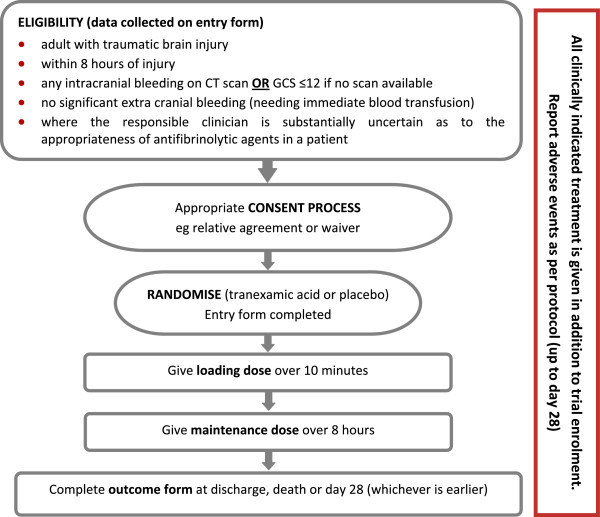
METHODS/DESIGN: The CRASH-3 trial is an international, multicenter, pragmatic, randomized, double-blind, placebo-controlled trial to quantify the effects of the early administration of TXA on death and disability in patients with traumatic brain injury. Ten thousand adult patients who fulfil the eligibility criteria will be randomized to receive TXA or placebo. Adults with traumatic brain injury, who are within 8 h of injury and have any intracranial bleeding on computerized tomography (CT scan) or Glasgow Coma Score (GCS) of 12 or less can be included if the responsible doctor is substantially uncertain as to whether or not to use TXA in this patient. Patients with significant extracranial bleeding will be excluded since there is evidence that TXA improves outcome in these patients. Treatment will entail a 1 g loading dose followed by a 1 g maintenance dose over 8 h.The main analyses will be on an 'intention-to-treat' basis, irrespective of whether the allocated treatment was received. Results will be presented as appropriate effect estimates with a measure of precision (95% confidence intervals). Subgroup analyses for the primary outcome will be based on time from injury to randomization, the severity of the injury, location of the bleeding, and baseline risk. Interaction tests will be used to test whether the effect of treatment differs across these subgroups. A study with 10,000 patients will have approximately 90% power to detect a 15% relative reduction from 20% to 17% in all-cause mortality.
Current Controlled Trials ISRCTN15088122; Clinicaltrials.gov NCT01402882.
全世界每年有超过 1000 万人因创伤性脑损伤而死亡或住院。大约 90%的死亡发生在低收入和中等收入国家。这种情况主要影响年轻人,许多人经历长期或永久性残疾。其带来的社会和经济负担是相当可观的。氨甲环酸(TXA)通常用于外科患者以减少出血和输血的需求。研究表明,它可以将接受输血的患者数量减少约三分之一,减少约一个单位的输血量,并将择期手术患者进一步手术控制出血的需求减半。
方法/设计:CRASH-3 试验是一项国际性、多中心、实用、随机、双盲、安慰剂对照试验,旨在量化早期给予 TXA 对创伤性脑损伤患者死亡和残疾的影响。将有 10000 名符合入选标准的成年患者被随机分配接受 TXA 或安慰剂。符合以下条件的成年创伤性脑损伤患者,在受伤后 8 小时内,计算机断层扫描(CT 扫描)显示颅内有任何出血或格拉斯哥昏迷评分(GCS)为 12 或更低,且主治医生对是否在该患者中使用 TXA 存在较大的不确定性,可纳入研究。有明显颅外出血的患者将被排除在外,因为有证据表明 TXA 可改善这些患者的预后。治疗方法包括 1 g 负荷剂量,然后在 8 小时内给予 1 g 维持剂量。主要分析将基于“意向治疗”原则进行,无论是否接受了分配的治疗。结果将以适当的效果估计值和精度(95%置信区间)呈现。主要结局的亚组分析将基于受伤到随机分组的时间、损伤的严重程度、出血部位和基线风险。交互检验将用于检验治疗效果是否在这些亚组之间存在差异。这项研究纳入 10000 名患者,大约有 90%的把握度可以检测到从 20%到 17%的全因死亡率相对降低 15%。
当前对照试验 ISRCTN15088122;Clinicaltrials.gov NCT01402882。