Institute of Nutritional Sciences, Justus-Liebig-University Giessen, Wilhelmstr. 20, 35392, Giessen, Germany.
Eur J Nutr. 2013 Apr;52(3):905-15. doi: 10.1007/s00394-012-0398-1. Epub 2012 Jun 23.
Breast cancer is the second most common cancer among women in the Kilimanjaro Region of Tanzania. It was tested within a case-control study in this region whether a specific dietary pattern impacts on the breast cancer risk.
A validated semi-quantitative Food Frequency Questionnaire was used to assess the dietary intake of 115 female breast cancer patients and 230 healthy age-matched women living in the same districts. A logistic regression was performed to estimate breast cancer risk. Dietary patterns were obtained using principal component analysis with Varimax rotation.
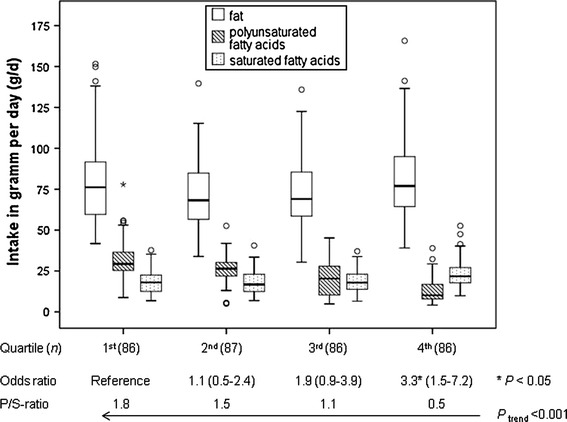
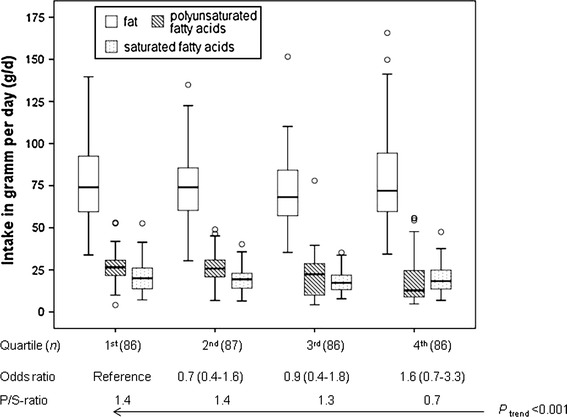
The adjusted logistic regression estimated an increased risk for a "Fatty Diet", characterized by a higher consumption of milk, vegetable oils and fats, butter, lard and red meat (OR = 1.42, 95 % CI 1.08-1.87; P = 0.01), and for a "Fruity Diet", characterized by a higher consumption of fish, mango, papaya, avocado and watery fruits (OR = 1.61, 95 % CI 1.14-2.28; P = 0.01). Both diets showed an inverse association with the ratio between polyunsaturated and saturated fatty acids (P/S ratio).
A diet characterized by a low P/S ratio seems to be more important for the development of breast cancer than total fat intake.
在坦桑尼亚乞力马扎罗地区,乳腺癌是女性中第二常见的癌症。在该地区进行的一项病例对照研究中,研究了特定的饮食模式是否会影响乳腺癌风险。
使用经过验证的半定量食物频率问卷,评估了 115 名女性乳腺癌患者和 230 名居住在同一地区的健康年龄匹配女性的饮食摄入情况。使用逻辑回归估计乳腺癌风险。使用主成分分析(Varimax 旋转)获得饮食模式。
调整后的逻辑回归估计,“高脂肪饮食”(以更高的牛奶、植物油和脂肪、黄油、猪油和红肉摄入量为特征)的风险增加(OR = 1.42,95%CI 1.08-1.87;P = 0.01),以及“水果饮食”(以更高的鱼、芒果、木瓜、鳄梨和多汁水果摄入量为特征)的风险增加(OR = 1.61,95%CI 1.14-2.28;P = 0.01)。这两种饮食模式与多不饱和脂肪酸与饱和脂肪酸的比例(P/S 比)呈负相关。
低 P/S 比的饮食模式似乎比总脂肪摄入对乳腺癌的发展更为重要。