Helmholtz Zentrum München, National Research Center for Environment and Health, GmbH, Institute of Experimental Genetics, Ingolstaedter Landstr. 1, 85764, Neuherberg, Germany.
Acta Neuropathol. 2012 Aug;124(2):187-97. doi: 10.1007/s00401-012-1003-7. Epub 2012 Jun 23.
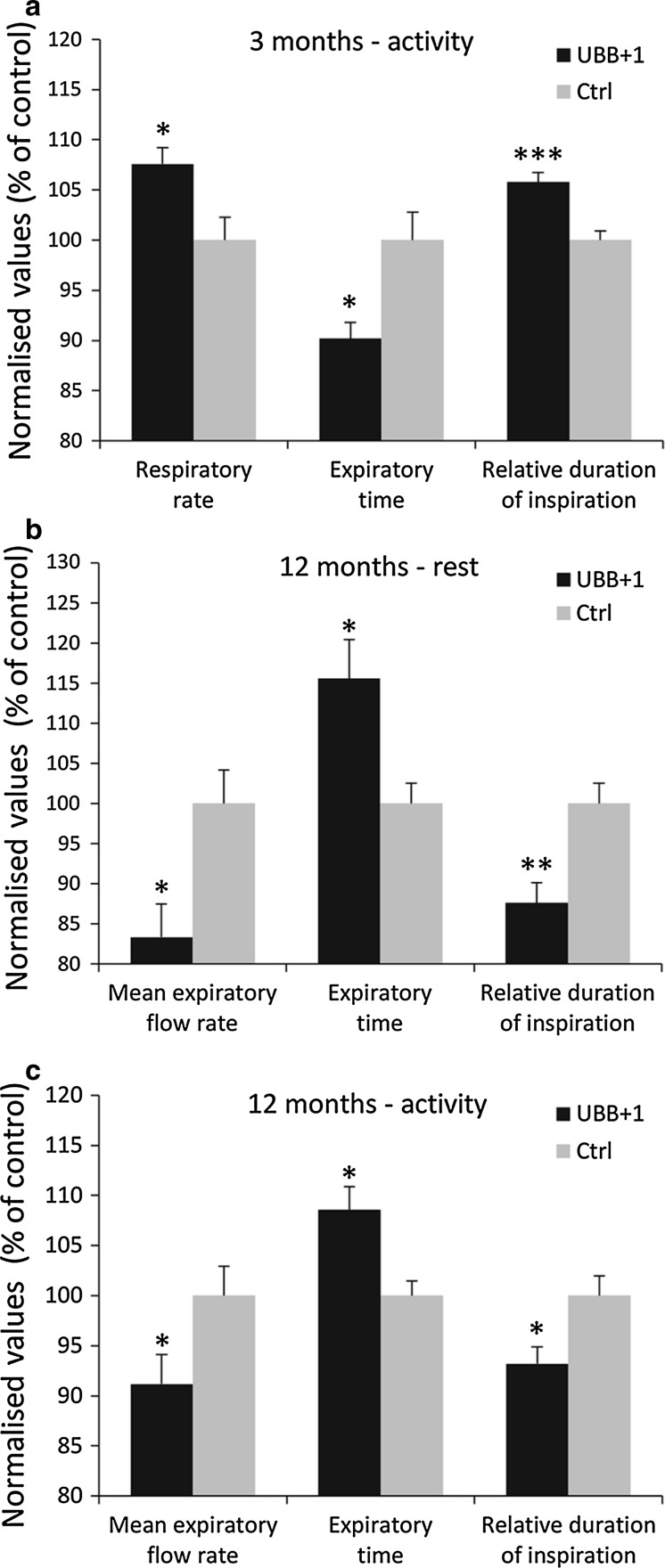
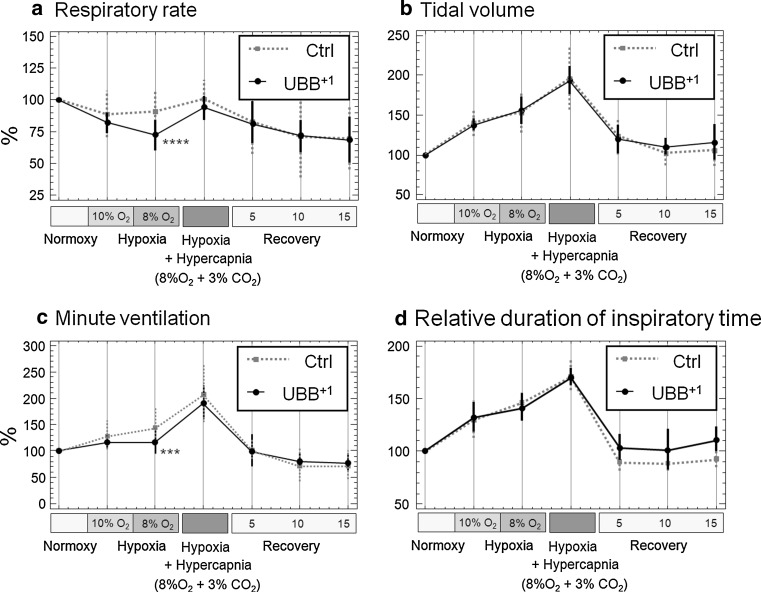
Aging and neurodegeneration are often accompanied by a functionally impaired ubiquitin-proteasome system (UPS). In tauopathies and polyglutamine diseases, a mutant form of ubiquitin B (UBB(+1)) accumulates in disease-specific aggregates. UBB(+1) mRNA is generated at low levels in vivo during transcription from the ubiquitin B locus by molecular misreading. The resulting mutant protein has been shown to inhibit proteasome function. To elucidate causative effects and neuropathological consequences of UBB(+1) accumulation, we used a UBB(+1) expressing transgenic mouse line that models UPS inhibition in neurons and exhibits behavioral phenotypes reminiscent of Alzheimer's disease (AD). In order to reveal affected organs and functions, young and aged UBB(+1) transgenic mice were comprehensively phenotyped for more than 240 parameters. This revealed unexpected changes in spontaneous breathing patterns and an altered response to hypoxic conditions. Our findings point to a central dysfunction of respiratory regulation in transgenic mice in comparison to wild-type littermate mice. Accordingly, UBB(+1) was strongly expressed in brainstem regions of transgenic mice controlling respiration. These regions included, e.g., the medial part of the nucleus of the tractus solitarius and the lateral subdivisions of the parabrachial nucleus. In addition, UBB(+1) was also strongly expressed in these anatomical structures of AD patients (Braak stage #6) and was not expressed in non-demented controls. We conclude that long-term UPS inhibition due to UBB(+1) expression causes central breathing dysfunction in a transgenic mouse model of AD. The UBB(+1) expression pattern in humans is consistent with the contribution of bronchopneumonia as a cause of death in AD patients.
衰老和神经退行性变通常伴随着功能受损的泛素-蛋白酶体系统 (UPS)。在 tau 病和多聚谷氨酰胺病中,泛素 B 的突变形式 (UBB(+1)) 在疾病特异性聚集体中积累。UBB(+1)mRNA 是在体内通过分子误读从泛素 B 基因座转录过程中以低水平产生的。已经表明,产生的突变蛋白抑制蛋白酶体功能。为了阐明 UBB(+1)积累的因果作用和神经病理学后果,我们使用了一种表达 UBB(+1)的转基因小鼠系,该系模拟了神经元中的 UPS 抑制,并表现出类似于阿尔茨海默病 (AD) 的行为表型。为了揭示受影响的器官和功能,年轻和老年 UBB(+1)转基因小鼠被全面表型分析了超过 240 个参数。这揭示了自发呼吸模式的意外变化和对低氧条件的反应改变。与野生型同窝小鼠相比,我们的研究结果表明转基因小鼠的呼吸调节存在中枢功能障碍。因此,UBB(+1)在控制呼吸的转基因小鼠脑干区域强烈表达。这些区域包括,例如,孤束核的中间部分和臂旁核的外侧亚区。此外,UBB(+1)在 AD 患者的这些解剖结构中也强烈表达(Braak 阶段 #6),而在非痴呆对照中不表达。我们得出结论,由于 UBB(+1)表达导致 UPS 长期抑制导致 AD 转基因小鼠模型中的中枢呼吸功能障碍。UBB(+1)在人类中的表达模式与支气管肺炎作为 AD 患者死亡原因的贡献一致。