Athinoula A. Martinos Center for Biomedical Imaging, Dept. of Radiology, Massachusetts General Hospital, Charlestown, MA 02129, USA.
Neuroimage. 2012 Oct 15;63(1):569-80. doi: 10.1016/j.neuroimage.2012.06.033. Epub 2012 Jun 23.
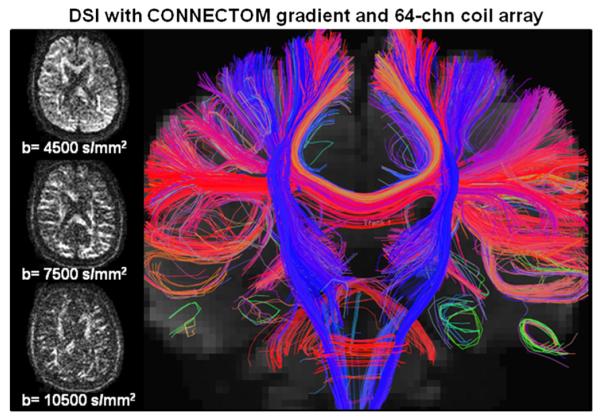
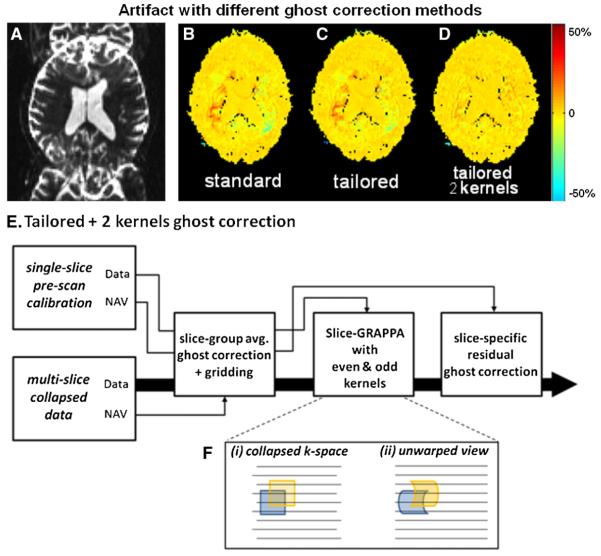
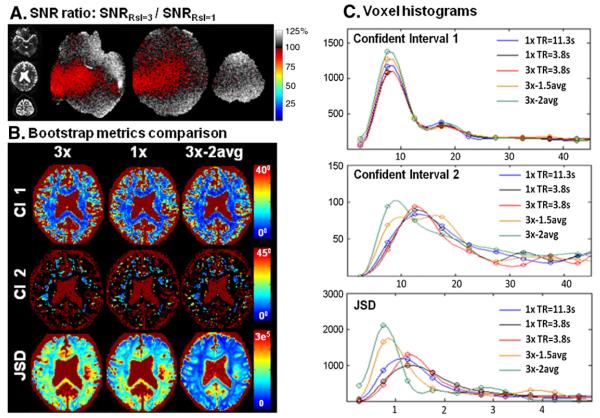
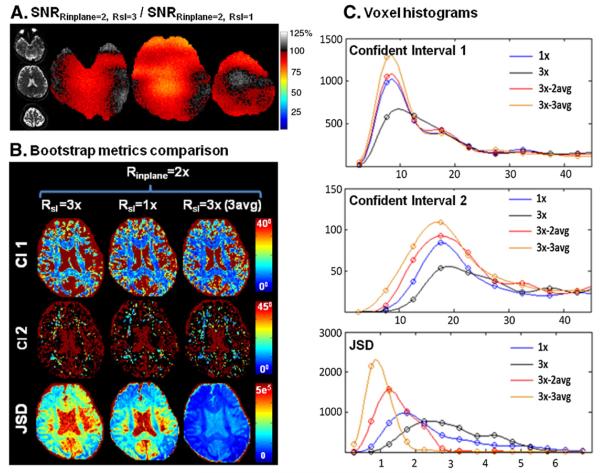
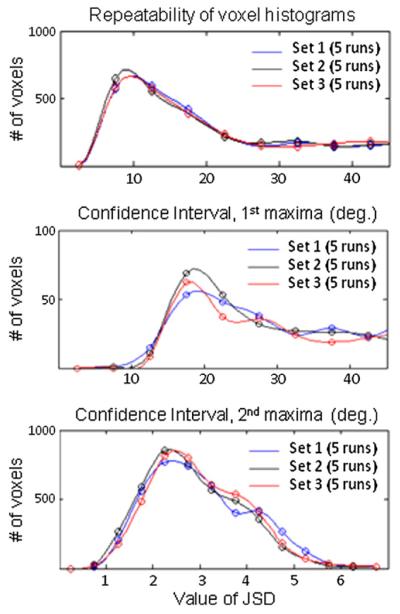
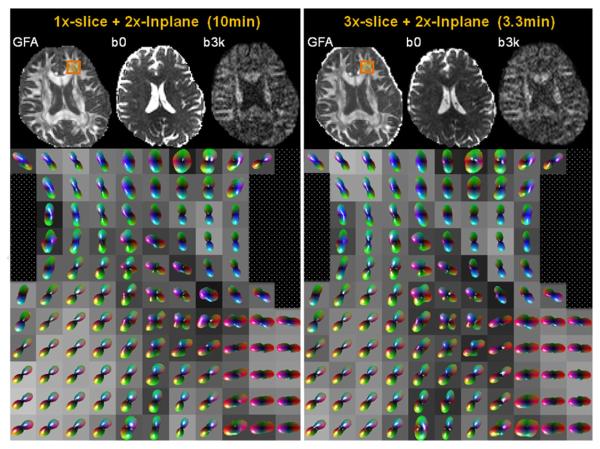
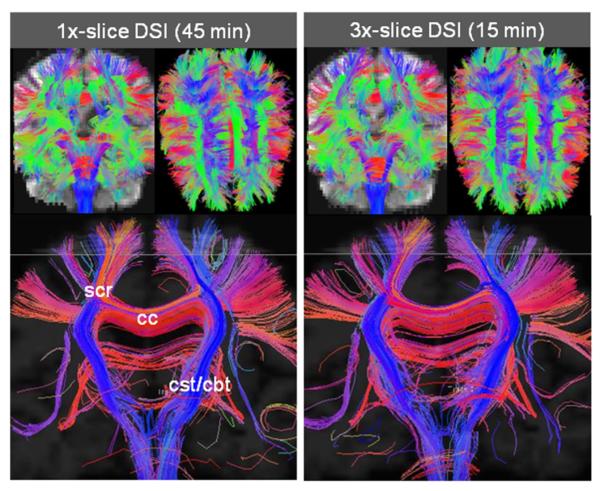
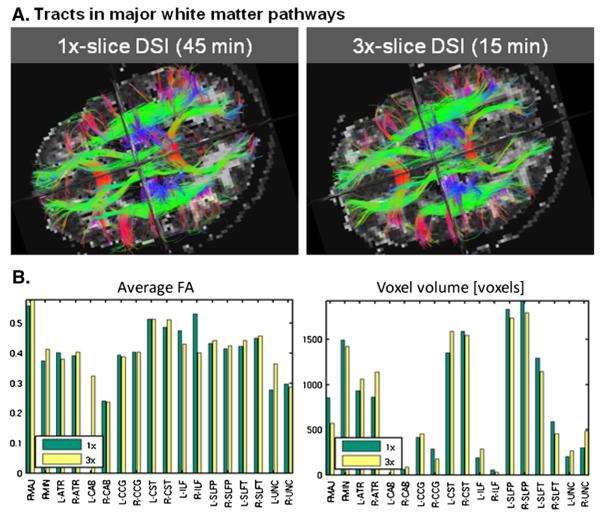
In diffusion MRI, simultaneous multi-slice single-shot EPI acquisitions have the potential to increase the number of diffusion directions obtained per unit time, allowing more diffusion encoding in high angular resolution diffusion imaging (HARDI) acquisitions. Nonetheless, unaliasing simultaneously acquired, closely spaced slices with parallel imaging methods can be difficult, leading to high g-factor penalties (i.e., lower SNR). The CAIPIRINHA technique was developed to reduce the g-factor in simultaneous multi-slice acquisitions by introducing inter-slice image shifts and thus increase the distance between aliased voxels. Because the CAIPIRINHA technique achieved this by controlling the phase of the RF excitations for each line of k-space, it is not directly applicable to single-shot EPI employed in conventional diffusion imaging. We adopt a recent gradient encoding method, which we termed "blipped-CAIPI", to create the image shifts needed to apply CAIPIRINHA to EPI. Here, we use pseudo-multiple replica SNR and bootstrapping metrics to assess the performance of the blipped-CAIPI method in 3× simultaneous multi-slice diffusion studies. Further, we introduce a novel image reconstruction method to reduce detrimental ghosting artifacts in these acquisitions. We show that data acquisition times for Q-ball and diffusion spectrum imaging (DSI) can be reduced 3-fold with a minor loss in SNR and with similar diffusion results compared to conventional acquisitions.
在扩散 MRI 中,单次激发多切片同时采集技术有可能增加单位时间内获得的扩散方向数量,从而在高角分辨率扩散成像(HARDI)采集时获得更多的扩散编码。尽管如此,利用并行成像方法对同时采集的、紧密间隔的切片进行解卷绕可能会很困难,从而导致高 g 因子惩罚(即,更低的 SNR)。CAIPIRINHA 技术的开发旨在通过引入切片间图像移位来降低同时多切片采集的 g 因子,从而增加混叠体素之间的距离。由于 CAIPIRINHA 技术通过控制每个 k 空间线的 RF 激励的相位来实现这一点,因此它不能直接应用于传统扩散成像中使用的单次激发 EPI。我们采用了一种最近的梯度编码方法,我们称之为“blipped-CAIPI”,来创建需要应用 CAIPIRINHA 的图像移位。在这里,我们使用伪多副本 SNR 和引导指标来评估 blipped-CAIPI 方法在 3×同时多切片扩散研究中的性能。此外,我们引入了一种新的图像重建方法,以减少这些采集中的有害鬼影伪影。我们表明,与传统采集相比,Q 球和扩散谱成像(DSI)的数据采集时间可以减少 3 倍,SNR 略有损失,并且扩散结果相似。