MRC Centre for Causal Analyses in Translational Epidemiology, School of Social and Community Medicine, University of Bristol, U.K.
Stat Med. 2012 Nov 20;31(26):3147-64. doi: 10.1002/sim.5385. Epub 2012 Jun 26.
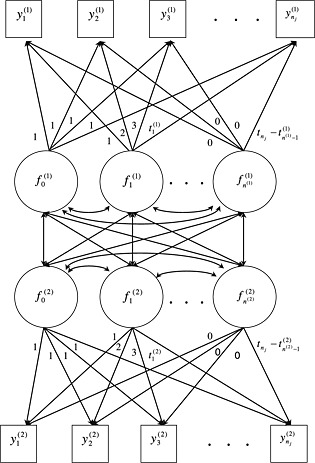
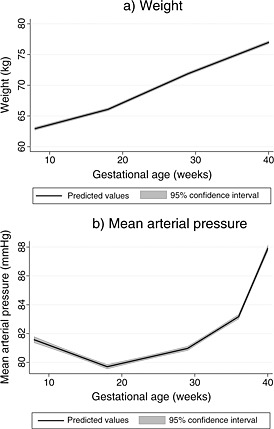
Growth models are commonly used in life course epidemiology to describe growth trajectories and their determinants or to relate particular patterns of change to later health outcomes. However, methods to analyse relationships between two or more change processes occurring in parallel, in particular to assess evidence for causal influences of change in one variable on subsequent changes in another, are less developed. We discuss linear spline multilevel models with a multivariate response and show how these can be used to relate rates of change in a particular time period in one variable to later rates of change in another variable by using the variances and covariances of individual-level random effects for each of the splines. We describe how regression coefficients can be calculated for these associations and how these can be adjusted for other parameters such as random effect variables relating to baseline values or rates of change in earlier time periods, and compare different methods for calculating the standard errors of these regression coefficients. We also show that these models can equivalently be fitted in the structural equation modelling framework and apply each method to weight and mean arterial pressure changes during pregnancy, obtaining similar results for multilevel and structural equation models. This method improves on the multivariate linear growth models, which have been used previously to model parallel processes because it enables nonlinear patterns of change to be modelled and the temporal sequence of multivariate changes to be determined, with adjustment for change in earlier time periods.
生长模型常用于生命历程流行病学中,用于描述生长轨迹及其决定因素,或用于将特定的变化模式与后续的健康结果联系起来。然而,分析两个或更多同时发生的变化过程之间关系的方法,特别是评估一个变量的变化对另一个变量随后变化的因果影响的证据的方法,还不太发达。我们讨论了具有多元响应的线性样条多层模型,并展示了如何通过使用每个样条的个体水平随机效应的方差和协方差,将一个变量在特定时间段内的变化率与另一个变量的后续变化率联系起来。我们描述了如何为这些关联计算回归系数,以及如何为其他参数(如与基线值或早期时间段变化率相关的随机效应变量)进行调整,并比较了计算这些回归系数标准误差的不同方法。我们还表明,这些模型可以在结构方程模型框架中等效拟合,并将每种方法应用于妊娠期间体重和平均动脉压的变化,在多层次和结构方程模型中获得相似的结果。与之前用于模拟并行过程的多元线性生长模型相比,这种方法有所改进,因为它能够模拟非线性变化模式,并确定多元变化的时间顺序,同时调整早期时间段的变化。