Department of Pharmacology, Key Laboratory of Medical Neurobiology of Ministry of Health of China, Zhejiang Province Key Laboratory of Neurobiology, Zhejiang University School of Medicine, 866 Yuhangtang Road, Hangzhou 310058, China.
J Neuroinflammation. 2012 Jun 26;9:145. doi: 10.1186/1742-2094-9-145.
Transforming growth factor-β 1 (TGF-β 1) is an important regulator of cell migration and plays a role in the scarring response in injured brain. It is also reported that 5-lipoxygenase (5-LOX) and its products, cysteinyl leukotrienes (CysLTs, namely LTC₄, LTD₄ and LTE₄), as well as cysteinyl leukotriene receptor 1 (CysLT₁R) are closely associated with astrocyte proliferation and glial scar formation after brain injury. However, how these molecules act on astrocyte migration, an initial step of the scarring response, is unknown. To clarify this, we determined the roles of 5-LOX and CysLT₁R in TGF-β 1-induced astrocyte migration.
In primary cultures of rat astrocytes, the effects of TGF-β 1 and CysLT receptor agonists on migration and proliferation were assayed, and the expression of 5-LOX, CysLT receptors and TGF-β1 was detected. 5-LOX activation was analyzed by measuring its products (CysLTs) and applying its inhibitor. The role of CysLT₁R was investigated by applying CysLT receptor antagonists and CysLT₁R knockdown by small interfering RNA (siRNA). TGF-β 1 release was assayed as well.
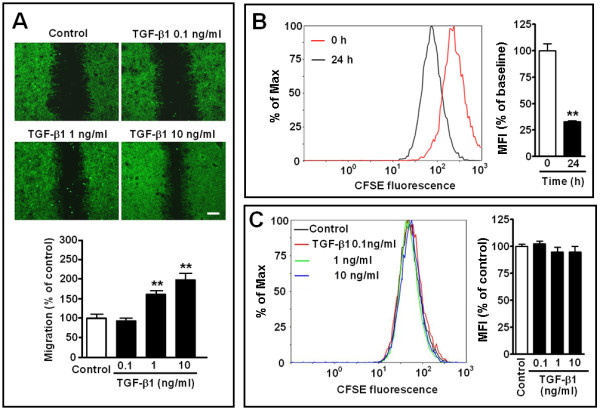
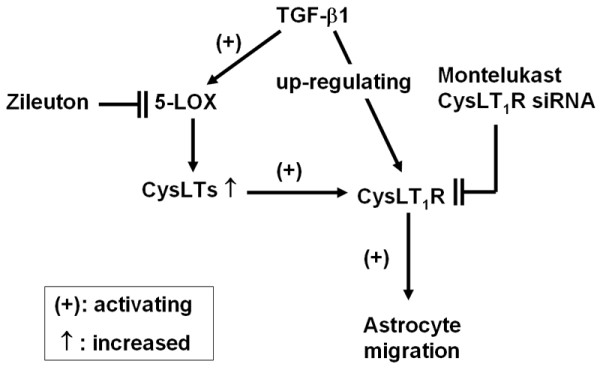
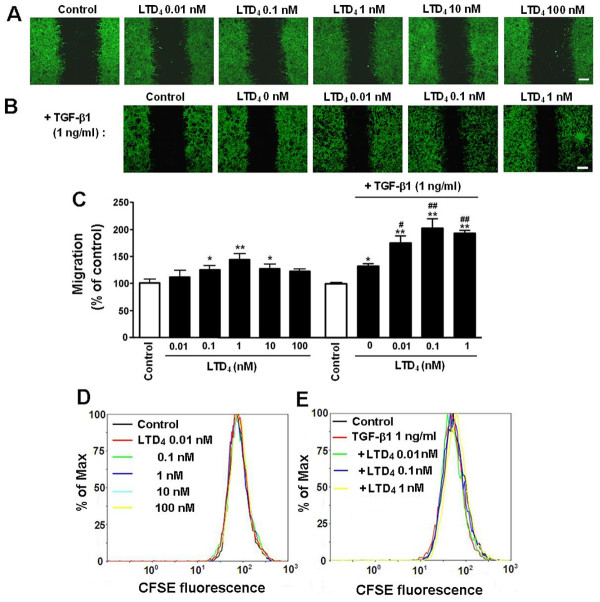
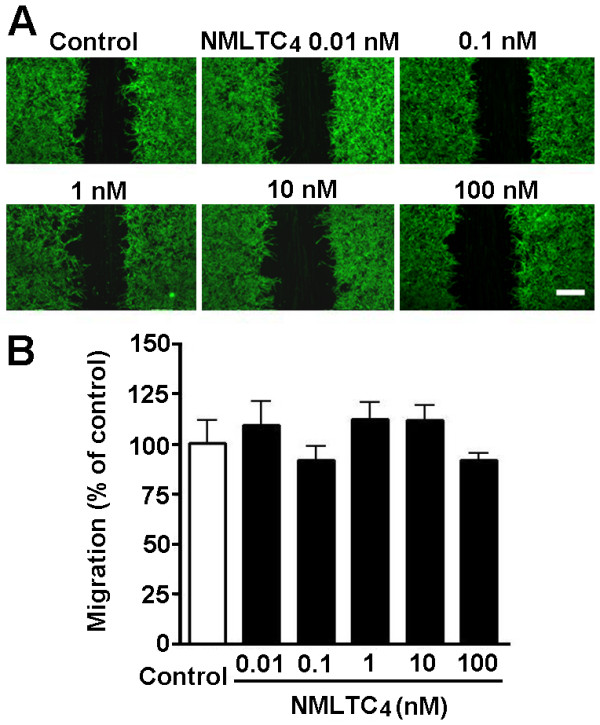
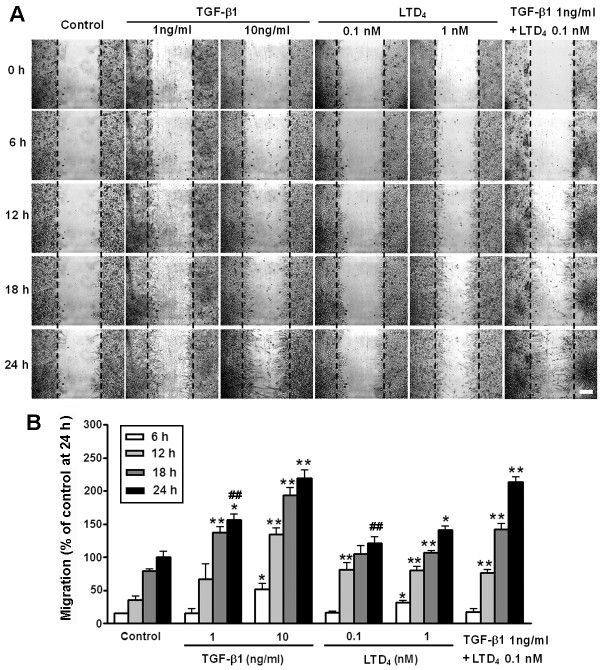
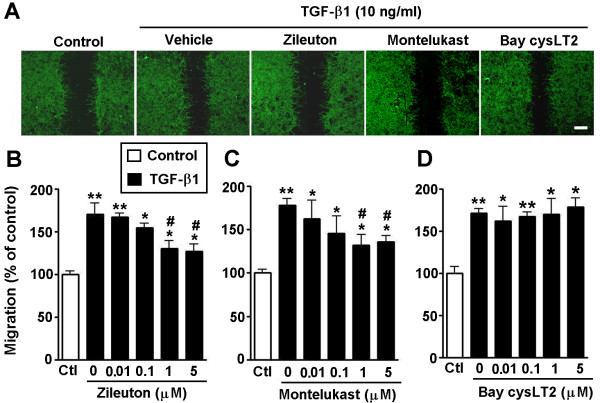
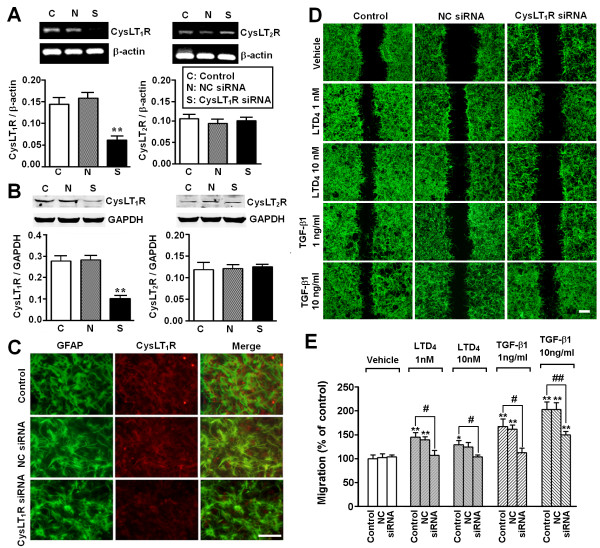
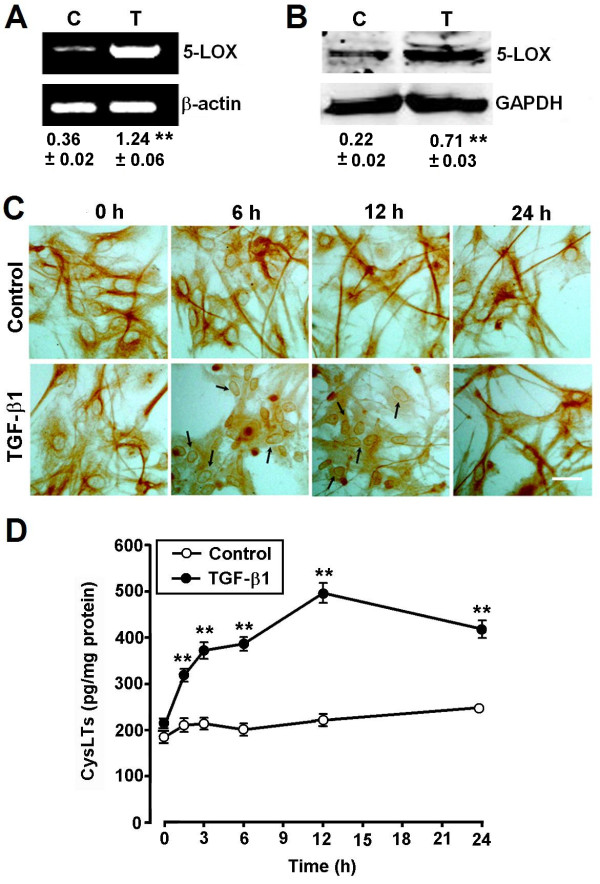
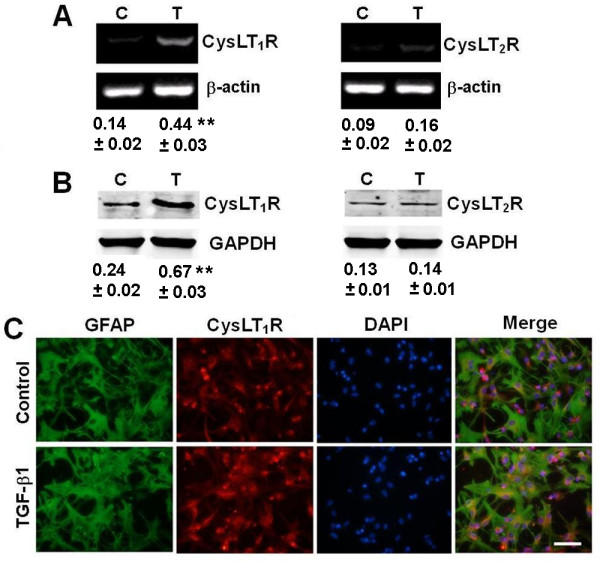
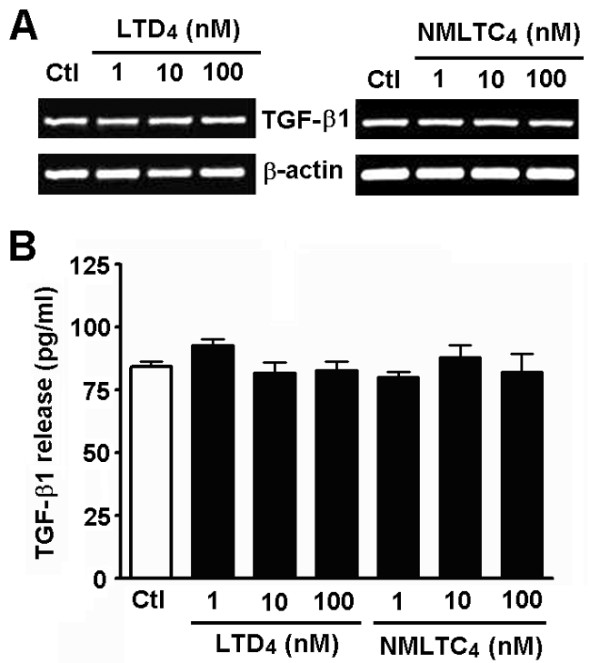
TGF-β 1-induced astrocyte migration was potentiated by LTD₄, but attenuated by the 5-LOX inhibitor zileuton and the CysLT₁R antagonist montelukast. The non-selective agonist LTD₄ at 0.1 to 10 nM also induced a mild migration; however, the selective agonist N-methyl-LTC₄ and the selective antagonist Bay cysLT2 for CysLT₂R had no effects. Moreover, CysLT₁R siRNA inhibited TGF-β 1- and LTD₄-induced astrocyte migration by down-regulating the expression of this receptor. However, TGF-β 1 and LTD4 at various concentrations did not affect astrocyte proliferation 24 h after exposure. On the other hand, TGF-β 1 increased 5-LOX expression and the production of CysLTs, and up-regulated CysLT1R (not CysLT₂R), while LTD4 and N-methyl-LTC4 did not affect TGF-β 1 expression and release.
TGF-β 1-induced astrocyte migration is, at least in part, mediated by enhanced endogenous CysLTs through activating CysLT₁R. These findings indicate that the interaction between the cytokine TGF-β 1 and the pro-inflammatory mediators CysLTs in the regulation of astrocyte function is relevant to glial scar formation.
转化生长因子-β 1(TGF-β 1)是细胞迁移的重要调节剂,在受损大脑中的瘢痕反应中发挥作用。据报道,5-脂氧合酶(5-LOX)及其产物,半胱氨酰白三烯(CysLTs,即 LTC₄、LTD₄ 和 LTE₄)以及半胱氨酰白三烯受体 1(CysLT₁R)与脑损伤后星形胶质细胞增殖和神经胶质瘢痕形成密切相关。然而,这些分子如何作用于星形胶质细胞迁移,这是瘢痕反应的初始步骤,尚不清楚。为了阐明这一点,我们确定了 5-LOX 和 CysLT₁R 在 TGF-β 1 诱导的星形胶质细胞迁移中的作用。
在大鼠星形胶质细胞的原代培养物中,测定了 TGF-β 1 和 CysLT 受体激动剂对迁移和增殖的影响,并检测了 5-LOX、CysLT 受体和 TGF-β1 的表达。通过测量其产物(CysLTs)并应用其抑制剂来分析 5-LOX 的激活。通过应用 CysLT 受体拮抗剂和 CysLT₁R 小干扰 RNA(siRNA)来研究 CysLT₁R 的作用。还测定了 TGF-β 1 的释放。
LTD₄增强了 TGF-β 1 诱导的星形胶质细胞迁移,但 5-LOX 抑制剂齐留通和 CysLT₁R 拮抗剂孟鲁司特则减弱了这种迁移。非选择性激动剂 LTD₄在 0.1 至 10 nM 范围内也诱导了轻度迁移;然而,选择性激动剂 N-甲基-LTC₄和 CysLT₂R 的选择性拮抗剂 Bay cysLT2 没有作用。此外,CysLT₁R siRNA 通过下调该受体的表达抑制了 TGF-β 1 和 LTD₄ 诱导的星形胶质细胞迁移。然而,暴露 24 小时后,TGF-β 1 和 LTD4 在各种浓度下均未影响星形胶质细胞增殖。另一方面,TGF-β 1 增加了 5-LOX 的表达和 CysLTs 的产生,并上调了 CysLT1R(而非 CysLT₂R),而 LTD4 和 N-甲基-LTC4 则不影响 TGF-β 1 的表达和释放。
TGF-β 1 诱导的星形胶质细胞迁移至少部分是通过激活 CysLT₁R 增强内源性 CysLTs 介导的。这些发现表明,细胞因子 TGF-β 1 与促炎介质 CysLTs 之间的相互作用在调节星形胶质细胞功能方面与神经胶质瘢痕形成有关。