School of Physics and Electronic Engineering, Taizhou University, Taizhou 318000, China.
Sensors (Basel). 2012;12(3):3747-61. doi: 10.3390/s120303747. Epub 2012 Mar 21.
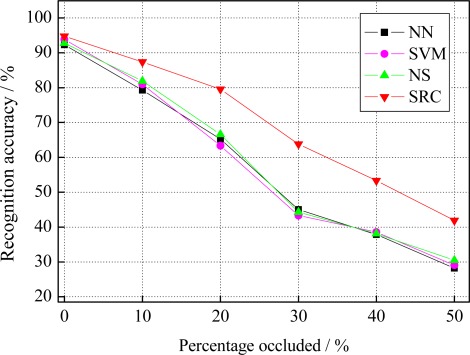
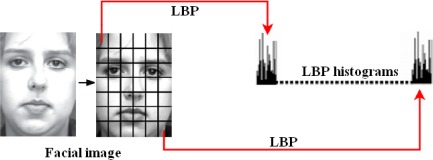
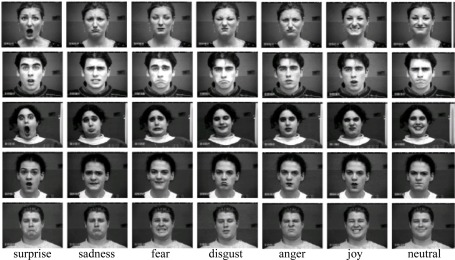
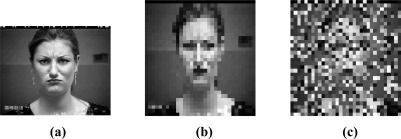
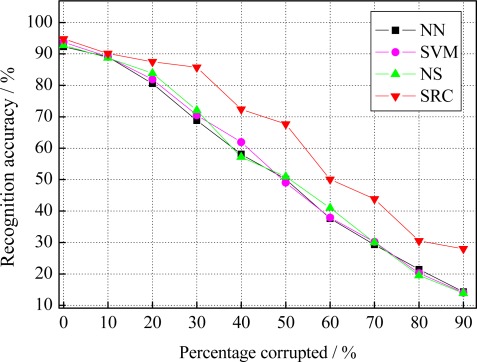
Recently, compressive sensing (CS) has attracted increasing attention in the areas of signal processing, computer vision and pattern recognition. In this paper, a new method based on the CS theory is presented for robust facial expression recognition. The CS theory is used to construct a sparse representation classifier (SRC). The effectiveness and robustness of the SRC method is investigated on clean and occluded facial expression images. Three typical facial features, i.e., the raw pixels, Gabor wavelets representation and local binary patterns (LBP), are extracted to evaluate the performance of the SRC method. Compared with the nearest neighbor (NN), linear support vector machines (SVM) and the nearest subspace (NS), experimental results on the popular Cohn-Kanade facial expression database demonstrate that the SRC method obtains better performance and stronger robustness to corruption and occlusion on robust facial expression recognition tasks.
最近,压缩感知 (CS) 在信号处理、计算机视觉和模式识别等领域引起了越来越多的关注。本文提出了一种基于 CS 理论的新方法,用于鲁棒的面部表情识别。CS 理论用于构建稀疏表示分类器 (SRC)。在干净和遮挡的面部表情图像上研究了 SRC 方法的有效性和鲁棒性。提取了三个典型的面部特征,即原始像素、Gabor 小波表示和局部二值模式 (LBP),以评估 SRC 方法的性能。与最近邻 (NN)、线性支持向量机 (SVM) 和最近子空间 (NS) 相比,在流行的 Cohn-Kanade 面部表情数据库上的实验结果表明,SRC 方法在鲁棒的面部表情识别任务中具有更好的性能和更强的对噪声和遮挡的鲁棒性。