Department of Internal Medicine, Pusan National University School of Medicine, Yangsan, Korea.
Diabetes Metab J. 2012 Jun;36(3):190-8. doi: 10.4093/dmj.2012.36.3.190. Epub 2012 Jun 14.
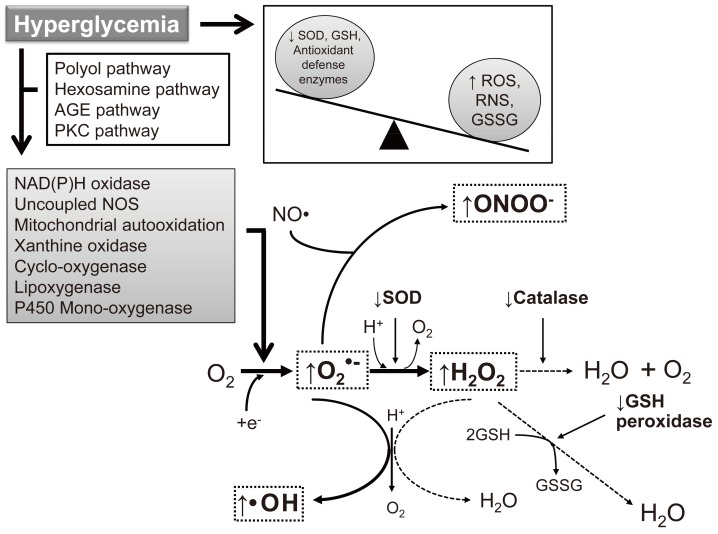
Macrovascular and microvascular diseases are currently the principal causes of morbidity and mortality in subjects with diabetes. Disorders of the physiological signaling functions of reactive oxygen species (superoxide and hydrogen peroxide) and reactive nitrogen species (nitric oxide and peroxynitrite) are important features of diabetes. In the absence of an appropriate compensation by the endogenous antioxidant defense network, increased oxidative stress leads to the activation of stress-sensitive intracellular signaling pathways and the formation of gene products that cause cellular damage and contribute to the vascular complications of diabetes. It has recently been suggested that diabetic subjects with vascular complications may have a defective cellular antioxidant response against the oxidative stress generated by hyperglycemia. This raises the concept that antioxidant therapy may be of great benefit to these subjects. Although our understanding of how hyperglycemia-induced oxidative stress ultimately leads to tissue damage has advanced considerably in recent years, effective therapeutic strategies to prevent or delay the development of this damage remain limited. Thus, further investigation of therapeutic interventions to prevent or delay the progression of diabetic vascular complications is needed.
目前,大血管和微血管疾病是糖尿病患者发病率和死亡率的主要原因。活性氧(超氧阴离子和过氧化氢)和活性氮(一氧化氮和过氧亚硝酸盐)的生理信号功能障碍是糖尿病的重要特征。在缺乏内源性抗氧化防御网络的适当补偿的情况下,氧化应激增加会导致应激敏感的细胞内信号通路的激活,并形成导致细胞损伤的基因产物,从而导致糖尿病的血管并发症。最近有人提出,有血管并发症的糖尿病患者的细胞抗氧化反应可能对高血糖产生的氧化应激有缺陷。这就提出了一个概念,即抗氧化治疗可能对这些患者有很大的益处。尽管近年来我们对高血糖诱导的氧化应激如何最终导致组织损伤的理解有了很大的进展,但预防或延迟这种损伤发展的有效治疗策略仍然有限。因此,需要进一步研究治疗干预措施,以预防或延迟糖尿病血管并发症的进展。