Zhang Hong-Qiang, Shi Jie, Yue Tong, Weng Jia-Hao, Wang Xu-Lin, Wang Hao, Su Xiao-Yu, Zheng Xue-Ying, Luo Si-Hui, Ding Yu, Wang Chao-Fan
Department of Cardiology, Centre for Leading Medicine and Advanced Technologies of IHM, The First Affiliated Hospital of USTC, Division of Life Sciences and Medicine, University of Science and Technology of China, Hefei 230001, Anhui Province, China.
Department of Endocrinology, Centre for Leading Medicine and Advanced Technologies of IHM, The First Affiliated Hospital of USTC, Division of Life Sciences and Medicine, University of Science and Technology of China, Hefei 230001, Anhui Province, China.
World J Diabetes. 2024 Aug 15;15(8):1742-1752. doi: 10.4239/wjd.v15.i8.1742.
Recent research has underscored the potentially protective role of dietary antioxidants against chronic conditions, such as cardiovascular diseases and stroke. The composite dietary antioxidant index (CDAI), which reflects the overall intake of key dietary antioxidants, has been identified as a crucial metric for exploring this relationship. Although previous research has shown a negative correlation between CDAI levels and stroke risk in prediabetic individuals, there remains a substantial gap in understanding this association among individuals with dia-betes, who are at an inherently greater risk for cerebrovascular events.
To investigate the association between CDAI and stroke risk in individuals with diabetes.
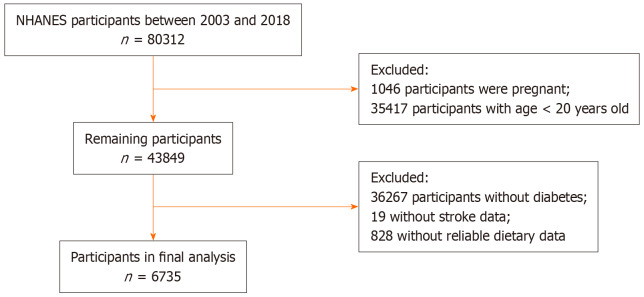
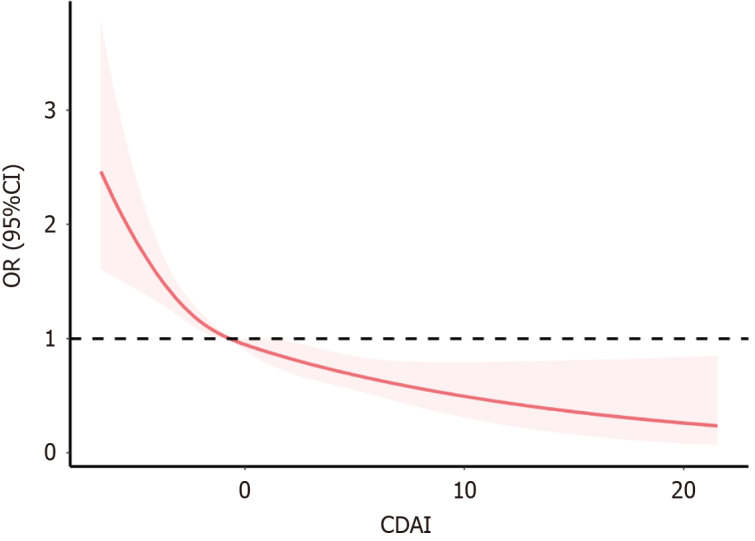
Using a cross-sectional study design, this investigation analyzed data from the National Health and Nutrition Examination Survey spanning from 2003 to 2018 that included 6735 participants aged over 20 years with diabetes. The CDAI was calculated from 24-h dietary recalls to assess intake of key antioxidants: Vitamins A, C, and E; carotenoids; selenium; and zinc. Multivariate logistic regression and restricted cubic spline analysis were used to rigorously examine the relationship between CDAI and stroke risk.
The participant cohort, with an average age of 59.5 years and a slight male majority, reflected the broader demographic characteristics of individuals with diabetes. The analysis revealed a strong inverse relationship between CDAI levels and stroke risk. Remarkably, those in the highest quintile of CDAI demonstrated a 43% lower prevalence of stroke compared to those in the lowest quintile, even after adjustments for various confounders. This finding not only highlights the negative association between CDAI and stroke risk but also underscores the significant potential of antioxidant-rich diets in reducing stroke prevalence among patients with diabetes.
Our findings suggested that CDAI was inversely associated with stroke prevalence among patients with diabetes. These results suggest incorporating antioxidant-rich foods into dietary regimens as a potential strategy for stroke prevention.
近期研究强调了膳食抗氧化剂对心血管疾病和中风等慢性病可能具有的保护作用。复合膳食抗氧化剂指数(CDAI)反映了关键膳食抗氧化剂的总体摄入量,已被确定为探索这种关系的关键指标。尽管先前的研究表明,糖尿病前期个体的CDAI水平与中风风险呈负相关,但在糖尿病患者(他们本身发生脑血管事件的风险更高)中,对这种关联的理解仍存在很大差距。
研究糖尿病患者中CDAI与中风风险之间的关联。
本研究采用横断面研究设计,分析了2003年至2018年美国国家健康与营养检查调查的数据,该调查纳入了6735名年龄超过20岁的糖尿病患者。通过24小时饮食回忆法计算CDAI,以评估关键抗氧化剂的摄入量:维生素A、C和E;类胡萝卜素;硒;以及锌。采用多变量逻辑回归和受限立方样条分析来严格检验CDAI与中风风险之间的关系。
参与者队列的平均年龄为59.5岁,男性略占多数,反映了糖尿病患者更广泛的人口统计学特征。分析显示CDAI水平与中风风险之间存在强烈的负相关。值得注意的是,即使在对各种混杂因素进行调整后,CDAI最高五分位数的人群中风患病率比最低五分位数的人群低43%。这一发现不仅突出了CDAI与中风风险之间的负相关,还强调了富含抗氧化剂的饮食在降低糖尿病患者中风患病率方面的巨大潜力。
我们的研究结果表明,CDAI与糖尿病患者的中风患病率呈负相关。这些结果表明,将富含抗氧化剂的食物纳入饮食方案可能是预防中风的一种策略。