Structural Glycobiology Section, SAIC-Frederick, Inc., Center for Cancer Research Nanobiology Program, Center for Cancer Research, Frederick National Laboratory for Cancer Research, National Institutes of Health, Frederick, Maryland 21702, USA.
J Biol Chem. 2012 Aug 17;287(34):28666-74. doi: 10.1074/jbc.M112.373514. Epub 2012 Jun 27.
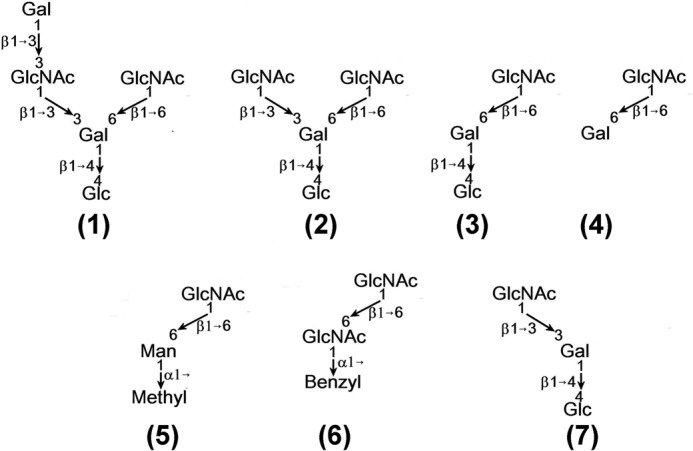
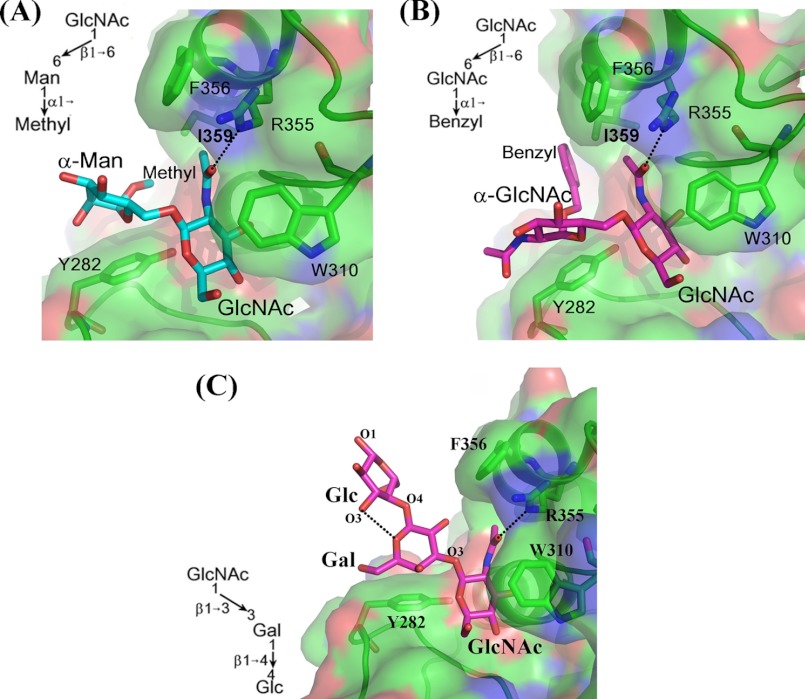
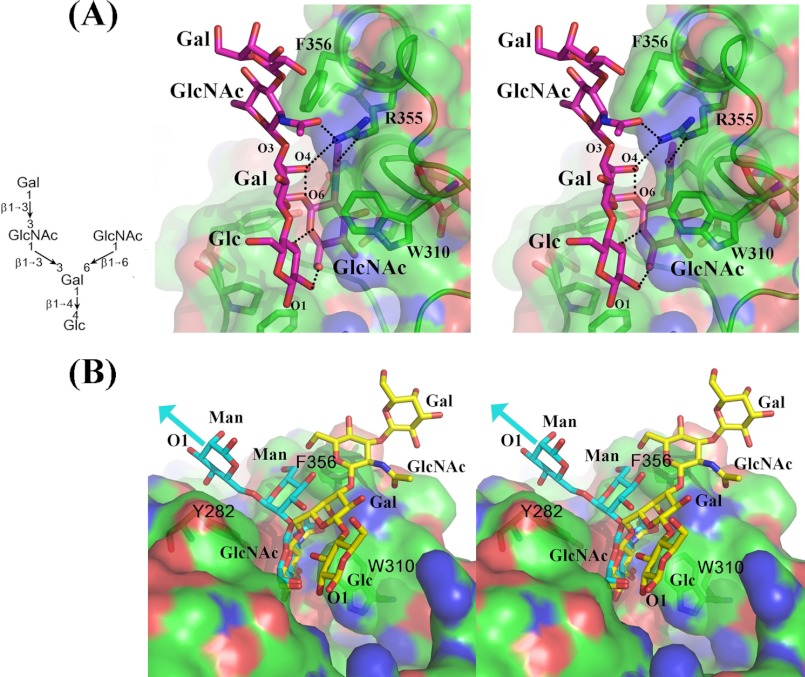
N-acetyllactosamine is the most prevalent disaccharide moiety in the glycans on the surface of mammalian cells and often found as repeat units in the linear and branched polylactosamines, known as i- and I-antigen, respectively. The β1-4-galactosyltransferase-I (β4Gal-T1) enzyme is responsible for the synthesis of the N-acetyllactosamine moiety. To understand its oligosaccharide acceptor specificity, we have previously investigated the binding of tri- and pentasaccharides of N-glycan with a GlcNAc at their nonreducing end and found that the extended sugar moiety in these acceptor substrates binds to the crevice present at the acceptor substrate binding site of the β4Gal-T1 molecule. Here we report seven crystal structures of β4Gal-T1 in complex with an oligosaccharide acceptor with a nonreducing end GlcNAc that has a β1-6-glycosidic link and that are analogous to either N-glycan or i/I-antigen. In the crystal structure of the complex of β4Gal-T1 with I-antigen analog pentasaccharide, the β1-6-branched GlcNAc moiety is bound to the sugar acceptor binding site of the β4Gal-T1 molecule in a way similar to the crystal structures described previously; however, the extended linear tetrasaccharide moiety does not interact with the previously found extended sugar binding site on the β4Gal-T1 molecule. Instead, it interacts with the different hydrophobic surface of the protein molecule formed by the residues Tyr-276, Trp-310, and Phe-356. Results from the present and previous studies suggest that β4Gal-T1 molecule has two different oligosaccharide binding regions for the binding of the extended oligosaccharide moiety of the acceptor substrate.
N-乙酰乳糖胺是哺乳动物细胞表面糖链中最常见的二糖部分,通常作为线性和分支多乳糖胺的重复单元存在,分别称为 i-和 I-抗原。β1-4-半乳糖基转移酶-I(β4Gal-T1)酶负责合成 N-乙酰乳糖胺部分。为了了解其寡糖受体特异性,我们之前研究了具有非还原端 GlcNAc 的三糖和五糖 N-聚糖与受体的结合,发现这些受体底物中延伸的糖部分与β4Gal-T1 分子的受体底物结合位点存在的裂隙结合。在这里,我们报告了β4Gal-T1 与具有非还原端 GlcNAc 的寡糖受体结合的七个晶体结构,该 GlcNAc 具有β1-6-糖苷键,类似于 N-聚糖或 i/I-抗原。在β4Gal-T1 与 I-抗原类似物五糖复合物的晶体结构中,β1-6-支化的 GlcNAc 部分以类似于先前描述的晶体结构的方式结合到β4Gal-T1 分子的糖受体结合位点;然而,延伸的线性四糖部分与β4Gal-T1 分子上先前发现的延伸糖结合位点没有相互作用。相反,它与由残基 Tyr-276、Trp-310 和 Phe-356 形成的β4Gal-T1 分子的不同疏水表面相互作用。来自本研究和先前研究的结果表明,β4Gal-T1 分子具有两个不同的寡糖结合区域,用于结合受体底物延伸的寡糖部分。