Department of Psychiatry, Addenbrooke's Hospital, Cambridge, UK.
Br J Psychiatry. 2012 Aug;201(2):124-30. doi: 10.1192/bjp.bp.111.102053. Epub 2012 Jun 28.
Lower cognitive ability in childhood is associated with increased risk of future schizophrenia, but its relationship with adult psychotic-like experiences and other psychopathology is less understood.
To investigate whether this childhood risk factor is shared with adult subclinical psychiatric phenotypes including psychotic-like experiences and general psychiatric morbidity.
A population-based sample of participants born in Great Britain during 1 week in March 1946 was contacted up to 20 times between ages 6 weeks and 53 years. Cognition was assessed at ages 8, 11 and 15 years using a composite of age-appropriate verbal and non-verbal cognitive tests. At age 53 years, psychotic-like experiences were self-reported by 2918 participants using four items from the Psychosis Screening Questionnaire and general psychiatric morbidity was assessed using the scaled version of the General Health Questionnaire (GHQ-28).
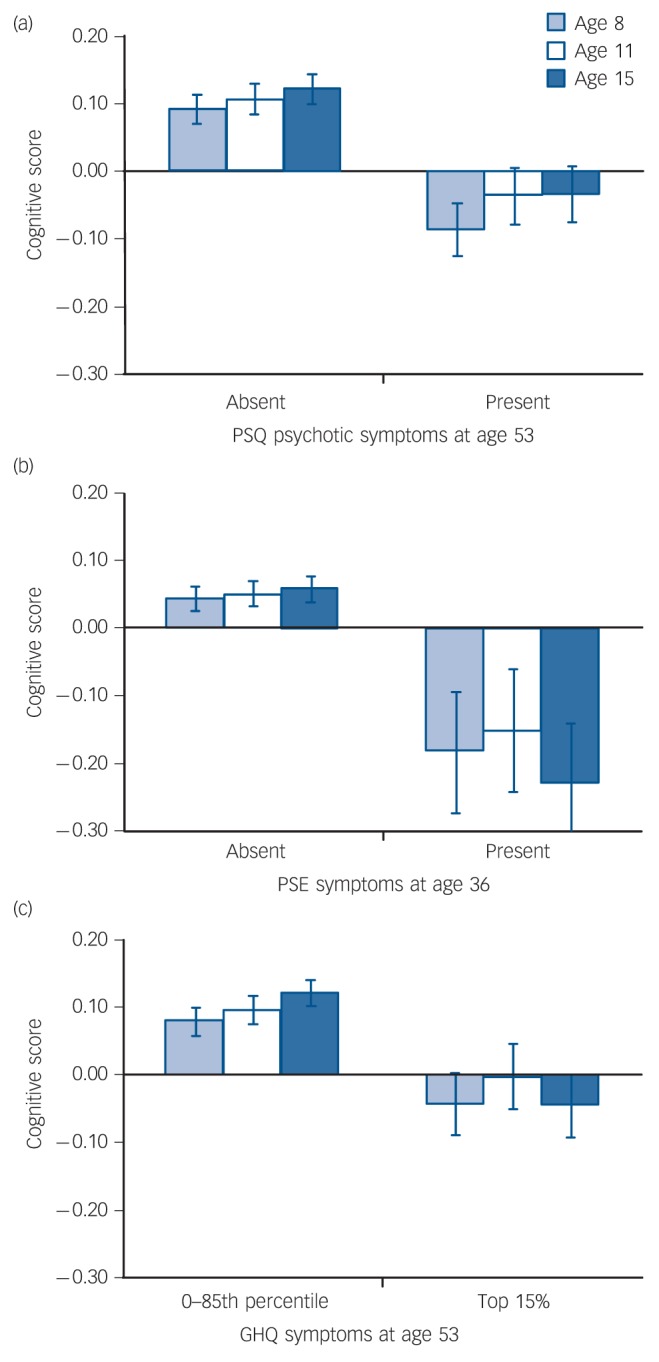
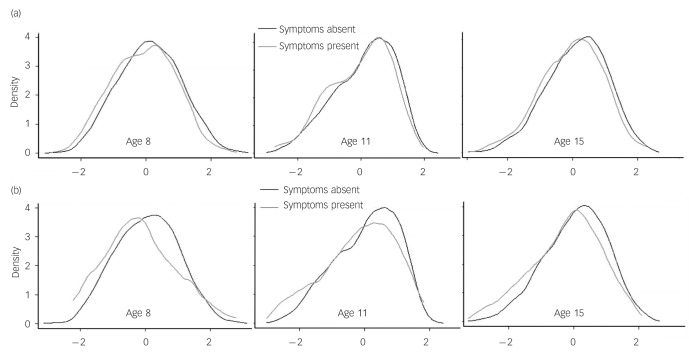
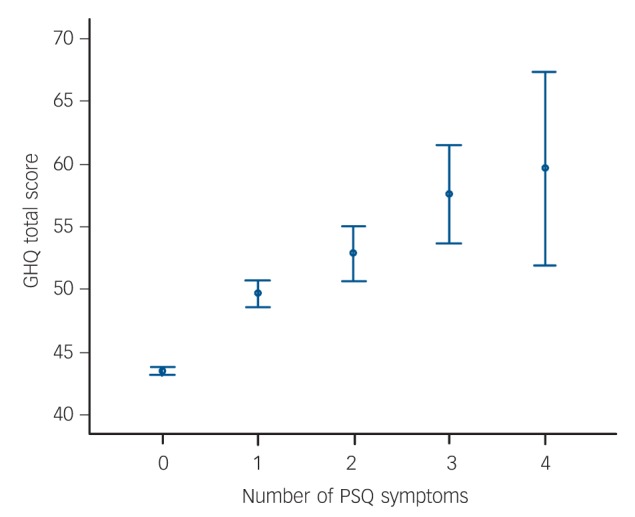
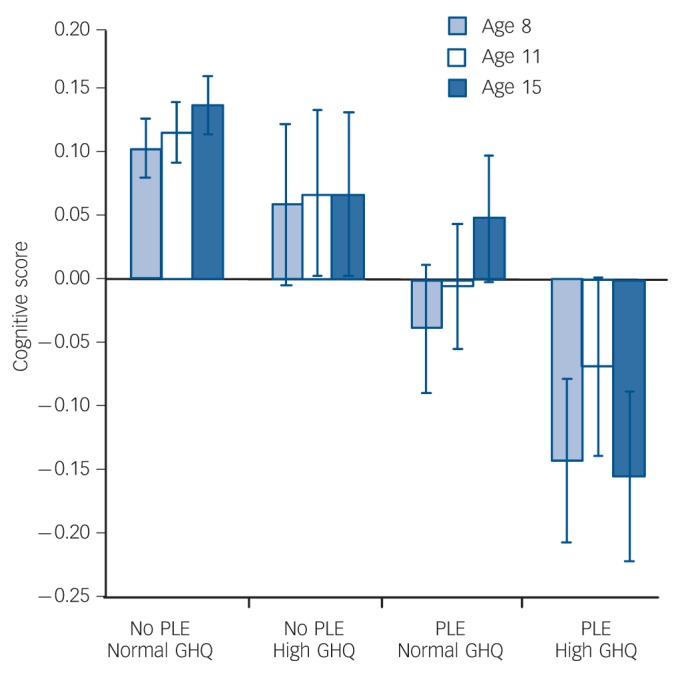
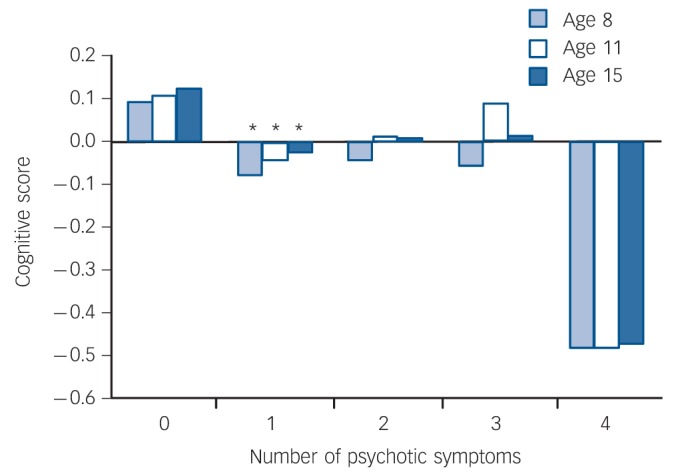
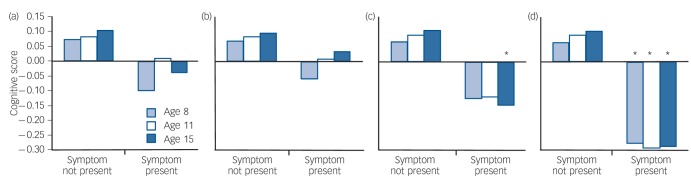
Psychotic-like experiences were reported by 22% of participants, and were highly comorbid with other psychopathology. Their presence in adults was significantly associated with poorer childhood cognitive test scores at ages 8 and 15 years, and marginally so at age 11 years. In contrast, high GHQ scores were not associated with poorer childhood cognition after adjustment for the presence of psychotic-like experiences.
Psychotic and non-psychotic psychopathologic symptoms are highly comorbid in the general population. Lower childhood cognitive ability is a risk factor for psychotic-like experiences in mid-life; these phenomena may be one end of a continuum of phenotypic expression driven by variation in early neurodevelopment.
儿童时期认知能力较低与未来精神分裂症风险增加有关,但与成人类似精神病体验和其他精神病理学的关系尚不清楚。
调查这种儿童时期的风险因素是否与包括类似精神病体验和一般精神疾病发病率在内的成人亚临床精神表型共享。
对出生于英国 1946 年 3 月一周内的参与者进行了一项基于人群的抽样调查,在 6 周到 53 岁之间,共接触了 20 次。认知能力在 8、11 和 15 岁时通过适当年龄的言语和非言语认知测试的综合测试进行评估。在 53 岁时,2918 名参与者使用精神病筛查问卷的四个项目自我报告了类似精神病的体验,使用一般健康问卷(GHQ-28)的缩放版本评估了一般精神疾病发病率。
有 22%的参与者报告了类似精神病的体验,并且与其他精神病理学高度共病。成人中存在这些体验与 8 岁和 15 岁时的儿童认知测试分数较差显著相关,与 11 岁时的分数相关但具有边缘意义。相比之下,在调整了类似精神病体验的存在后,高 GHQ 评分与儿童认知能力下降无关。
精神病和非精神病精神病理症状在一般人群中高度共病。儿童时期认知能力较低是中年人出现类似精神病体验的风险因素;这些现象可能是由早期神经发育变异驱动的表型表达连续体的一个末端。