Department of Internal Medicine/Endocrinology and Metabolism, University of Iowa Hospitals and Clinics and Iowa City VAMC, Iowa City, Iowa, United States of America.
PLoS One. 2012;7(6):e39430. doi: 10.1371/journal.pone.0039430. Epub 2012 Jun 22.
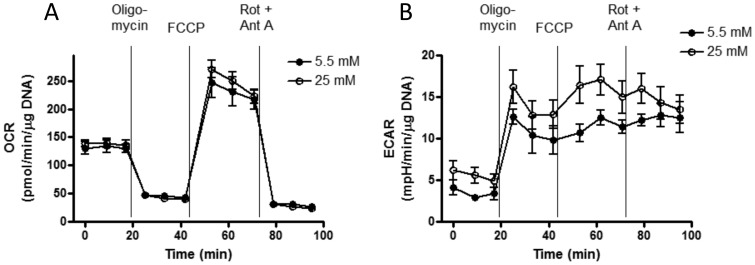
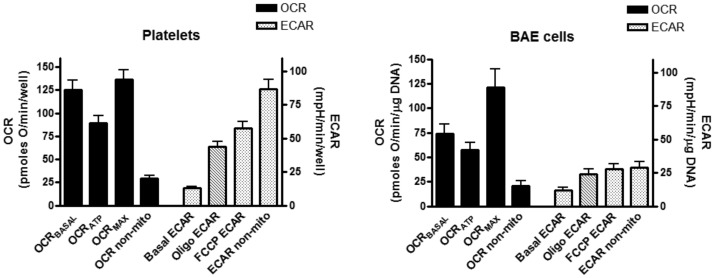
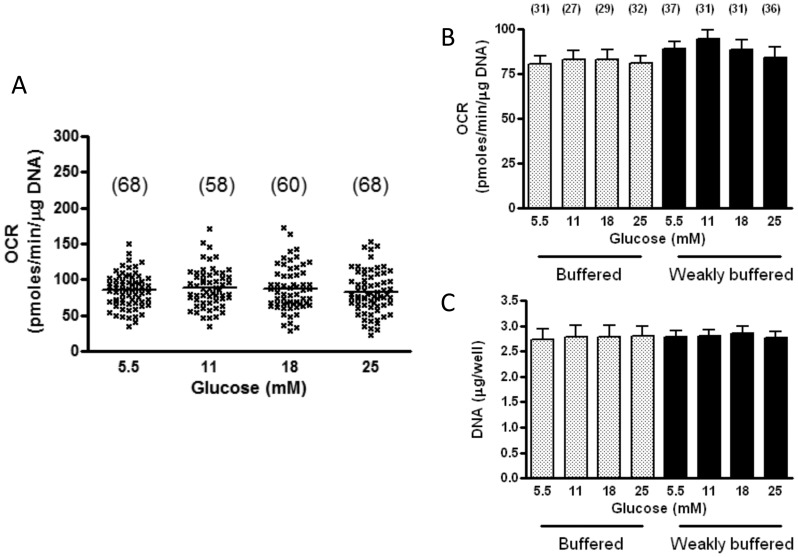
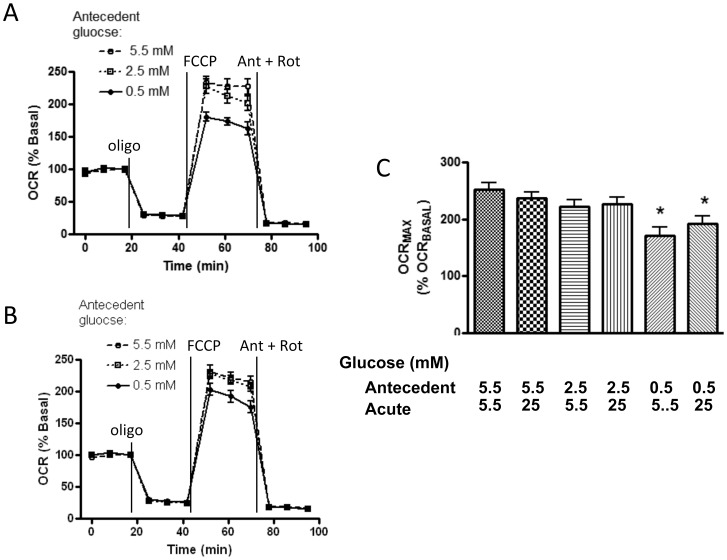
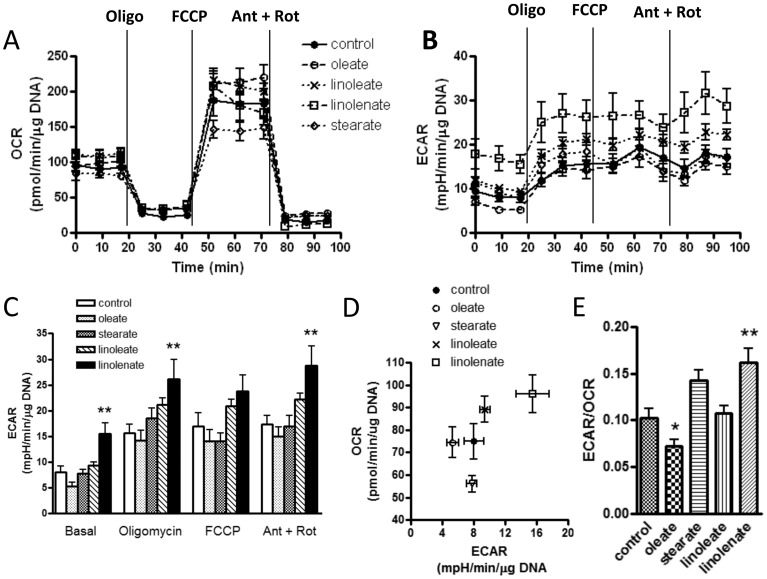
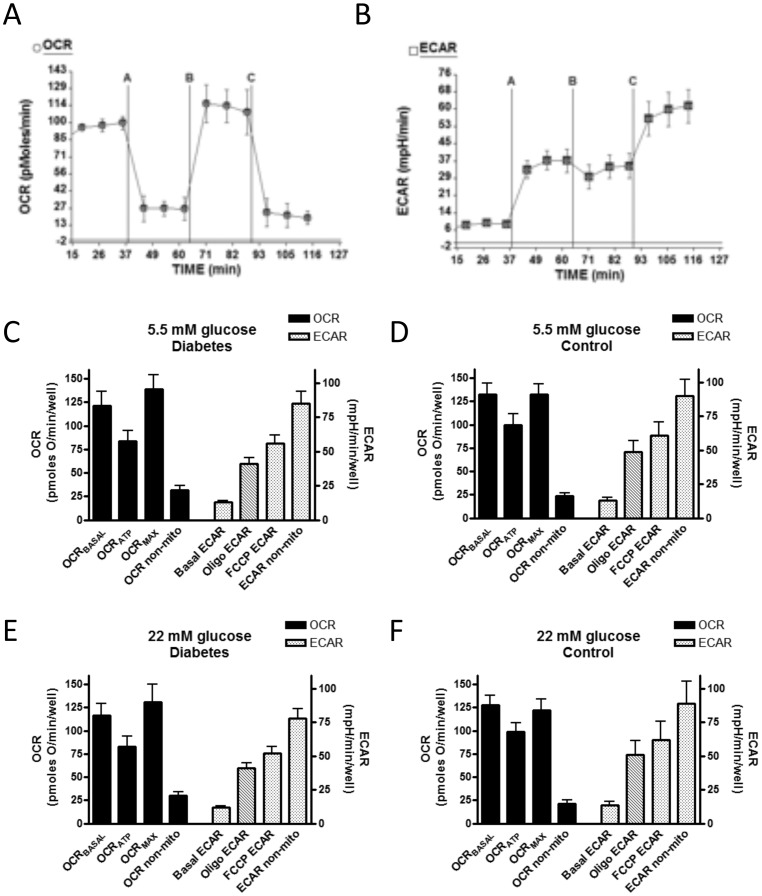
It has been suggested that cells that are independent of insulin for glucose uptake, when exposed to high glucose or other nutrient concentrations, manifest enhanced mitochondrial substrate oxidation with consequent enhanced potential and generation of reactive oxygen species (ROS); a paradigm that could predispose to vascular complications of diabetes. Here we exposed bovine aortic endothelial (BAE) cells and human platelets to variable glucose and fatty acid concentrations. We then examined oxygen consumption and acidification rates using recently available technology in the form of an extracellular oxygen and proton flux analyzer. Acute or overnight exposure of confluent BAE cells to glucose concentrations from 5.5 to 25 mM did not enhance or change the rate of oxygen consumption (OCR) under basal conditions, during ATP synthesis, or under uncoupled conditions. Glucose also did not alter OCR in sub-confluent cells, in cells exposed to low serum, or in cells treated with added pyruvate. Likewise, overnight exposure to fatty acids of varying saturation had no such effects. Overnight exposure of BAE cells to low glucose concentration decreased maximal uncoupled respiration, but not basal or ATP related oxygen consumption. Labeled glucose oxidation to CO(2) increased, but only marginally after high glucose exposure while oleate oxidation to CO(2) decreased. Overnight exposure to linolenic acid, but not oleic or linoleic acid increased extracellular acidification consistent with enhanced glycolytic metabolism. We were unable to detect an increase in production of reactive oxygen species (ROS) from BAE cells exposed to high medium glucose. Like BAE cells, exposure of human platelets to glucose did not increase oxygen consumption. As opposed to BAE cells, platelet mitochondria demonstrate less respiratory reserve capacity (beyond that needed for basal metabolism). Our data do not support the concept that exposure to high glucose or fatty acids accelerates mitochondrial oxidative metabolism in endothelial cells or platelets.
有人提出,当依赖胰岛素摄取葡萄糖的细胞暴露于高葡萄糖或其他营养物质浓度下时,会表现出增强的线粒体基质氧化,随之而来的是增强的潜在和活性氧物质(ROS)的产生;这一范式可能导致糖尿病的血管并发症。在这里,我们将牛主动脉内皮(BAE)细胞和人血小板暴露于不同的葡萄糖和脂肪酸浓度下。然后,我们使用最近可用的技术(即细胞外氧和质子通量分析仪)来检测氧消耗和酸化率。将汇合的 BAE 细胞急性或过夜暴露于 5.5 至 25mM 的葡萄糖浓度下,不会增强或改变基础条件下、ATP 合成过程中或解偶联条件下的氧消耗率(OCR)。葡萄糖也不会改变亚汇合细胞、低血清暴露细胞或添加丙酮酸处理的细胞中的 OCR。同样,不同饱和度的脂肪酸过夜暴露也没有这种作用。BAE 细胞过夜暴露于低葡萄糖浓度会降低最大解偶联呼吸,但不会降低基础或与 ATP 相关的氧消耗。标记的葡萄糖氧化为 CO2 增加,但仅在高葡萄糖暴露后略有增加,而油酸氧化为 CO2 减少。BAE 细胞过夜暴露于亚油酸,而不是油酸或亚油酸,会增加细胞外酸化,这与增强的糖酵解代谢一致。我们无法检测到高培养基葡萄糖暴露的 BAE 细胞中活性氧物质(ROS)产量的增加。与 BAE 细胞一样,血小板暴露于葡萄糖不会增加氧消耗。与 BAE 细胞相反,血小板线粒体的呼吸储备能力(超过基础代谢所需的能力)较低。我们的数据不支持这样的概念,即暴露于高葡萄糖或脂肪酸会加速内皮细胞或血小板中线粒体的氧化代谢。