Departamento de Genética, Facultade de Veterinaria, Universidade de Santiago de Compostela (USC), Campus de Lugo, 27002, Lugo, Spain.
BMC Genet. 2012 Jul 2;13:54. doi: 10.1186/1471-2156-13-54.
The turbot (Scophthalmus maximus) is a relevant species in European aquaculture. The small turbot genome provides a source for genomics strategies to use in order to understand the genetic basis of productive traits, particularly those related to sex, growth and pathogen resistance. Genetic maps represent essential genomic screening tools allowing to localize quantitative trait loci (QTL) and to identify candidate genes through comparative mapping. This information is the backbone to develop marker-assisted selection (MAS) programs in aquaculture. Expressed sequenced tag (EST) resources have largely increased in turbot, thus supplying numerous type I markers suitable for extending the previous linkage map, which was mostly based on anonymous loci. The aim of this study was to construct a higher-resolution turbot genetic map using EST-linked markers, which will turn out to be useful for comparative mapping studies.
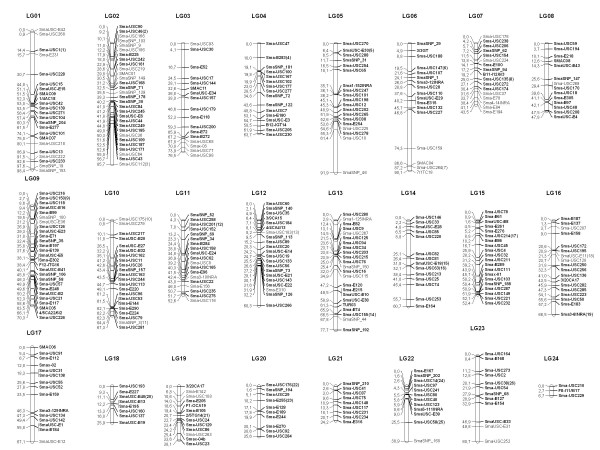
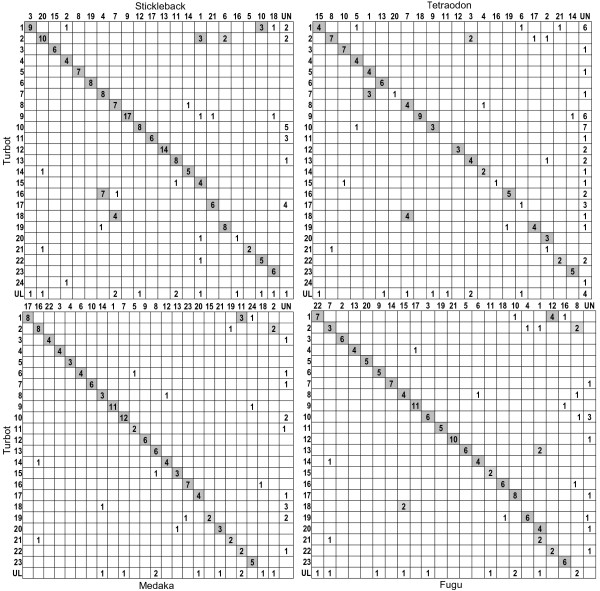
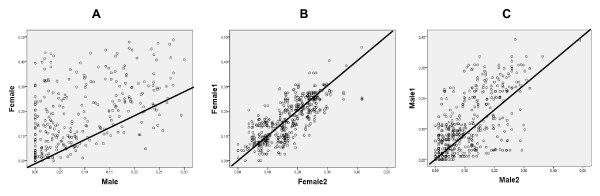
A consensus gene-enriched genetic map of the turbot was constructed using 463 SNP and microsatellite markers in nine reference families. This map contains 438 markers, 180 EST-linked, clustered at 24 linkage groups. Linkage and comparative genomics evidences suggested additional linkage group fusions toward the consolidation of turbot map according to karyotype information. The linkage map showed a total length of 1402.7 cM with low average intermarker distance (3.7 cM; ~2 Mb). A global 1.6:1 female-to-male recombination frequency (RF) ratio was observed, although largely variable among linkage groups and chromosome regions. Comparative sequence analysis revealed large macrosyntenic patterns against model teleost genomes, significant hits decreasing from stickleback (54%) to zebrafish (20%). Comparative mapping supported particular chromosome rearrangements within Acanthopterygii and aided to assign unallocated markers to specific turbot linkage groups.
The new gene-enriched high-resolution turbot map represents a useful genomic tool for QTL identification, positional cloning strategies, and future genome assembling. This map showed large synteny conservation against model teleost genomes. Comparative genomics and data mining from landmarks will provide straightforward access to candidate genes, which will be the basis for genetic breeding programs and evolutionary studies in this species.
大菱鲆(Scophthalmus maximus)是欧洲水产养殖中的重要物种。小个体大菱鲆基因组为我们提供了一个重要的资源,可用于研究生产性状的遗传基础,特别是与性别、生长和病原体抗性相关的遗传基础。遗传图谱是基因组筛选的重要工具,可以定位数量性状基因座(QTL)并通过比较作图鉴定候选基因。这些信息是开发水产养殖中标记辅助选择(MAS)计划的基础。大菱鲆的表达序列标签(EST)资源大量增加,因此提供了许多适合扩展先前主要基于匿名基因座的连锁图谱的 I 型标记。本研究的目的是利用 EST 连锁标记构建更高分辨率的大菱鲆遗传图谱,这将对比较作图研究很有用。
使用 9 个参考家系中的 463 个 SNP 和微卫星标记构建了大菱鲆共识基因富集遗传图谱。该图谱包含 438 个标记,其中 180 个是 EST 连锁标记,聚类在 24 个连锁群中。连锁和比较基因组学证据表明,根据染色体核型信息,通过连锁群融合可以进一步整合大菱鲆图谱。该图谱全长 1402.7 cM,平均标记间距离较短(3.7 cM;~2 Mb)。观察到雌性与雄性的总重组频率(RF)比值为 1.6:1,但在连锁群和染色体区域之间存在很大差异。比较序列分析显示,大菱鲆与模式硬骨鱼基因组具有较大的宏基因组同线性模式,与棘鱼(54%)相比,与斑马鱼(20%)的相似度较低。比较作图支持棘鱼目中特定的染色体重排,并有助于将未分配的标记分配到特定的大菱鲆连锁群。
新的基因富集的大菱鲆高分辨率图谱是鉴定 QTL、定位克隆策略和未来基因组组装的有用基因组工具。该图谱与模式硬骨鱼基因组具有高度的宏基因组同线性保守性。比较基因组学和来自标记的数据分析将为候选基因提供直接途径,这些候选基因将成为该物种遗传育种计划和进化研究的基础。