The Ethox Centre, Department of Public Health, University of Oxford, Old Road Campus, Headington, Oxford, OX3 7LF, United Kingdom.
BMC Med Ethics. 2012 Jul 2;13:15. doi: 10.1186/1472-6939-13-15.
Seeking consent for genetic and genomic research can be challenging, particularly in populations with low literacy levels, and in emergency situations. All of these factors were relevant to the MalariaGEN study of genetic factors influencing immune responses to malaria in northern rural Ghana. This study sought to identify issues arising in practice during the enrollment of paediatric cases with severe malaria and matched healthy controls into the MalariaGEN study.
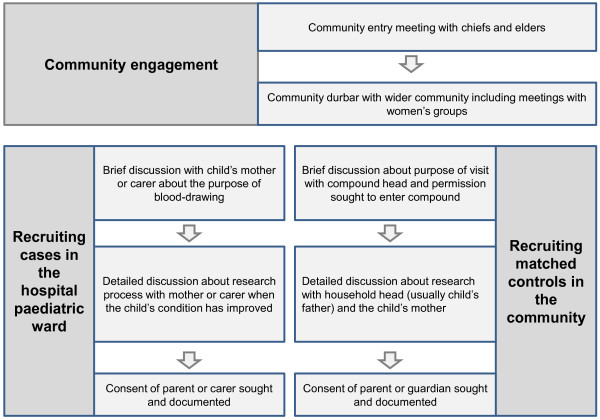
The study used a rapid assessment incorporating multiple qualitative methods including in depth interviews, focus group discussions and observations of consent processes. Differences between verbal information provided during community engagement processes, and consent processes during the enrollment of cases and controls were identified, as well as the factors influencing the tailoring of such information.
MalariaGEN participants and field staff seeking consent were generally satisfied with their understanding of the project and were familiar with aspects of the study relating to malaria. Some genetic aspects of the study were also well understood. Participants and staff seeking consent were less aware of the methodologies employed during genomic research and their implications, such as the breadth of data generated and the potential for future secondary research.Moreover, trust in and previous experience with the Navrongo Health Research Centre which was conducting the research influenced beliefs about the benefits of participating in the MalariaGEN study and subsequent decision-making about research participation.
It is important to recognise that some aspects of complex genomic research may be of less interest to and less well understood by research participants and that such gaps in understanding may not be entirely addressed by best practice in the design and conduct of consent processes. In such circumstances consideration needs to be given to additional protections for participants that may need to be implemented in such research, and how best to provide such protections.Capacity building for research ethics committees with limited familiarity with genetic and genomic research, and appropriate engagement with communities to elicit opinions of the ethical issues arising and acceptability of downstream uses of genome wide association data are likely to be important.
在低识字水平的人群中,以及在紧急情况下,寻求遗传和基因组研究的同意可能具有挑战性。所有这些因素都与加纳北部农村地区影响疟疾免疫反应的遗传因素的 MalariaGEN 研究有关。本研究旨在确定在招募患有严重疟疾的儿科病例和匹配的健康对照者入组 MalariaGEN 研究期间实践中出现的问题。
该研究采用了快速评估,结合了多种定性方法,包括深入访谈、焦点小组讨论和对同意过程的观察。确定了在社区参与过程中提供的口头信息与病例和对照者入组期间的同意过程之间的差异,以及影响此类信息定制的因素。
MalariaGEN 参与者和现场工作人员对他们对项目的理解以及对与疟疾有关的研究方面的理解普遍感到满意。研究的一些遗传方面也得到了很好的理解。参与者和寻求同意的工作人员对基因组研究中使用的方法及其影响了解较少,例如生成数据的广度和未来二次研究的潜力。此外,对进行研究的纳夫龙戈健康研究中心的信任和以往经验影响了他们对参与 MalariaGEN 研究的益处的信念,以及随后对研究参与的决策。
重要的是要认识到,复杂的基因组研究的某些方面可能对研究参与者的兴趣较小,理解程度较低,并且这种理解上的差距可能无法通过同意过程的设计和实施中的最佳实践完全解决。在这种情况下,需要考虑为参与者提供额外的保护措施,这些措施可能需要在这种研究中实施,以及如何最好地提供这些保护措施。对遗传和基因组研究不太熟悉的研究伦理委员会进行能力建设,以及适当参与社区,以征求对出现的伦理问题的意见和接受全基因组关联数据的下游用途,可能是重要的。