Section on Integrative Physiology and Metabolism, Joslin Diabetes Center and Harvard Medical School, Boston, Massachusetts, USA.
Diabetes. 2012 Sep;61(9):2289-98. doi: 10.2337/db11-1395. Epub 2012 Jun 29.
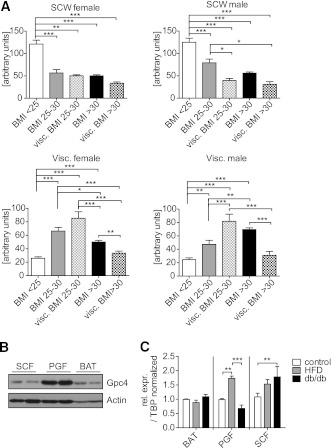
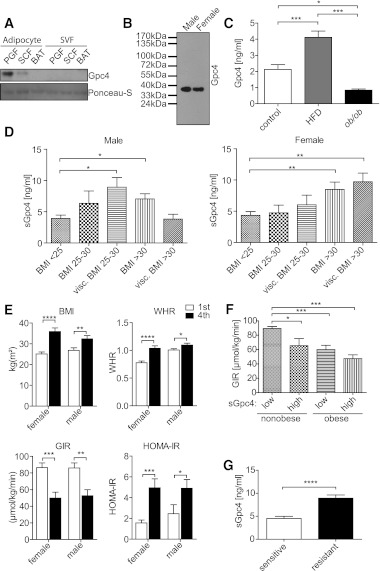
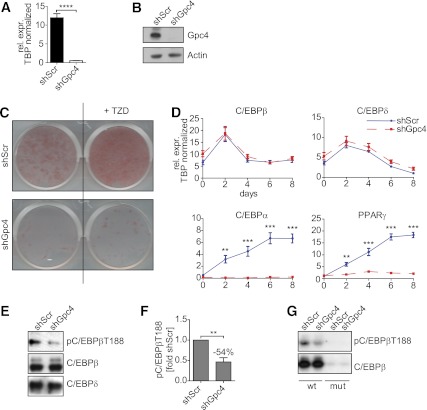
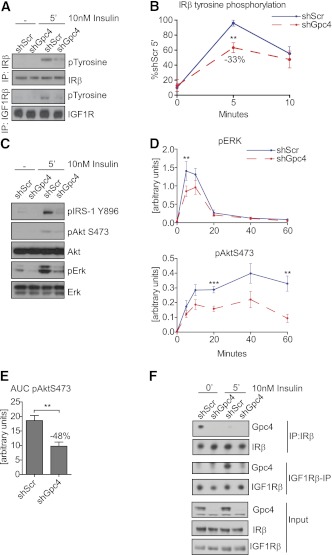
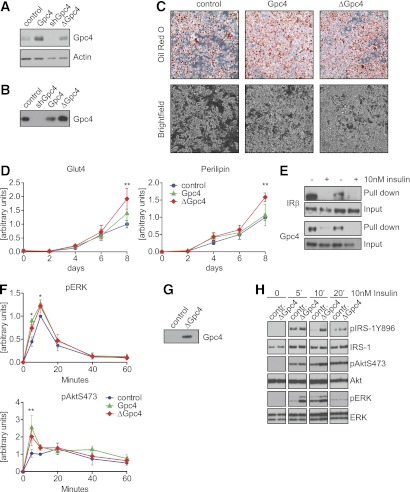
Obesity, especially visceral obesity, is associated with insulin resistance and metabolic syndrome. We previously identified the cell surface proteoglycan glypican-4 as differentially expressed in subcutaneous versus visceral white fat depots. Here we show that glypican-4 is released from cells and adipose tissue explants of mice, and that circulating glypican-4 levels correlate with BMI and insulin sensitivity in humans. Furthermore, glypican-4 interacts with the insulin receptor, enhances insulin receptor signaling, and enhances adipocyte differentiation. Conversely, depletion of glypican-4 results in reduced activation of the insulin receptor and prevents adipocyte differentiation in vitro by inhibiting insulin-mediated C/EBPβ phosphorylation. These functions of glypican-4 are independent of its glycosylphosphatidylinositol membrane anchorage, as a nonmembrane-bound mutant of glypican-4 phenocopies the effects of native glypican-4 overexpression. In summary, glypican-4 is a novel circulating insulin sensitizing adipose-derived factor that, unlike other insulin sensitizers, acts directly on the insulin receptor to enhance signaling.
肥胖,尤其是内脏肥胖,与胰岛素抵抗和代谢综合征有关。我们之前发现细胞表面蛋白聚糖聚糖-4在皮下和内脏白色脂肪组织中的表达存在差异。在这里,我们表明聚糖-4可以从小鼠的细胞和脂肪组织外植体中释放出来,并且循环中的聚糖-4水平与人的 BMI 和胰岛素敏感性相关。此外,聚糖-4与胰岛素受体相互作用,增强胰岛素受体信号,并增强脂肪细胞分化。相反,聚糖-4的耗竭会导致胰岛素受体的激活减少,并通过抑制胰岛素介导的 C/EBPβ磷酸化来防止体外脂肪细胞分化。聚糖-4 的这些功能与其糖基磷脂酰肌醇膜锚定无关,因为非膜结合的聚糖-4 突变体能模拟天然聚糖-4 过表达的作用。总之,聚糖-4 是一种新型的循环胰岛素增敏脂肪来源因子,与其他胰岛素增敏剂不同,它直接作用于胰岛素受体以增强信号。