Health Economics Research Group (HERG), Brunel University, Uxbridge, Middlesex UB8 3PH, UK.
J Public Health (Oxf). 2013 Mar;35(1):32-9. doi: 10.1093/pubmed/fds050. Epub 2012 Jul 2.
This paper explores the application of alternative approaches to economic evaluation of public health interventions, using a worked example of exercise referral schemes (ERSs).
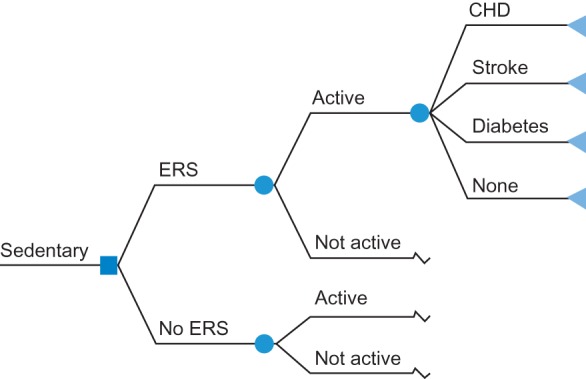
Cost-utility (CUA) and cost-consequence analyses (CCA) were used to assess the cost-effectiveness of ERSs. For the CUA, evidence was synthesized using a decision analytic model that adopts a lifetime horizon and NHS/Personal Social Services perspective. Outcomes were expressed as incremental cost per quality-adjusted life-year (QALY). CCA was conducted from a partial-societal perspective, including health and non-healthcare costs and benefits. Outcomes were reported in natural units, such as cases of strokes or CHD avoided.
Compared with usual care, the incremental cost per QALY of ERS is £20 876. Based on a cohort of 100 000 individuals, CCA estimates cost of ERS at £22 million to the healthcare provider and £12 million to participants. The benefits of ERS include additional 3900 people becoming physically active, 51 cases of CHD avoided, 16 cases of stroke avoided, 86 cases of diabetes avoided and a gain of ∼800 QALYs.
CCA might provide greater transparency than CUA in reporting the outcomes of public health interventions and have greater resonance with stakeholders involved in commissioning these interventions.
本文通过一个运动推荐计划(ERS)的实例,探讨了将替代方法应用于公共卫生干预措施的经济评估。
采用成本-效用分析(CUA)和成本-后果分析(CCA)来评估 ERS 的成本效益。对于 CUA,使用决策分析模型综合证据,该模型采用终生时间范围和 NHS/个人社会服务视角。结果表示为每增加一个质量调整生命年(QALY)的增量成本。CCA 从部分社会视角进行,包括健康和非医疗保健成本和收益。结果以自然单位报告,如避免的中风或 CHD 病例数。
与常规护理相比,ERS 的每 QALY 增量成本为 20876 英镑。基于 10 万人的队列,CCA 估计医疗保健提供者的 ERS 成本为 2200 万英镑,参与者的成本为 1200 万英镑。ERS 的效益包括增加 3900 人进行身体活动、51 例 CHD 避免、16 例中风避免、86 例糖尿病避免和 800 个 QALYs 的收益。
CCA 可能比 CUA 在报告公共卫生干预措施的结果方面提供更大的透明度,并与参与这些干预措施委托的利益相关者产生更大的共鸣。