Cai Qiaoyan, Lin Jiumao, Wei Lihui, Zhang Ling, Wang Lili, Zhan Youzhi, Zeng Jianwei, Xu Wei, Shen Aling, Hong Zhenfeng, Peng Jun
Academy of Integrative Medicine Biomedical Research Center, Fujian University of Traditional Chinese Medicine, 1 Huatuo Road, Minhou Shangjie, Fuzhou 350108, China.
Fujian Key Laboratory of Integrative Medicine on Geriatrics, Fujian University of Traditional Chinese Medicine, 1 Huatuo Road, Minhou Shangjie, Fuzhou 350108, China.
Int J Mol Sci. 2012;13(5):6117-6128. doi: 10.3390/ijms13056117. Epub 2012 May 18.
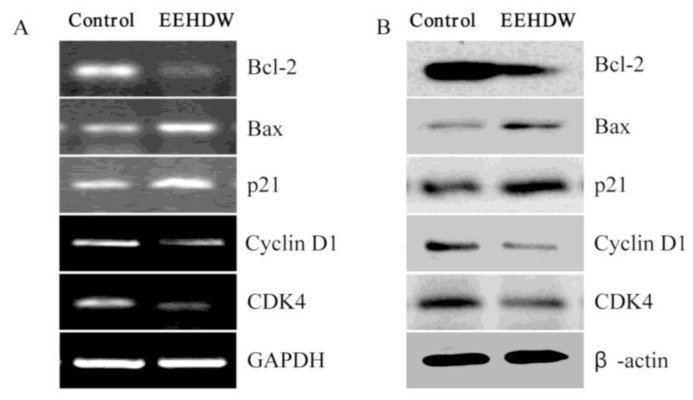
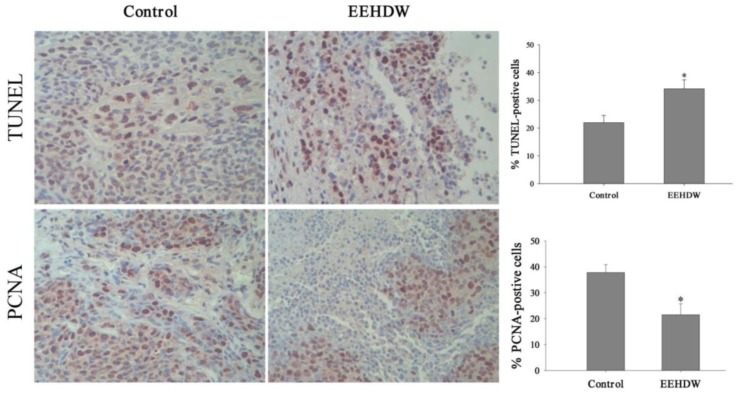
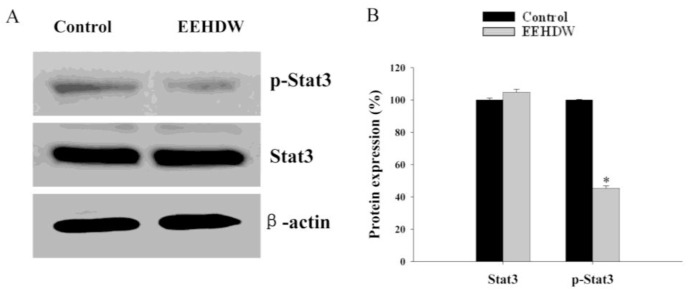
Signal Transducer and Activator of Transcription 3 (STAT3), a common oncogenic mediator, is constitutively activated in many types of human cancers; therefore it is a major focus in the development of novel anti-cancer agents. Hedyotis diffusa Willd has been used as a major component in several Chinese medicine formulas for the clinical treatment of colorectal cancer (CRC). However, the precise mechanism of its anti-tumor activity remains largely unclear. Using a CRC mouse xenograft model, in the present study we evaluated the effect of the ethanol extract of Hedyotis diffusa Willd (EEHDW) on tumor growth in vivo and investigated the underlying molecular mechanisms. We found that EEHDW reduced tumor volume and tumor weight, but had no effect on body weight gain in CRC mice, demonstrating that EEHDW can inhibit CRC growth in vivo without apparent adverse effect. In addition, EEHDW treatment suppressed STAT3 phosphorylation in tumor tissues, which in turn resulted in the promotion of cancer cell apoptosis and inhibition of proliferation. Moreover, EEHDW treatment altered the expression pattern of several important target genes of the STAT3 signaling pathway, i.e., decreased expression of Cyclin D1, CDK4 and Bcl-2 as well as up-regulated p21 and Bax. These results suggest that suppression of the STAT3 pathway might be one of the mechanisms by which EEHDW treats colorectal cancer.
信号转导子与转录激活子3(STAT3)是一种常见的致癌介质,在多种人类癌症中持续激活;因此,它是新型抗癌药物研发的主要焦点。白花蛇舌草已被用作多种中药配方的主要成分,用于临床治疗结直肠癌(CRC)。然而,其抗肿瘤活性的确切机制仍不清楚。在本研究中,我们使用CRC小鼠异种移植模型评估了白花蛇舌草乙醇提取物(EEHDW)对体内肿瘤生长的影响,并研究了潜在的分子机制。我们发现EEHDW减小了CRC小鼠的肿瘤体积和肿瘤重量,但对体重增加没有影响,表明EEHDW可以在体内抑制CRC生长而无明显不良反应。此外,EEHDW处理抑制了肿瘤组织中STAT3的磷酸化,进而促进癌细胞凋亡并抑制增殖。而且,EEHDW处理改变了STAT3信号通路几个重要靶基因的表达模式,即细胞周期蛋白D1、细胞周期蛋白依赖性激酶4(CDK4)和Bcl-2的表达降低,以及p21和Bax的表达上调。这些结果表明,抑制STAT3途径可能是EEHDW治疗结直肠癌的机制之一。