Ghatak Tanmoy, Singh Dinesh, Kapoor Rajni, Bogra Jaishree
Department of Critical Care Medicine, SGPGIMS, Lucknow, Uttar Pradesh, India.
Saudi J Anaesth. 2012 Apr;6(2):140-4. doi: 10.4103/1658-354X.97027.
The aim of this double-blind, prospective, randomized, controlled study was to compare the effect of addition of ketamine; fentanyl and saline with propofol anesthesia on hemodynamic profile and laryngeal mask airway (LMA) insertion conditions in oral clonidine premedicated children.
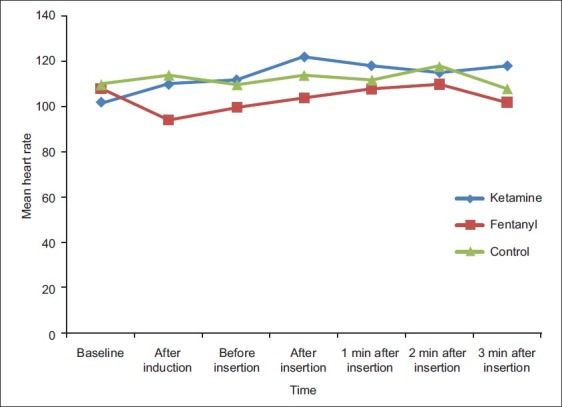
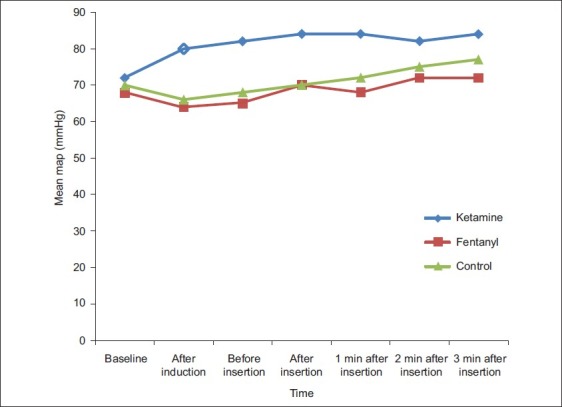
180 children (age 2 - 10 years) were at first given oral clonidine (4 μg/kg) 90 minutes before operation, and then were randomly allocated to receive either ketamine 0.5 mg/kg (n=60), fentanyl 1 μg/kg (n=60) or 0.9% normal saline (n=60) before induction with propofol 3.0 mg/kg. Insertion of LMA was performed within 1 minute of injection of propofol. Heart rate and mean blood pressure were noted 1 min before induction (baseline), immediately after induction, before and after insertion of LMA for up to 3 min. Following LMA insertion, 6 subjective end points were noted-mouth opening, coughing, swallowing, patient's movement, laryngospasm, and ease of an insertion. LMA insertion summed score was prepared depending upon these variables.
LMA insertion summed score was nearly similar in ketamine and fentanyl group, which were significantly better than saline group (P<0.004). Mean blood pressure and heart rate were maintained in ketamine than with fentanyl or saline group. Incidence of prolonged apnea (>120 secs.) was higher in fentanyl group compared to ketamine and saline group.
Even in oral clonidine premedicated children, addition of ketamine with propofol provides hemodynamic stability and comparable conditions for LMA insertion like fentanyl propofol with significantly less prolonged apnea.
这项双盲、前瞻性、随机对照研究的目的是比较在口服可乐定进行术前用药的儿童中,氯胺酮、芬太尼和生理盐水与丙泊酚麻醉联合使用对血流动力学特征和喉罩气道(LMA)插入条件的影响。
180名2至10岁的儿童在手术前90分钟首先口服可乐定(4μg/kg),然后随机分为三组,分别在丙泊酚3.0mg/kg诱导前接受氯胺酮0.5mg/kg(n = 60)、芬太尼1μg/kg(n = 60)或0.9%生理盐水(n = 60)。在注射丙泊酚后1分钟内进行LMA插入。在诱导前1分钟(基线)、诱导后立即、插入LMA前后长达3分钟记录心率和平均血压。LMA插入后,记录6个主观终点——张口、咳嗽、吞咽、患者移动、喉痉挛和插入难易程度。根据这些变量编制LMA插入总分。
氯胺酮组和芬太尼组的LMA插入总分几乎相似,均显著优于生理盐水组(P < 0.004)。与芬太尼组或生理盐水组相比,氯胺酮组能更好地维持平均血压和心率。与氯胺酮组和生理盐水组相比,芬太尼组发生长时间呼吸暂停(> 120秒)的发生率更高。
即使在口服可乐定进行术前用药的儿童中,氯胺酮与丙泊酚联合使用也能提供血流动力学稳定性,且LMA插入条件与芬太尼 - 丙泊酚相当,长时间呼吸暂停明显减少。