Molecular Toxicology Research Laboratory, NIH-RCMI Center for Environmental Health, College of Science Engineering and Technology, Jackson State University, Jackson, MS 39217, USA.
Int J Environ Res Public Health. 2012 May;9(5):1649-62. doi: 10.3390/ijerph9051649. Epub 2012 May 4.
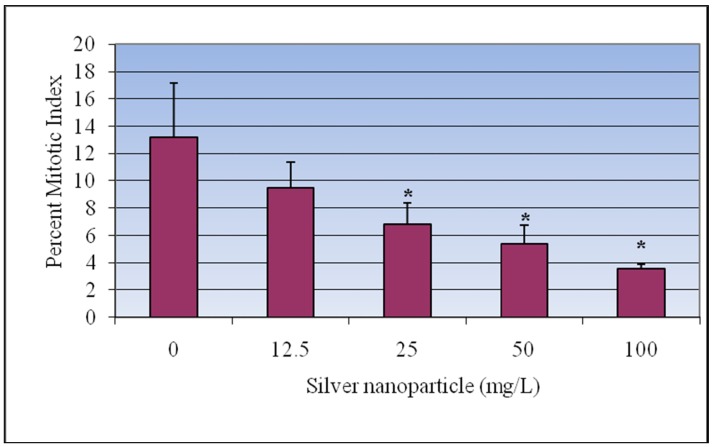
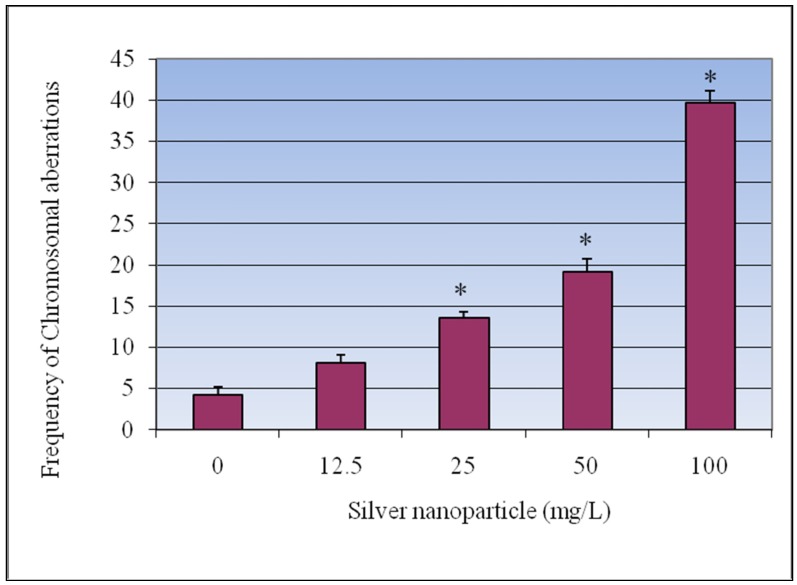
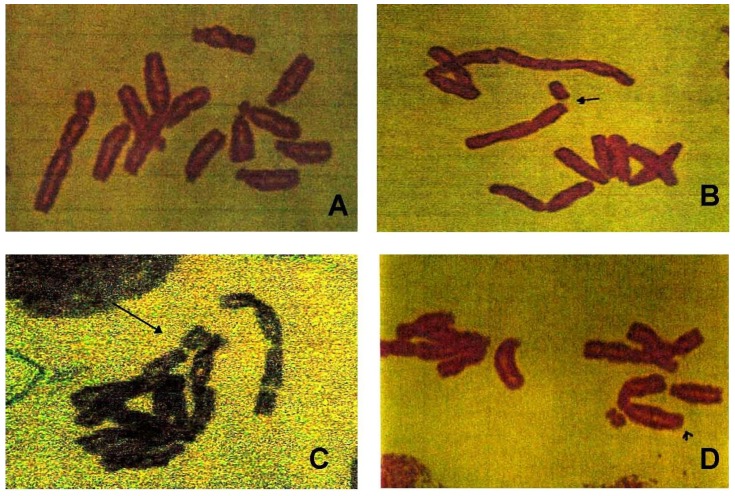
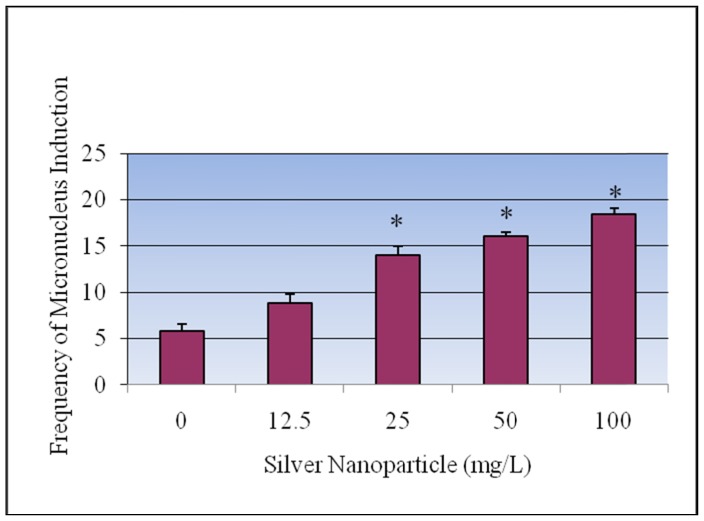
The use of silver nanoparticles (AgNPs) in commercial products has increased significantly in recent years. Although there have been some attempts to determine the toxic effects of AgNPs in mammalian and human cell-lines, there is little information on plants which play a vital role in ecosystems. The study reports the use of Vicia faba root-tip meristem to investigate the genotoxicity of AgNPs under modified GENE-TOX test conditions. The root tip cells of V. faba were treated with four different concentrations of engineered AgNPs dispersion to study toxicological endpoints such as mitotic index (MI), chromosomal aberrations (CA) and micronucleus induction (MN). For each concentration, five sets of microscopy observations were carried out. The results demonstrated that AgNPs exposure significantly increased (p < 0.05) the number of chromosomal aberrations, micronuclei, and decreased the MI in exposed groups compared to control. From this study we infer that AgNPs might have penetrated the plant system and may have impaired mitosis causing CA and MN. The results of this study demonstrate that AgNPs are genotoxic to plant cells. Since plant assays have been integrated as a genotoxicity component in risk assessment for detection of environmental mutagens, they should be given full consideration when evaluating the overall toxicological impact of the nanoparticles in the environment.
近年来,商业产品中纳米银(AgNPs)的使用显著增加。虽然已经有一些尝试来确定 AgNPs 在哺乳动物和人类细胞系中的毒性作用,但关于在生态系统中起着至关重要作用的植物的信息却很少。本研究报告使用蚕豆根尖细胞微核试验(Vicia faba root-tip meristem),在改良的 GENE-TOX 测试条件下研究 AgNPs 的遗传毒性。用 4 种不同浓度的工程 AgNPs 分散体处理蚕豆根尖细胞,以研究毒性终点,如有丝分裂指数(MI)、染色体畸变(CA)和微核诱导(MN)。对于每种浓度,进行了五组显微镜观察。结果表明,与对照组相比,AgNPs 暴露显著增加了(p < 0.05)染色体畸变、微核的数量,降低了有丝分裂指数。从这项研究中我们推断,AgNPs 可能已经穿透了植物系统,并可能通过有丝分裂障碍导致 CA 和 MN。本研究结果表明,AgNPs 对植物细胞具有遗传毒性。由于植物检测已作为环境诱变剂检测风险评估中的遗传毒性组成部分,因此在评估纳米颗粒在环境中的整体毒理学影响时应充分考虑它们。