Franco Irina Saraiva, Shuman Howard A
Bioarchitecture. 2012 Feb 1;2(2):38-42. doi: 10.4161/bioa.20422.
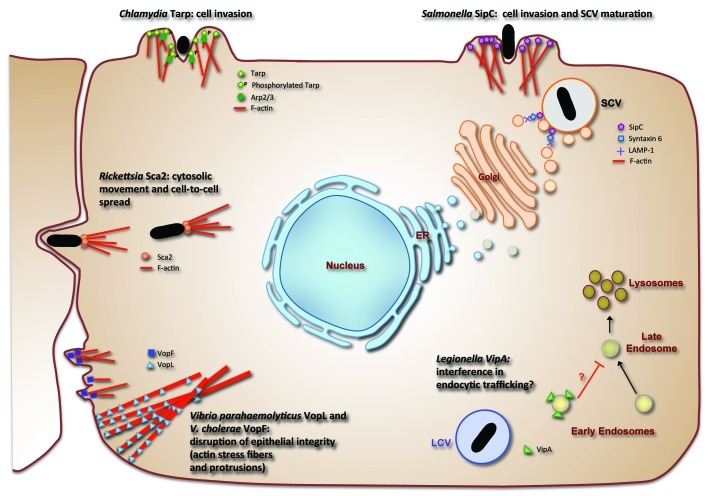
Manipulation of the actin cytoskeleton is a commonly used process by which bacterial pathogens and viruses are able to neutralize host defense mechanisms and subvert them in order to replicate in a hostile environment. Diverse bacteria display a wide array of mechanisms of regulation of microfilaments to enter, move within or exit the host cell. A less studied subject is how pathogens may co-opt the actin cytoskeleton to disturb vesicle trafficking pathways, namely phagolysosomal fusion, and avoid degradation. In fact, although actin plays a role in endosomal trafficking and phagosome maturation, the knowledge on the exact mechanisms and additional players is still scarce. Recently, we found that the Legionella pneumophila virulence factor VipA is an actin nucleator, associates with actin filaments and early endosomes during infection, and interferes in yeast organelle trafficking pathways, suggesting it may be linking actin dynamics to endosome biogenesis. Further studies on this protein, together with work on other bacterial effectors, may help shed light in the role of actin in endosomal maturation.
对肌动蛋白细胞骨架的操控是细菌病原体和病毒常用的一种手段,借此它们能够中和宿主防御机制并将其颠覆,从而在恶劣环境中进行复制。多种细菌展现出一系列调控微丝的机制,以便进入、在宿主细胞内移动或离开宿主细胞。一个较少被研究的课题是病原体如何利用肌动蛋白细胞骨架干扰囊泡运输途径,即吞噬溶酶体融合,进而避免被降解。事实上,尽管肌动蛋白在内体运输和吞噬体成熟过程中发挥作用,但关于确切机制和其他相关因素的了解仍然匮乏。最近,我们发现嗜肺军团菌毒力因子VipA是一种肌动蛋白成核剂,在感染期间与肌动蛋白丝和早期内体相关联,并干扰酵母细胞器运输途径,这表明它可能将肌动蛋白动态变化与内体生物发生联系起来。对该蛋白的进一步研究,以及对其他细菌效应蛋白的研究,可能有助于阐明肌动蛋白在内体成熟中的作用。