Department of Psychology , Indiana University Purdue University at Indianapolis (IUPUI), Indianapolis,IN 46202, USA.
Alcohol Clin Exp Res. 2013 Feb;37(2):194-201. doi: 10.1111/j.1530-0277.2012.01873.x. Epub 2012 Jul 3.
Crossed high alcohol preferring (cHAP) mice were selectively bred from a cross of the HAP1 × HAP2 replicate lines, and we demonstrate blood ethanol concentrations (BECs) during free-choice drinking that are reminiscent of those observed in alcohol-dependent humans. Therefore, this line may provide an unprecedented opportunity to learn about the consequences of excessive voluntary ethanol (EtOH) consumption, including metabolic tolerance and liver pathology. Cytochrome p450 2E1 (CYP2E1) induction plays a prominent role in driving both metabolic tolerance and EtOH-induced liver injury. In this report, we sought to characterize cHAP drinking by assessing whether pharmacologically relevant BEC levels are sustained throughout the active portion of the light-dark cycle. Given that cHAP intakes and BECs are similar to those observed in mice given an EtOH liquid diet, we assessed whether free-choice exposure results in metabolic tolerance, hepatic enzyme induction, and hepatic steatosis.
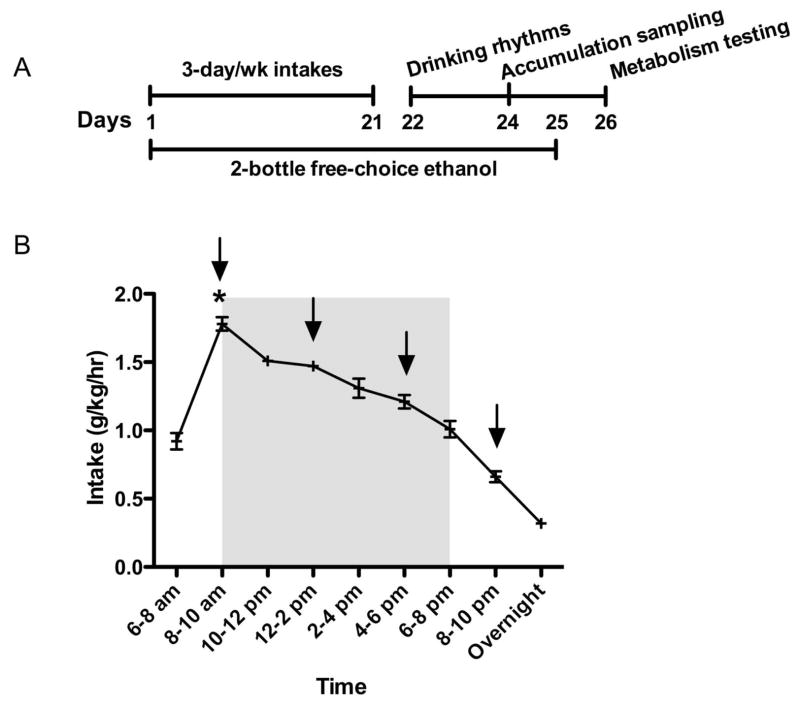
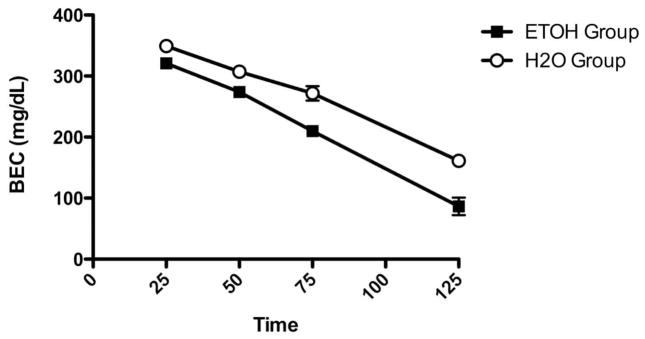
In experiment 1, blood samples were taken across the dark portion of a 12:12 light-dark cycle to examine the pattern of EtOH accumulation in these mice. In experiments 1 and 2, mice were injected with EtOH following 3 to 4 weeks of access to water or 10% EtOH and water, and blood samples were taken to assess metabolic tolerance. In experiment 3, 24 mice had 4 weeks of access to 10% EtOH and water or water alone, followed by necropsy and hepatological assessment.
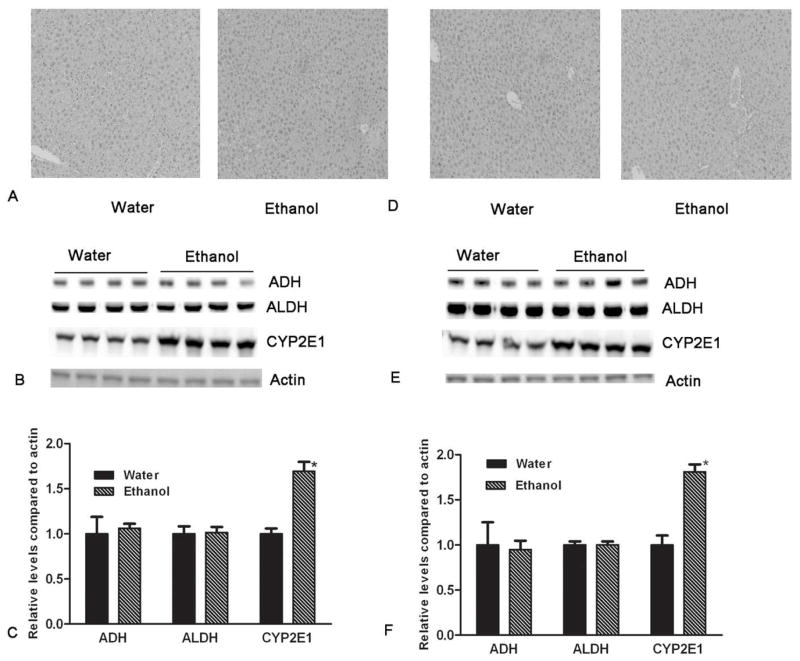
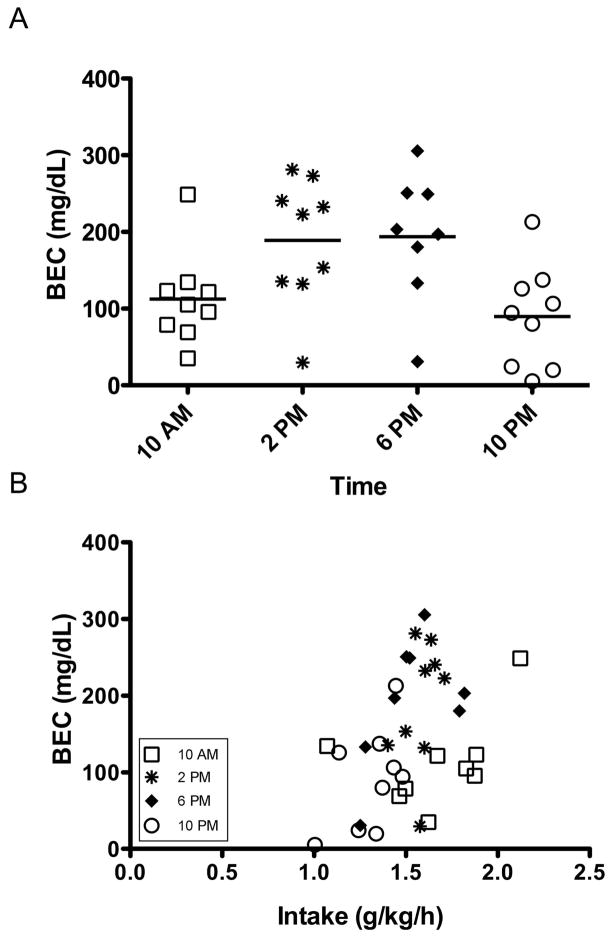
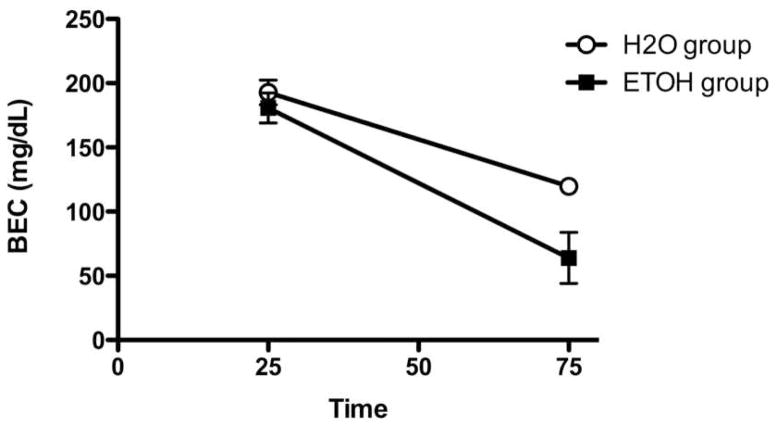
In experiment 1, cHAP mice mean BEC values exceeded 80 mg/dl at all sampling points and approached 200 mg/dl during the middle of the dark cycle. In experiments 1 and 2, EtOH-exposed mice metabolized EtOH faster than EtOH-naïve mice, demonstrating metabolic tolerance (p < 0.05). In experiment 3, EtOH-drinking mice showed greater expression of hepatic CYP2E1 than water controls, consistent with the development of metabolic tolerance (p < 0.05). EtOH access altered neither hepatic histology nor levels of alcohol dehydrogenase and aldehyde dehydrogenase.
These results demonstrate that excessive intake by cHAP mice results in sustained BECs throughout the active period, leading to the development of metabolic tolerance and evidence of CYP2E1 induction. Together, these results provide additional support for the cHAP mice as a highly translational rodent model of alcoholism.
交叉高酒精偏爱(cHAP)小鼠是从 HAP1×HAP2 重复系的杂交中选择性繁殖而来的,我们在自由选择饮酒期间展示了血液乙醇浓度(BEC),这些浓度让人联想到在酒精依赖的人类中观察到的浓度。因此,该品系可能为了解过度自愿性乙醇(EtOH)消费的后果,包括代谢耐受性和肝病理学,提供了前所未有的机会。细胞色素 p450 2E1(CYP2E1)诱导在驱动代谢耐受性和 EtOH 诱导的肝损伤方面起着突出作用。在本报告中,我们试图通过评估在明暗周期的活跃部分是否维持药理相关的 BEC 水平来描述 cHAP 饮酒情况。鉴于 cHAP 的摄入量和 BEC 与给予乙醇液体饮食的小鼠相似,我们评估了自由选择暴露是否会导致代谢耐受性、肝酶诱导和肝脂肪变性。
在实验 1 中,在 12:12 明暗周期的暗部取血样,以检查这些小鼠中 EtOH 积累的模式。在实验 1 和 2 中,在给予水或 10% EtOH 和水 3 至 4 周后,用 EtOH 注射这些小鼠,取血样评估代谢耐受性。在实验 3 中,24 只小鼠在 4 周内摄入 10% EtOH 和水或单独摄入水,然后进行尸检和肝脏评估。
在实验 1 中,cHAP 小鼠的平均 BEC 值在所有采样点均超过 80mg/dl,在暗周期的中间接近 200mg/dl。在实验 1 和 2 中,暴露于 EtOH 的小鼠比 EtOH 未处理的小鼠更快地代谢 EtOH,表明存在代谢耐受性(p<0.05)。在实验 3 中,与水对照相比,EtOH 饮酒小鼠的肝 CYP2E1 表达增加,表明发生了代谢耐受性(p<0.05)。EtOH 摄入既没有改变肝组织学,也没有改变醇脱氢酶和醛脱氢酶的水平。
这些结果表明,cHAP 小鼠的过度摄入导致 BEC 在活跃期持续升高,导致代谢耐受性的发展和 CYP2E1 诱导的证据。总之,这些结果为 cHAP 小鼠作为一种高度转化的酒精中毒啮齿动物模型提供了更多支持。