Department of Geriatrics, Hospital Universitario de la Ribera, Valencia, Spain.
Clinics (Sao Paulo). 2012;67(6):547-56. doi: 10.6061/clinics/2012(06)02.
Hip fractures are associated with high levels of co-morbidity and mortality. Orthogeriatric units have been shown to be effective with respect to functional recovery and mortality reduction. The aim of this study is to document the natural history of early multidisciplinary intervention in elderly patients with hip fractures and to establish the prognostic factors of mortality and walking ability after discharge.
This observational, retrospective study was performed in an orthogeriatric care unit on patients aged >70 years with a diagnosis of hip fracture between 2004 and 2008. This study included 1363 patients with a mean age of 82.7 + 6.4 years.
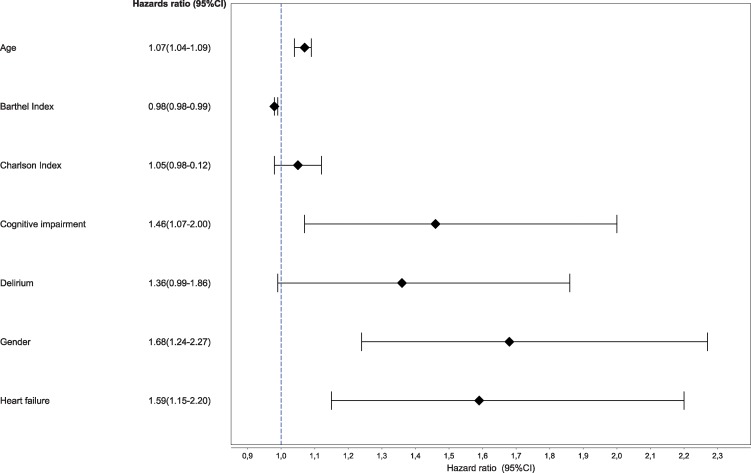
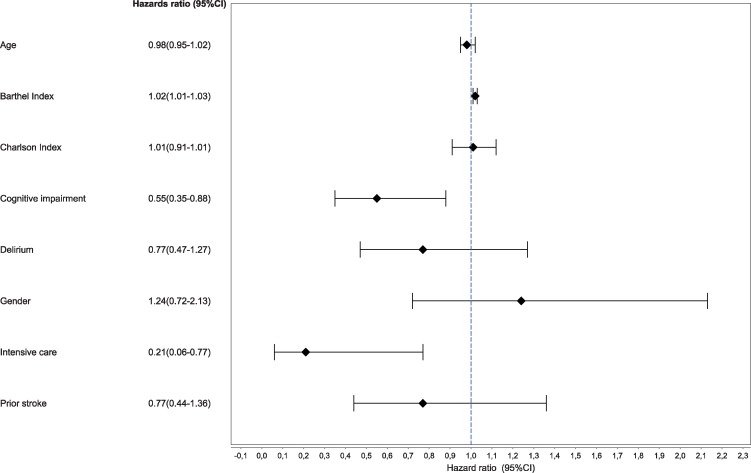
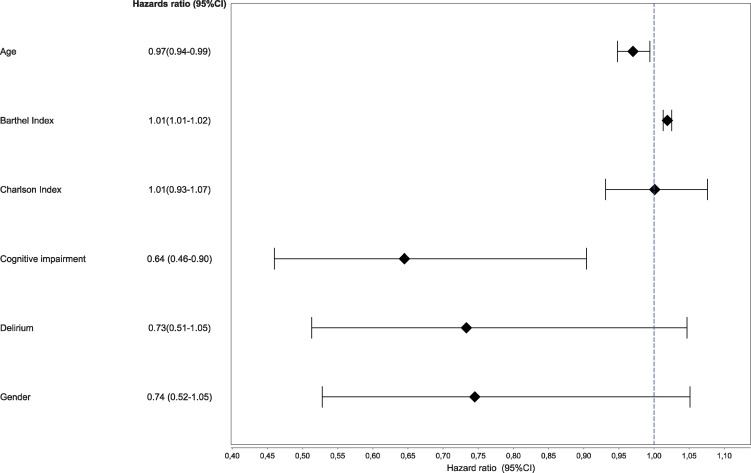
On admission to the unit, the average Barthel score of these patients was 77.2 + 27.8 points, and the average Charlson index score was 2.14 + 2.05. The mean length of stay was 8.9 + 4.26 days, and the readmission rate was 2.3%. The in-hospital mortality rate was 4.7%, and the mortality rates at one, six, and 12 months after discharge were 8.7%, 16.9%, and 25.9%, respectively. The Cox proportional hazards model estimated that male sex, Barthel scale, heart failure, and cognitive impairment were associated with an increased risk of death. With regard to functionality, 63.7% of the patients were able to walk at the time of discharge, whereas 77.4% and 80.1% were able to walk at one month and six months post-discharge, respectively. The factors associated with a worse functional recovery included cognitive impairment, performance status, age, stroke, Charlson score, and delirium during the hospital stay.
Early multidisciplinary intervention appears to be effective for the management of hip fracture. Age, male sex, baseline function, cognitive impairment and previous comorbidities are associated with a higher mortality rate and worse functional recovery.
髋部骨折与较高的合并症和死亡率相关。矫形老年病学单元在功能恢复和降低死亡率方面已被证明是有效的。本研究的目的是记录老年髋部骨折患者早期多学科干预的自然史,并确定出院后死亡率和行走能力的预后因素。
这项观察性、回顾性研究在矫形老年护理病房进行,研究对象为 2004 年至 2008 年间诊断为髋部骨折且年龄>70 岁的患者。本研究共纳入 1363 名患者,平均年龄 82.7±6.4 岁。
患者入院时,平均巴氏量表评分为 77.2±27.8 分,平均查尔森指数评分为 2.14±2.05。平均住院时间为 8.9±4.26 天,再入院率为 2.3%。住院期间死亡率为 4.7%,出院后 1、6 和 12 个月的死亡率分别为 8.7%、16.9%和 25.9%。Cox 比例风险模型估计,男性、巴氏量表、心力衰竭和认知障碍与死亡风险增加相关。在功能方面,63.7%的患者在出院时能够行走,而在出院后 1 个月和 6 个月时分别有 77.4%和 80.1%能够行走。与功能恢复较差相关的因素包括认知障碍、表现状态、年龄、中风、查尔森指数和住院期间的谵妄。
早期多学科干预似乎对髋部骨折的治疗有效。年龄、性别、基线功能、认知障碍和既往合并症与较高的死亡率和较差的功能恢复相关。