Department of Biomolecular Mechanisms, Max-Planck Institute for Medical Research, Jahnstrasse 29, 69120 Heidelberg, Germany.
Nucleic Acids Res. 2012 Oct;40(18):9308-18. doi: 10.1093/nar/gks603. Epub 2012 Jul 2.
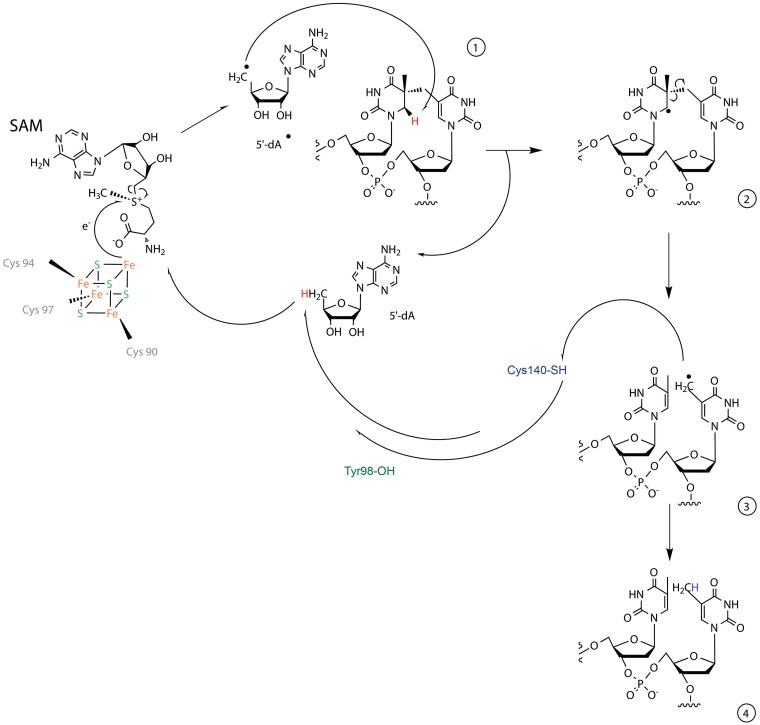
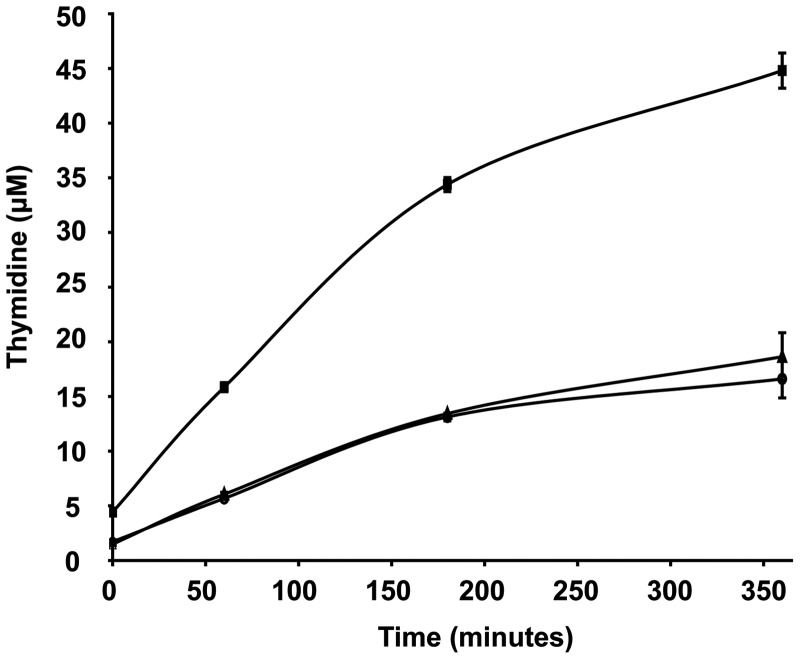
Bacterial spores possess an enormous resistance to ultraviolet (UV) radiation. This is largely due to a unique DNA repair enzyme, Spore Photoproduct Lyase (SP lyase) that repairs a specific UV-induced DNA lesion, the spore photoproduct (SP), through an unprecedented radical-based mechanism. Unlike DNA photolyases, SP lyase belongs to the emerging superfamily of radical S-adenosyl-l-methionine (SAM) enzymes and uses a 4Fe-4S cluster and SAM to initiate the repair reaction. We report here the first crystal structure of this enigmatic enzyme in complex with its [4Fe-4S] cluster and its SAM cofactor, in the absence and presence of a DNA lesion, the dinucleoside SP. The high resolution structures provide fundamental insights into the active site, the DNA lesion recognition and binding which involve a β-hairpin structure. We show that SAM and a conserved cysteine residue are perfectly positioned in the active site for hydrogen atom abstraction from the dihydrothymine residue of the lesion and donation to the α-thyminyl radical moiety, respectively. Based on structural and biochemical characterizations of mutant proteins, we substantiate the role of this cysteine in the enzymatic mechanism. Our structure reveals how SP lyase combines specific features of radical SAM and DNA repair enzymes to enable a complex radical-based repair reaction to take place.
细菌孢子具有很强的抗紫外线(UV)辐射能力。这主要归因于一种独特的 DNA 修复酶,即孢子光产物裂合酶(SP 裂合酶),它通过一种前所未有的基于自由基的机制修复特定的 UV 诱导的 DNA 损伤,即孢子光产物(SP)。与 DNA 光解酶不同,SP 裂合酶属于新兴的自由基 S-腺苷甲硫氨酸(SAM)酶超家族,利用4Fe-4S簇和 SAM 启动修复反应。我们在此报告了该神秘酶与[4Fe-4S]簇及其 SAM 辅因子(在不存在和存在 DNA 损伤二核苷 SP 的情况下)复合物的首个晶体结构。高分辨率结构提供了对活性位点、涉及β发夹结构的 DNA 损伤识别和结合的基本了解。我们表明,SAM 和保守半胱氨酸残基在活性位点中的位置非常合适,可以分别从损伤的二氢胸腺嘧啶残基上进行氢原子抽象,并将其捐赠给α-胸腺嘧啶基自由基部分。基于突变蛋白的结构和生化特性,我们证实了该半胱氨酸在酶促机制中的作用。我们的结构揭示了 SP 裂合酶如何结合自由基 SAM 和 DNA 修复酶的特定特征,以实现复杂的基于自由基的修复反应。