Department of Biology, University of California Riverside, Riverside, California, United States of America.
PLoS One. 2012;7(6):e38084. doi: 10.1371/journal.pone.0038084. Epub 2012 Jun 22.
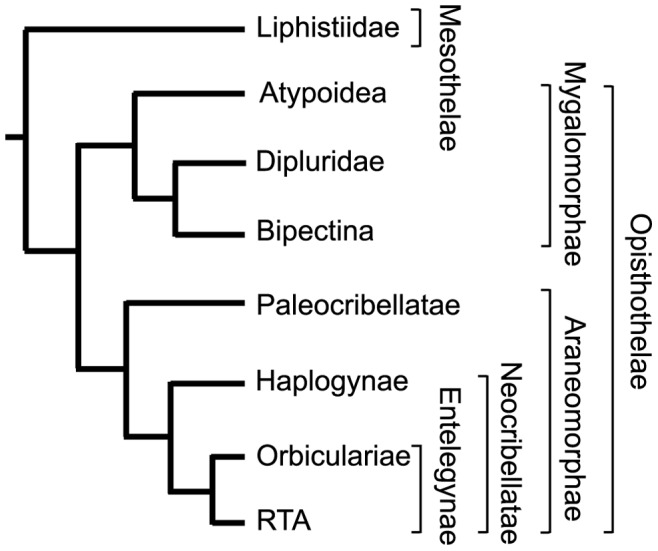
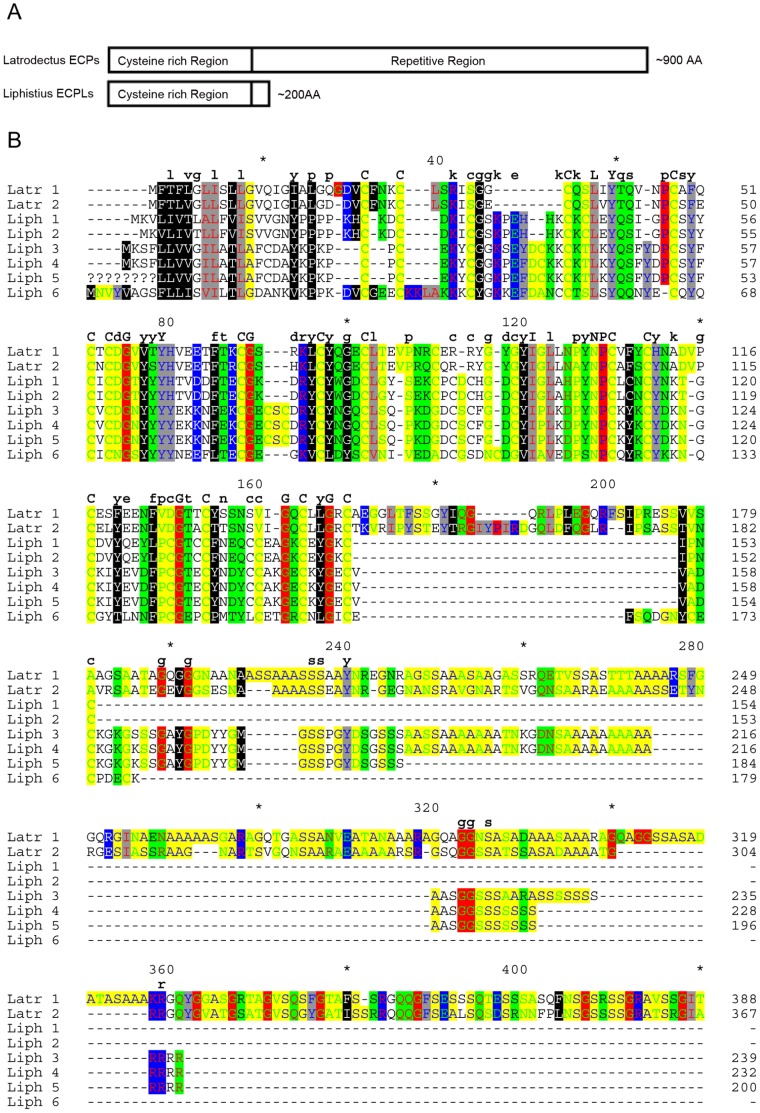
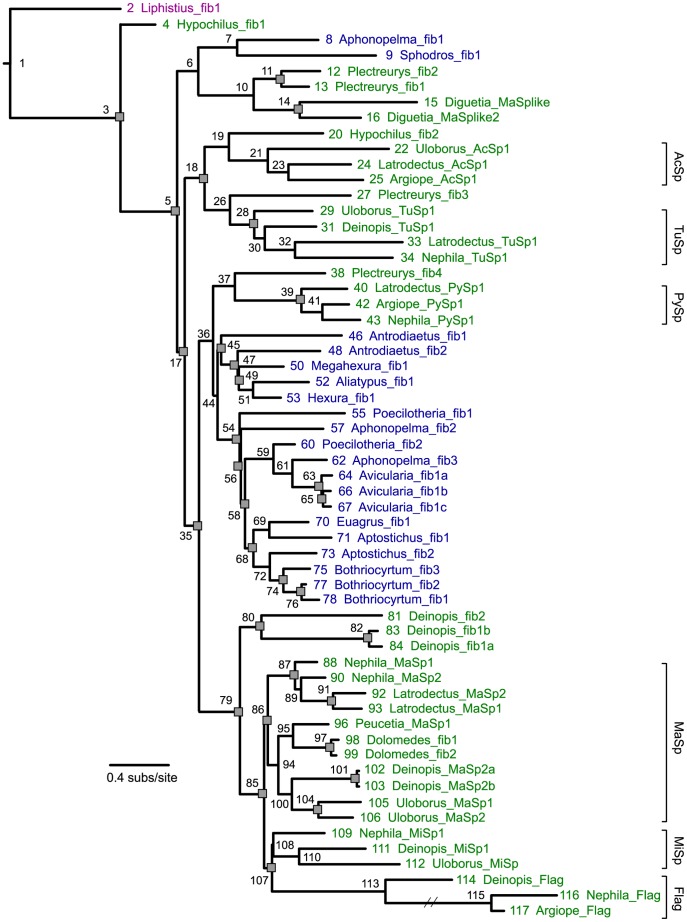
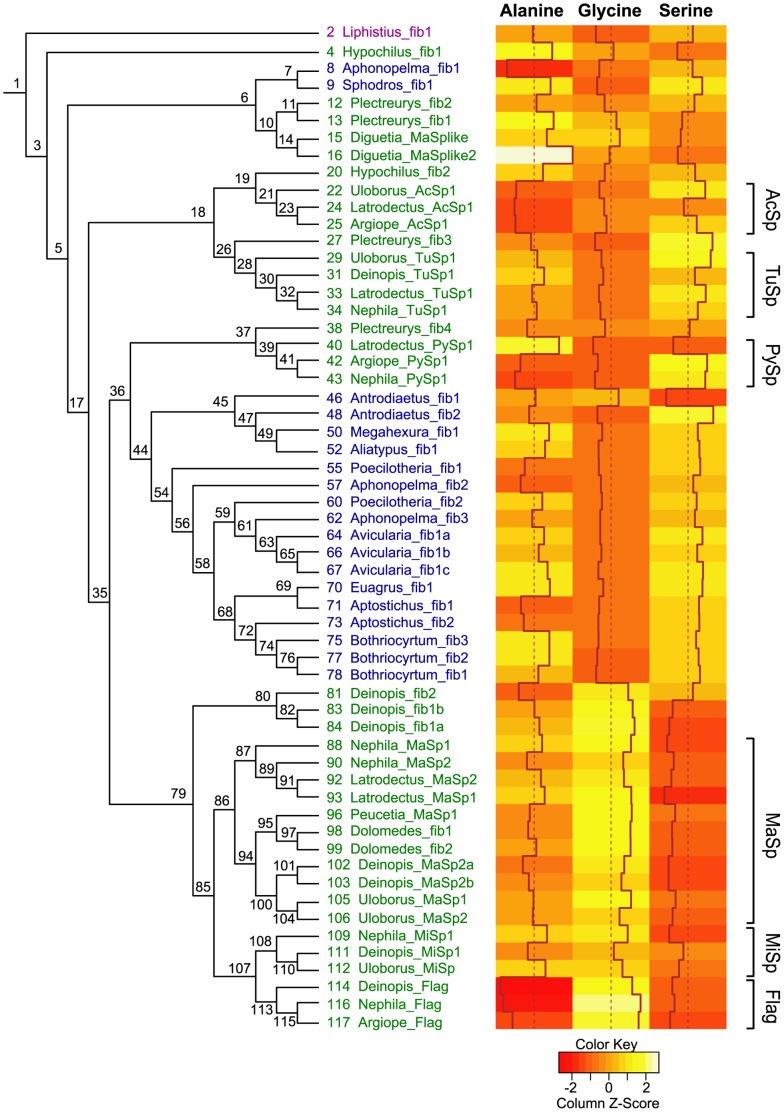
Silk spinning is essential to spider ecology and has had a key role in the expansive diversification of spiders. Silk is composed primarily of proteins called spidroins, which are encoded by a multi-gene family. Spidroins have been studied extensively in the derived clade, Orbiculariae (orb-weavers), from the suborder Araneomorphae ('true spiders'). Orbicularians produce a suite of different silks, and underlying this repertoire is a history of duplication and spidroin gene divergence. A second class of silk proteins, Egg Case Proteins (ECPs), is known only from the orbicularian species, Lactrodectus hesperus (Western black widow). In L. hesperus, ECPs bond with tubuliform spidroins to form egg case silk fibers. Because most of the phylogenetic diversity of spiders has not been sampled for their silk genes, there is limited understanding of spidroin gene family history and the prevalence of ECPs. Silk genes have not been reported from the suborder Mesothelae (segmented spiders), which diverged from all other spiders >380 million years ago, and sampling from Mygalomorphae (tarantulas, trapdoor spiders) and basal araneomorph lineages is sparse. In comparison to orbicularians, mesotheles and mygalomorphs have a simpler silk biology and thus are hypothesized to have less diversity of silk genes. Here, we present cDNAs synthesized from the silk glands of six mygalomorph species, a mesothele, and a non-orbicularian araneomorph, and uncover a surprisingly rich silk gene diversity. In particular, we find ECP homologs in the mesothele, suggesting that ECPs were present in the common ancestor of extant spiders, and originally were not specialized to complex with tubuliform spidroins. Furthermore, gene-tree/species-tree reconciliation analysis reveals that numerous spidroin gene duplications occurred after the split between Mesothelae and Opisthothelae (Mygalomorphae plus Araneomorphae). We use the spidroin gene tree to reconstruct the evolution of amino acid compositions of spidroins that perform different ecological functions.
丝纺对于蜘蛛生态学至关重要,并在蜘蛛的广泛多样化中发挥了关键作用。丝主要由称为蜘蛛丝蛋白的蛋白质组成,这些蛋白质由多基因家族编码。蜘蛛丝蛋白在衍生的 Orbiculariae (orb-weavers,orb 织网者)类群中得到了广泛研究,该类群属于 Araneomorphae 亚目(“真蜘蛛”)。orbicularians 产生了一系列不同的丝,而这种 repertoire 背后是复制和蜘蛛丝基因分化的历史。第二类丝蛋白,卵壳蛋白(ECPs),仅从 orbicularian 物种 Lactrodectus hesperus(西方黑寡妇)中得知。在 L. hesperus 中,ECPs 与管状蜘蛛丝蛋白结合形成卵壳丝纤维。由于蜘蛛的大部分系统发育多样性尚未对其丝基因进行采样,因此对蜘蛛丝基因家族历史和 ECPs 的普遍性的了解有限。从Mesothelae (节肢蜘蛛)亚目(3.8 亿年前与所有其他蜘蛛分化)中没有报道过丝基因,而且对 Mygalomorphae (狼蛛、活板门蜘蛛)和基础 araneomorph 谱系的采样也很稀疏。与 orbicularians 相比,mesotheles 和 mygalomorphs 的丝生物学更为简单,因此据推测其丝基因的多样性也较少。在这里,我们从六个 mygalomorph 物种、一个 mesothele 和一个非 orbicularian araneomorph 的丝腺中合成了 cDNA,并揭示了令人惊讶的丰富的丝基因多样性。特别是,我们在 mesothele 中发现了 ECP 同源物,这表明 ECPs 存在于现存蜘蛛的共同祖先中,并且最初并不是专门与管状蜘蛛丝蛋白结合的。此外,基因树/种系发生树协调分析表明,在 Mesothelae 和 Opisthothelae(Mygalomorphae 加 Araneomorphae)之间的分裂之后,发生了许多蜘蛛丝基因复制。我们使用蜘蛛丝基因树来重建执行不同生态功能的蜘蛛丝蛋白的氨基酸组成的进化。