Université de Toulouse, UPS, INPT, LAPLACE, Laboratoire Plasma et Conversion d'Energie, Toulouse, France.
PLoS One. 2012;7(6):e38588. doi: 10.1371/journal.pone.0038588. Epub 2012 Jun 26.
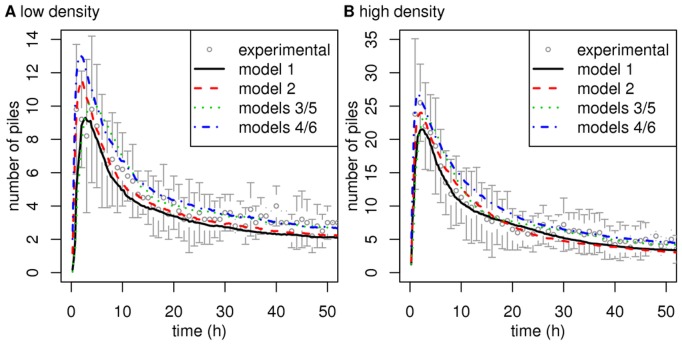
The last decades have seen an increasing interest in modeling collective animal behavior. Some studies try to reproduce as accurately as possible the collective dynamics and patterns observed in several animal groups with biologically plausible, individual behavioral rules. The objective is then essentially to demonstrate that the observed collective features may be the result of self-organizing processes involving quite simple individual behaviors. Other studies concentrate on the objective of establishing or enriching links between collective behavior researches and cognitive or physiological ones, which then requires that each individual rule be carefully validated. Here we discuss the methodological consequences of this additional requirement. Using the example of corpse clustering in ants, we first illustrate that it may be impossible to discriminate among alternative individual rules by considering only observational data collected at the group level. Six individual behavioral models are described: They are clearly distinct in terms of individual behaviors, they all reproduce satisfactorily the collective dynamics and distribution patterns observed in experiments, and we show theoretically that it is strictly impossible to discriminate two of these models even in the limit of an infinite amount of data whatever the accuracy level. A set of methodological steps are then listed and discussed as practical ways to partially overcome this problem. They involve complementary experimental protocols specifically designed to address the behavioral rules successively, conserving group-level data for the overall model validation. In this context, we highlight the importance of maintaining a sharp distinction between model enunciation, with explicit references to validated biological concepts, and formal translation of these concepts in terms of quantitative state variables and fittable functional dependences. Illustrative examples are provided of the benefits expected during the often long and difficult process of refining a behavioral model, designing adapted experimental protocols and inversing model parameters.
过去几十年,人们对动物集体行为建模越来越感兴趣。一些研究试图尽可能准确地再现多个动物群体中观察到的集体动态和模式,采用生物学上合理的、个体行为规则。其目标本质上是证明观察到的集体特征可能是涉及相当简单个体行为的自组织过程的结果。其他研究则集中于在集体行为研究与认知或生理研究之间建立或丰富联系的目标,这就需要仔细验证每个个体规则。在这里,我们讨论了这一额外要求的方法学后果。我们以蚂蚁尸体聚集为例,首先说明仅考虑在群体水平上收集的观测数据,可能无法区分替代个体规则。我们描述了六个个体行为模型:它们在个体行为方面明显不同,它们都能令人满意地再现实验中观察到的集体动力学和分布模式,并且我们从理论上表明,即使在数据量无限且无论准确性水平如何的情况下,也绝不可能区分其中两个模型。然后列出并讨论了一组方法步骤,作为部分克服这一问题的实用方法。这些步骤涉及专门设计的补充实验方案,用于逐步解决行为规则问题,并保留群体水平数据以用于整体模型验证。在这种情况下,我们强调了在模型阐述中保持明确区分的重要性,明确提及经过验证的生物学概念,并将这些概念以定量状态变量和可拟合的功能依赖性的形式进行形式翻译。我们提供了在行为模型细化、设计适应实验方案和反转模型参数的过程中,通常漫长而艰难的过程中预期的收益的示例。