
免疫毒素介导的灵长类大脑束路追踪:皮质-底丘脑“直接”通路的选择性消除。
Immunotoxin-mediated tract targeting in the primate brain: selective elimination of the cortico-subthalamic "hyperdirect" pathway.
机构信息
Systems Neuroscience Section, Primate Research Institute, Kyoto University, Inuyama, Japan.
出版信息
PLoS One. 2012;7(6):e39149. doi: 10.1371/journal.pone.0039149. Epub 2012 Jun 25.
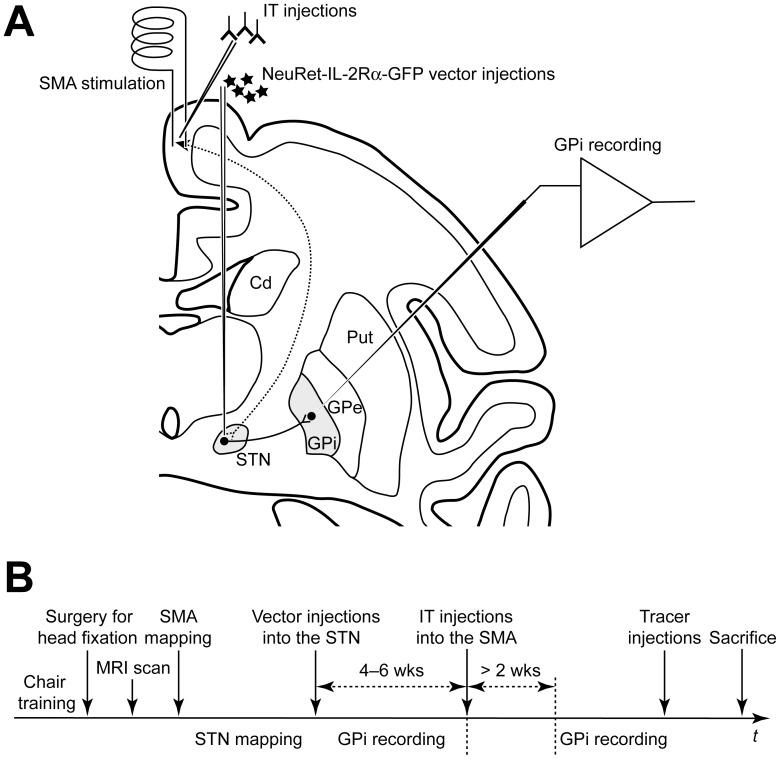
Using a neuron-specific retrograde gene-transfer vector (NeuRet vector), we established immunotoxin (IT)-mediated tract targeting in the primate brain that allows ablation of a neuronal population constituting a particular pathway. Here, we attempted selective removal of the cortico-subthalamic "hyperdirect" pathway. In conjunction with the direct and indirect pathways, the hyperdirect pathway plays a crucial role in motor information processing in the basal ganglia. This pathway links the motor-related areas of the frontal lobe directly to the subthalamic nucleus (STN) without relay at the striatum. After electrical stimulation in the motor-related areas such as the supplementary motor area (SMA), triphasic responses consisting of an early excitation, an inhibition, and a late excitation are usually detected in the internal segment of the globus pallidus (GPi). Several lines of pharmacophysiological evidence suggest that the early excitation may be derived from the hyperdirect pathway. In the present study, the NeuRet vector expressing human interleukin-2 receptor α-subunit was injected into the STN of macaque monkeys. Then, IT injections were made into the SMA. In these monkeys, single-neuron activity in the GPi was recorded in response to the SMA stimulation. We found that the early excitation was largely reduced, with neither the inhibition nor the late excitation affected. The spontaneous firing rate and pattern of GPi neurons remained unchanged. This indicates that IT-mediated tract targeting successfully eliminated the hyperdirect pathway selectively from the basal ganglia circuitry without affecting spontaneous activity of STN neurons. The electrophysiological finding was confirmed with anatomical data obtained from retrograde and anterograde neural tracings. The present results define that the cortically-driven early excitation in GPi neurons is mediated by the hyperdirect pathway. The IT-mediated tract targeting technique will provide us with novel strategies for elucidating various neural network functions.
利用神经元特异性逆行基因转移载体(NeuRet 载体),我们在灵长类动物大脑中建立了免疫毒素(IT)介导的靶向定位,从而能够消除构成特定通路的神经元群体。在这里,我们试图选择性地去除皮质-丘脑下“直接”通路。与直接和间接通路一起,直接通路在基底神经节的运动信息处理中起着至关重要的作用。该通路将额叶的运动相关区域直接连接到丘脑下核(STN),而不在纹状体中继。在运动相关区域(如辅助运动区[SMA])进行电刺激后,通常在苍白球内节(GPi)中检测到由早期兴奋、抑制和晚期兴奋组成的三相反应。几条药理学和生理学证据表明,早期兴奋可能来自直接通路。在本研究中,表达人白细胞介素 2 受体 α 亚基的 NeuRet 载体被注入猕猴的 STN。然后,将 IT 注入 SMA。在这些猴子中,记录了 GPi 中的单个神经元活动对 SMA 刺激的反应。我们发现,早期兴奋大大减少,抑制和晚期兴奋均不受影响。GPi 神经元的自发放电率和模式保持不变。这表明,IT 介导的靶向定位成功地选择性地从基底神经节回路中消除了直接通路,而不会影响 STN 神经元的自发活动。电生理发现得到了逆行和顺行神经追踪获得的解剖学数据的证实。这些结果定义了 GPi 神经元中由皮质驱动的早期兴奋是由直接通路介导的。IT 介导的靶向定位技术将为我们提供新的策略来阐明各种神经网络功能。



 Zotero 插件