Mathematical Biosciences Institute, The Ohio State University, USA.
J Theor Biol. 2012 Jun 21;303:141-51. doi: 10.1016/j.jtbi.2012.03.024. Epub 2012 Mar 28.
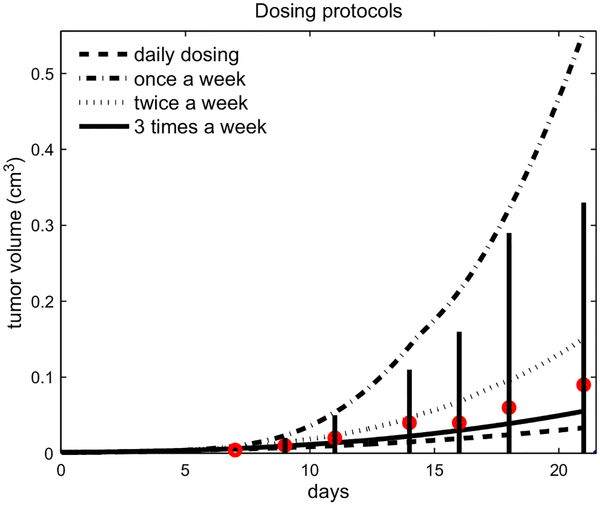
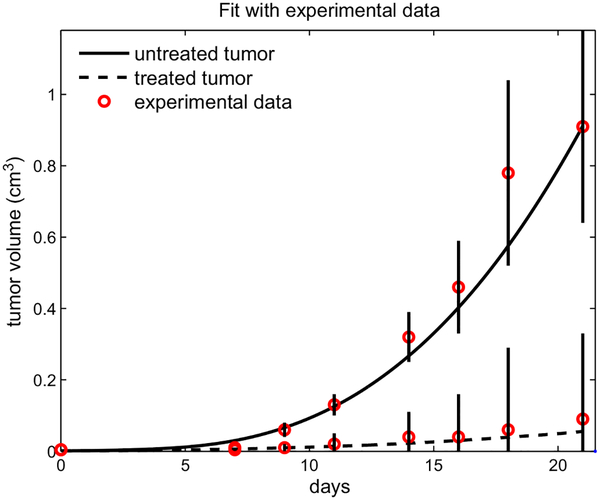
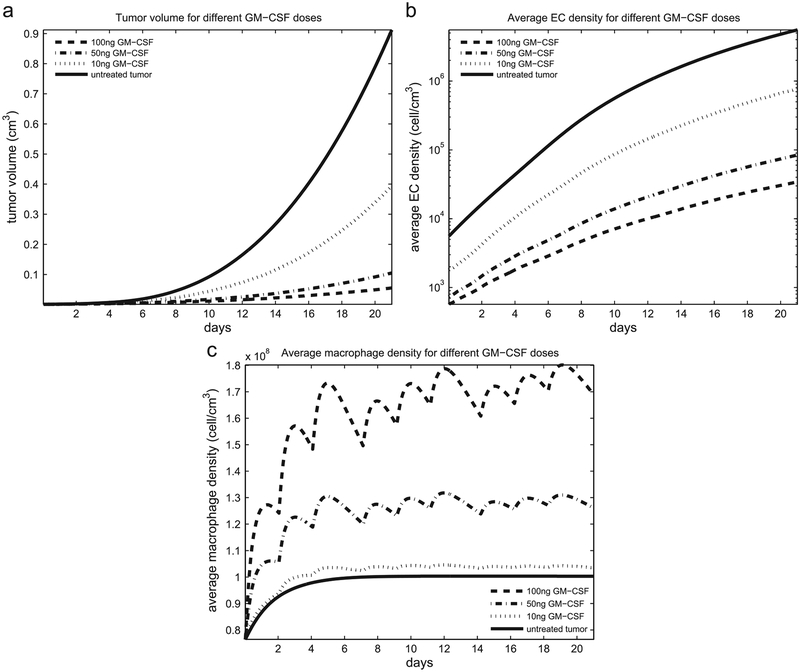
M-CSF is overexpressed in breast cancer and is known to stimulate macrophages to produce VEGF resulting in angiogenesis. It has recently been shown that the growth factor GM-CSF injected into murine breast tumors slowed tumor growth by secreting soluble VEGF receptor-1 (sVEGFR-1) that binds and inactivates VEGF. This study presents a mathematical model that includes all the components above, as well as MCP-1, tumor cells, and oxygen. The model simulations are representative of the in vivo data through predictions of tumor growth using different protocol strategies for GM-CSF for the purpose of predicting higher degrees of treatment success. For example, our model predicts that once a week dosing of GM-CSF would be less effective than daily, twice a week, or three times a week treatment because of the presence of essential factors required for the anti-tumor effect of GM-CSF.
M-CSF 在乳腺癌中过表达,已知其可刺激巨噬细胞产生 VEGF 从而导致血管生成。最近有研究表明,生长因子 GM-CSF 注射到鼠乳腺癌肿瘤中,通过分泌可溶性 VEGF 受体-1(sVEGFR-1)来减缓肿瘤生长,该受体可结合并使 VEGF 失活。本研究提出了一个数学模型,该模型包含了所有上述成分,以及 MCP-1、肿瘤细胞和氧气。通过使用不同的 GM-CSF 方案策略来预测肿瘤生长,模型模拟可以代表体内数据,目的是预测更高程度的治疗成功。例如,我们的模型预测,由于 GM-CSF 抗肿瘤作用所需的基本因素的存在,GM-CSF 每周一次的剂量不如每周两次、每周三次的剂量有效。