Department of Radiology, University of Texas Southwestern Medical Center at Dallas, Dallas, TX 75390, USA.
J Appl Clin Med Phys. 2012 Jul 5;13(4):3792. doi: 10.1120/jacmp.v13i4.3792.
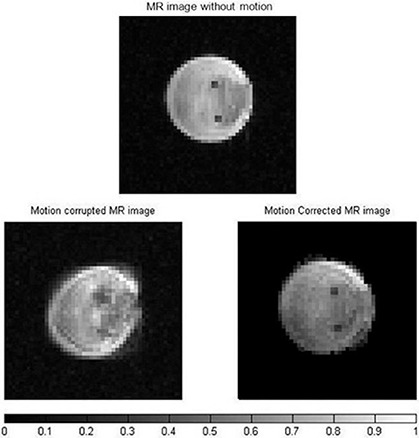
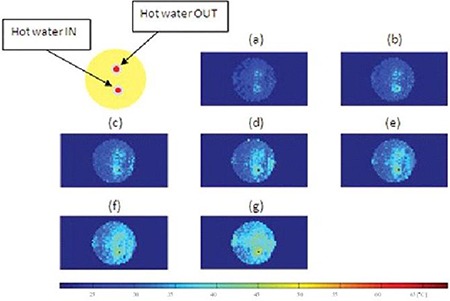
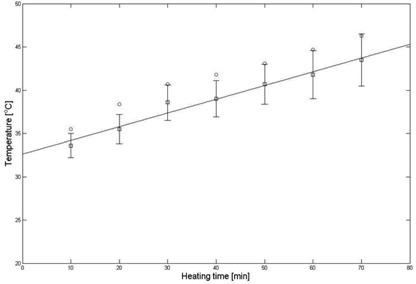
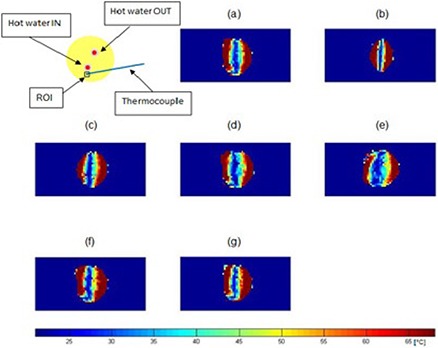
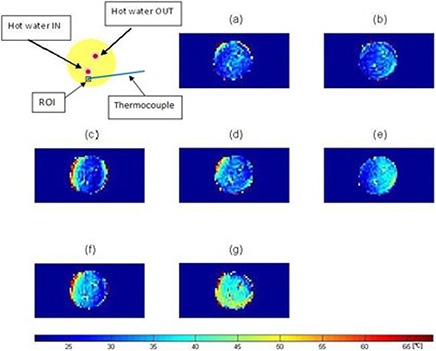
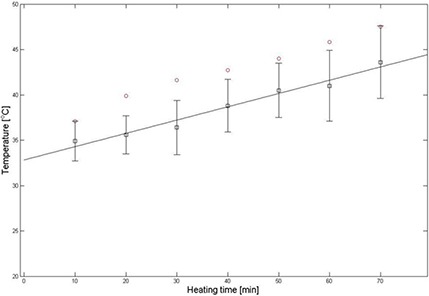
This study develops and tests an MR thermometry method combined with SMASH navigators in phantom experiments mimicking human liver motion with the purpose of detecting and correcting motion artifacts in thermal MR images. Experimental data were acquired on a 3T MRI scanner. Motion artifacts of mobile phantoms mimicking human liver motion were detected and corrected using the SMASH navigators and then MR temperature maps were obtained using a proton resonant frequency (PRF) shift method with complex image subtraction. Temperature acquired by MR thermal imaging was compared to that measured via thermocouples. MR thermal imaging combined with the SMASH navigator technique resulted in accurate temperature maps of the mobile phantoms compared to temperatures measured using the thermocouples. The differences between the obtained and measured temperatures varied from 8.2°C to 14.2°C and 2.2°C to 4.9°C without and with motion correction, respectively. Motion correction improved the temperature acquired by MR thermal imaging by > 55%. The combination of the MR thermal imaging and SMASH navigator technique will enable monitoring and controlling heat distribution and temperature change in tissues during thermal therapies and will be a very important tool for cancer treatment in mobile organs.
本研究开发并测试了一种结合了 SMASH 导航器的磁共振测温方法,在模拟人体肝脏运动的体模实验中,旨在检测和纠正热磁共振图像中的运动伪影。实验数据是在 3T MRI 扫描仪上采集的。使用 SMASH 导航器检测和校正模拟人体肝脏运动的移动体模的运动伪影,然后使用质子共振频率 (PRF) 偏移方法结合复数图像相减获得磁共振温度图。通过磁共振热成像获得的温度与热电偶测量的温度进行比较。与使用热电偶测量的温度相比,MR 热成像与 SMASH 导航技术相结合可获得移动体模的准确温度图。获得的温度与测量的温度之间的差异分别为 8.2°C 至 14.2°C 和 2.2°C 至 4.9°C,无运动校正和有运动校正。运动校正将 MR 热成像获得的温度提高了>55%。MR 热成像和 SMASH 导航技术的结合将能够在热疗期间监测和控制组织中的热分布和温度变化,并且是移动器官癌症治疗的重要工具。