Division of Molecular Microbiology, University of Dundee, College of Life Sciences Dundee, Scotland, UK.
BMC Microbiol. 2012 Jul 6;12:134. doi: 10.1186/1471-2180-12-134.
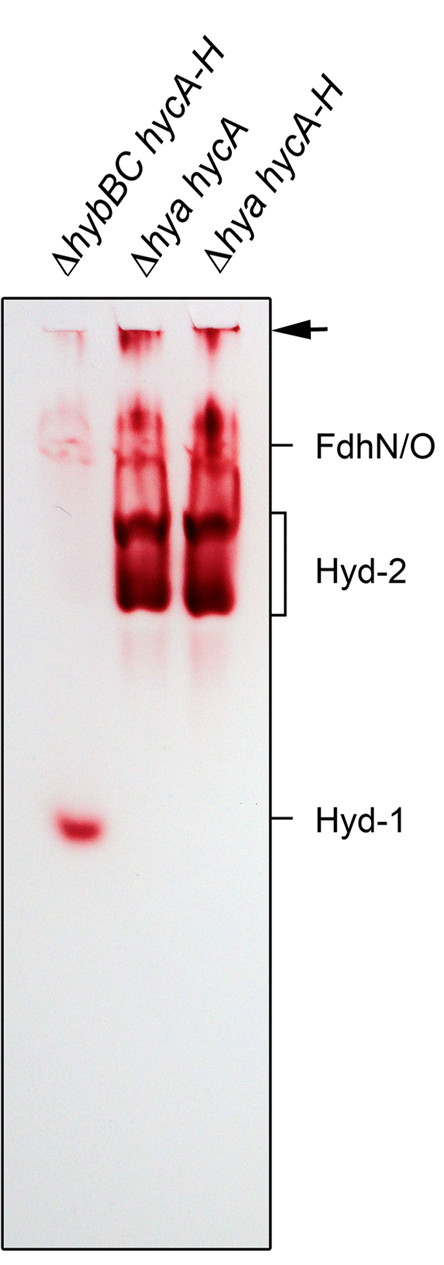
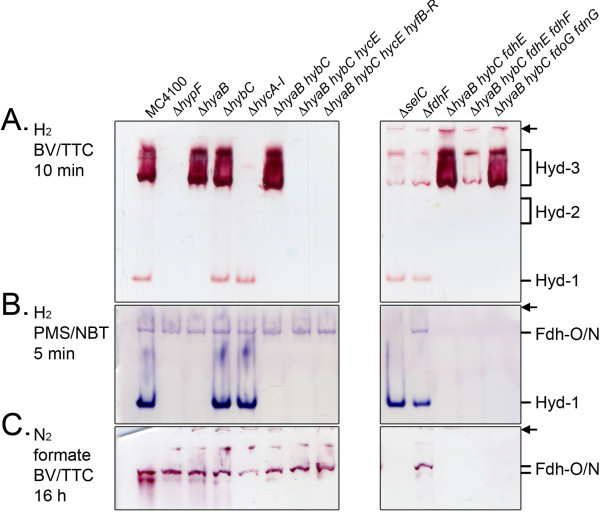
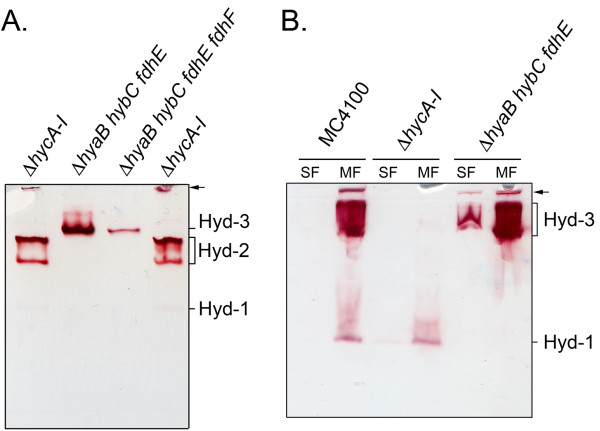
When grown under anaerobic conditions, Escherichia coli K-12 is able to synthesize three active [NiFe]-hydrogenases (Hyd1-3). Two of these hydrogenases are respiratory enzymes catalysing hydrogen oxidation, whereby Hyd-1 is oxygen-tolerant and Hyd-2 is considered a standard oxygen-sensitive hydrogenase. Hyd-3, together with formate dehydrogenase H (Fdh-H), forms the formate hydrogenlyase (FHL) complex, which is responsible for H2 evolution by intact cells. Hydrogen oxidation activity can be assayed for all three hydrogenases using benzyl viologen (BV; Eo' = -360 mV) as an artificial electron acceptor; however ascribing activities to specific isoenzymes is not trivial. Previously, an in-gel assay could differentiate Hyd-1 and Hyd-2, while Hyd-3 had long been considered too unstable to be visualized on such native gels. This study identifies conditions allowing differentiation of all three enzymes using simple in-gel zymographic assays.
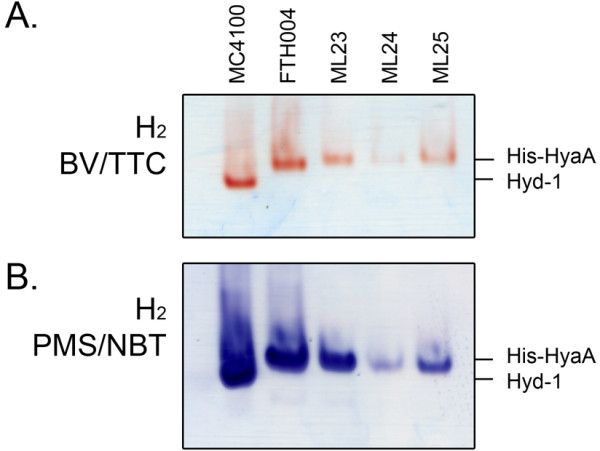
Using a modified in-gel assay hydrogen-dependent BV reduction catalyzed by Hyd-3 has been described for the first time. High hydrogen concentrations facilitated visualization of Hyd-3 activity. The activity was membrane-associated and although not essential for visualization of Hyd-3, the activity was maximal in the presence of a functional Fdh-H enzyme. Furthermore, through the use of nitroblue tetrazolium (NBT; Eo' = -80 mV) it was demonstrated that Hyd-1 reduces this redox dye in a hydrogen-dependent manner, while neither Hyd-2 nor Hyd-3 could couple hydrogen oxidation to NBT reduction. Hydrogen-dependent reduction of NBT was also catalysed by an oxygen-sensitive variant of Hyd-1 that had a supernumerary cysteine residue at position 19 of the small subunit substituted for glycine. This finding suggests that tolerance toward oxygen is not the main determinant that governs electron donation to more redox-positive electron acceptors such as NBT.
The utilization of particular electron acceptors at different hydrogen concentrations and redox potentials correlates with the known physiological functions of the respective hydrogenase. The ability to rapidly distinguish between oxygen-tolerant and standard [NiFe]-hydrogenases provides a facile new screen for the discovery of novel enzymes. A reliable assay for Hyd-3 will reinvigorate studies on the characterisation of the hydrogen-evolving FHL complex.
在厌氧条件下生长时,大肠杆菌 K-12 能够合成三种活性的 [NiFe]-氢化酶(Hyd1-3)。其中两种氢化酶是呼吸酶,催化氢气氧化,其中 Hyd-1 耐受氧气,而 Hyd-2 被认为是标准的氧气敏感氢化酶。Hyd-3 与甲酸脱氢酶 H(Fdh-H)一起形成甲酸盐氢化酶(FHL)复合物,负责完整细胞的氢气释放。可以使用苄基紫精(BV;Eo'=-360 mV)作为人工电子受体来测定所有三种氢化酶的氧化活性;然而,将活性归因于特定同工酶并不简单。以前,凝胶内分析可以区分 Hyd-1 和 Hyd-2,而 Hyd-3 长期以来被认为太不稳定,无法在这种天然凝胶上可视化。本研究确定了使用简单的凝胶内酶谱分析区分所有三种酶的条件。
首次描述了使用改良的凝胶内分析,由 Hyd-3 催化的依赖氢气的 BV 还原。高氢气浓度有利于观察 Hyd-3 的活性。该活性与膜相关,尽管不是可视化 Hyd-3 的必要条件,但在存在功能齐全的 Fdh-H 酶的情况下,该活性最大。此外,通过使用硝基蓝四唑(NBT;Eo'=-80 mV),证明 Hyd-1 以依赖氢气的方式还原这种氧化还原染料,而 Hyd-2 和 Hyd-3 都不能将氢气氧化与 NBT 还原偶联。氧气敏感的 Hyd-1 变体也催化 NBT 的依赖氢气还原,该变体在小亚基的第 19 位取代甘氨酸的位置有一个多余的半胱氨酸残基。这一发现表明,对氧气的耐受性不是决定电子向更氧化正的电子受体(如 NBT)供体的主要因素。
在不同的氢气浓度和氧化还原电位下利用特定的电子受体与相应氢化酶的已知生理功能相关。快速区分耐氧和标准 [NiFe]-氢化酶的能力为发现新酶提供了一种简便的新筛选方法。Hyd-3 的可靠测定方法将重新激发对氢气释放 FHL 复合物的特征研究。