Gururajan Murali, Posadas Edwin M, Chung Leland W K
Uro-Oncology Research Program, Department of Medicine, Samuel Oschin Comprehensive Cancer Institute, Cedars-Sinai Medical Center, Los Angeles, CA, USA.
Transl Androl Urol. 2012 Jan 3;1(1):19-32. doi: 10.3978/j.issn.2223-4683.2012.01.03.
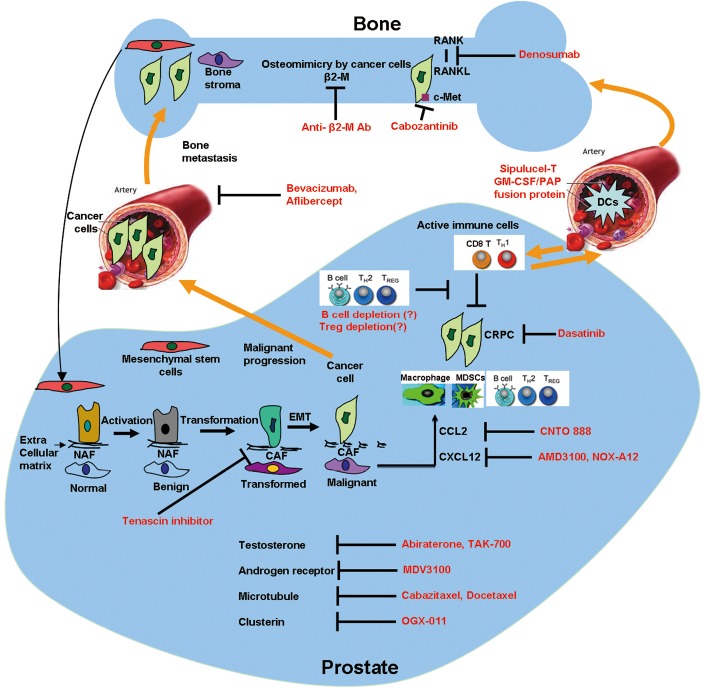
We summarize several recent laboratory advances to tackle the problem of tumor-stroma-immune cell microenvironment interaction with the hope of developing and advancing new concepts and therapeutic strategies for prostate cancer therapy by improving bone and soft tissue metastases in prostate cancer patients. Given the emerging enthusiasm for immunotherapy in prostate cancer due to (I) improved understanding of the role of immune cells in the tumor microenvironment, (II) approval by the FDA of an immunotherapeutic drug to treat prostate cancer, and (III) recognition of immunotherapy as a novel approach to treat solid tumors by the Nobel Prize Committee (for discovery of dendritic cells that are used in immunotherapy), the field of tumor immunology is poised for growth in the next decade with the hope of developing new immunomodulatory drugs which will compliment and perhaps eventually replace traditional chemotherapeutic drugs. In this article, we provide a timely review of recent advances in the field of immunotherapy for prostate cancer, lessons learned from successes and failures, the contributory factors in the tumor microenvironment that could be rendered hostile to cancer cells, an exciting area of future research.
我们总结了近期实验室在解决肿瘤-基质-免疫细胞微环境相互作用问题方面取得的进展,希望通过改善前列腺癌患者的骨和软组织转移,开发并推进前列腺癌治疗的新概念和治疗策略。鉴于免疫疗法在前列腺癌领域日益受到关注,原因如下:(I)对免疫细胞在肿瘤微环境中作用的认识不断提高;(II)美国食品药品监督管理局(FDA)批准了一种用于治疗前列腺癌的免疫治疗药物;(III)诺贝尔奖委员会将免疫疗法认定为治疗实体瘤的新方法(因发现了用于免疫治疗的树突状细胞),肿瘤免疫学领域有望在未来十年取得发展,有望开发出新的免疫调节药物,这些药物将补充并可能最终取代传统化疗药物。在本文中,我们及时回顾了前列腺癌免疫治疗领域的最新进展、从成功与失败中吸取的教训、肿瘤微环境中可能对癌细胞产生不利影响的因素,这是一个令人兴奋的未来研究领域。