Xu Pengfei, Wasielewski Logan J, Yang Joy C, Cai Demin, Evans Christopher P, Murphy William J, Liu Chengfei
Department of Urologic Surgery, University of California Davis, Sacramento, CA 95817, USA.
College of Animal Science and Technology, Yangzhou University, Yangzhou, 225009, China.
Biomedicines. 2022 Jul 22;10(8):1778. doi: 10.3390/biomedicines10081778.
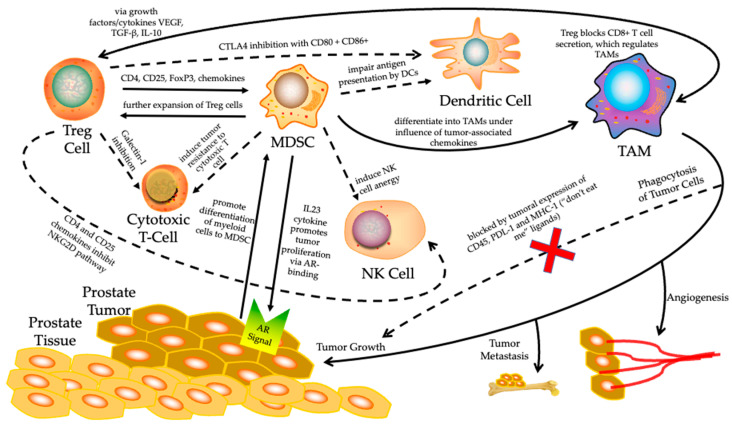
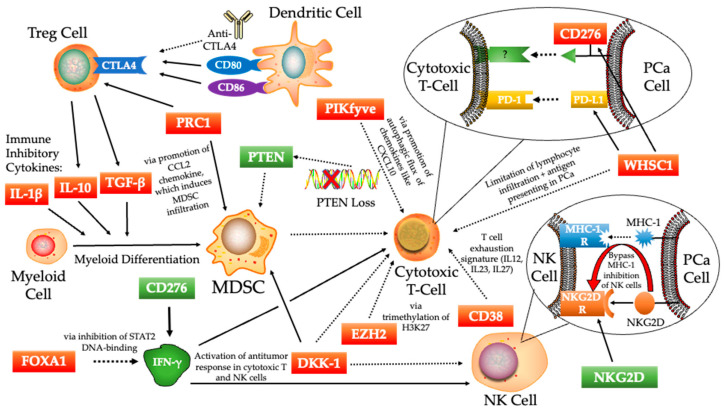
Prostate cancer is one of the most common malignant tumors in men. Initially, it is androgen-dependent, but it eventually develops into castration-resistant prostate cancer (CRPC), which is incurable with current androgen receptor signaling target therapy and chemotherapy. Immunotherapy, specifically with immune checkpoint inhibitors, has brought hope for the treatment of this type of prostate cancer. Approaches such as vaccines, adoptive chimeric antigen receptor-T (CAR-T) cells, and immune checkpoint inhibitors have been employed to activate innate and adaptive immune responses to treat prostate cancer, but with limited success. Only Sipuleucel-T and the immune checkpoint inhibitor pembrolizumab are approved by the US FDA for the treatment of limited prostate cancer patients. Prostate cancer has a complex tumor microenvironment (TME) in which various immunosuppressive molecules and mechanisms coexist and interact. Additionally, prostate cancer is considered a "cold" tumor with low levels of tumor mutational burden, low amounts of antigen-presenting and cytotoxic T-cell activation, and high levels of immunosuppressive molecules including cytokines/chemokines. Thus, understanding the mechanisms of immunosuppressive signaling activation and immune evasion will help develop more effective treatments for prostate cancer. The purpose of this review is to summarize emerging advances in prostate cancer immunotherapy, with a particular focus on the molecular mechanisms that lead to immune evasion in prostate cancer. At the same time, we also highlight some potential therapeutic targets to provide a theoretical basis for the treatment of prostate cancer.
前列腺癌是男性最常见的恶性肿瘤之一。起初,它依赖雄激素,但最终会发展为去势抵抗性前列腺癌(CRPC),而目前的雄激素受体信号靶向治疗和化疗对其无法治愈。免疫疗法,特别是使用免疫检查点抑制剂,为这类前列腺癌的治疗带来了希望。疫苗、过继性嵌合抗原受体T(CAR-T)细胞和免疫检查点抑制剂等方法已被用于激活先天性和适应性免疫反应来治疗前列腺癌,但成效有限。只有 sipuleucel-T 和免疫检查点抑制剂帕博利珠单抗被美国食品药品监督管理局(US FDA)批准用于治疗有限的前列腺癌患者。前列腺癌具有复杂的肿瘤微环境(TME),其中各种免疫抑制分子和机制共存并相互作用。此外,前列腺癌被认为是一种“冷”肿瘤,其肿瘤突变负荷水平低,抗原呈递和细胞毒性T细胞激活量少,包括细胞因子/趋化因子在内的免疫抑制分子水平高。因此,了解免疫抑制信号激活和免疫逃逸的机制将有助于开发更有效的前列腺癌治疗方法。本综述的目的是总结前列腺癌免疫治疗的新进展,特别关注导致前列腺癌免疫逃逸的分子机制。同时,我们还强调了一些潜在的治疗靶点,为前列腺癌的治疗提供理论依据。