Hao Ning-Bo, Lü Mu-Han, Fan Ya-Han, Cao Ya-Ling, Zhang Zhi-Ren, Yang Shi-Ming
Department of Gastroenterology, Xinqiao Hospital, Third Military Medical University, Chongqing 400037, China.
Clin Dev Immunol. 2012;2012:948098. doi: 10.1155/2012/948098. Epub 2012 Jun 19.
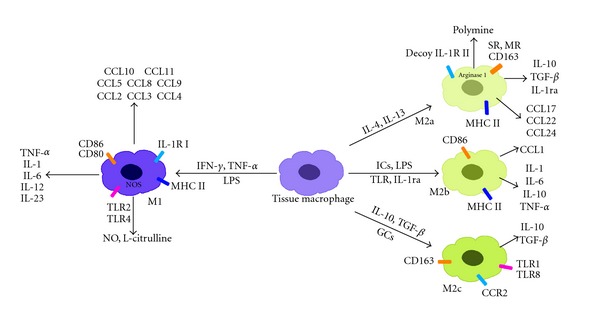
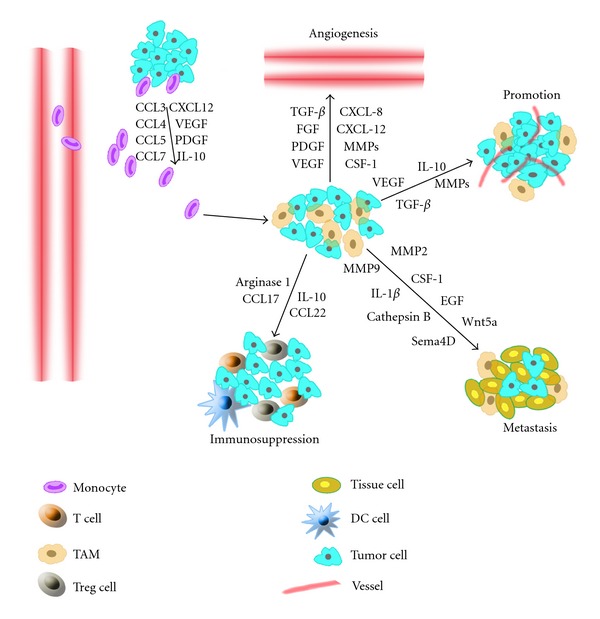
Macrophages are widely distributed innate immune cells that play indispensable roles in the innate and adaptive immune response to pathogens and in-tissue homeostasis. Macrophages can be activated by a variety of stimuli and polarized to functionally different phenotypes. Two distinct subsets of macrophages have been proposed, including classically activated (M1) and alternatively activated (M2) macrophages. M1 macrophages express a series of proinflammatory cytokines, chemokines, and effector molecules, such as IL-12, IL-23, TNF-α, iNOS and MHCI/II. In contrast, M2 macrophages express a wide array of anti-inflammatory molecules, such as IL-10, TGF-β, and arginase1. In most tumors, the infiltrated macrophages are considered to be of the M2 phenotype, which provides an immunosuppressive microenvironment for tumor growth. Furthermore, tumor-associated macrophages secrete many cytokines, chemokines, and proteases, which promote tumor angiogenesis, growth, metastasis, and immunosuppression. Recently, it was also found that tumor-associated macrophages interact with cancer stem cells. This interaction leads to tumorigenesis, metastasis, and drug resistance. So mediating macrophage to resist tumors is considered to be potential therapy.
巨噬细胞是广泛分布的固有免疫细胞,在对病原体的固有免疫和适应性免疫反应以及组织内稳态中发挥着不可或缺的作用。巨噬细胞可被多种刺激激活并极化为功能不同的表型。已提出巨噬细胞有两种不同的亚群,包括经典活化的(M1)和替代活化的(M2)巨噬细胞。M1巨噬细胞表达一系列促炎细胞因子、趋化因子和效应分子,如IL-12、IL-23、TNF-α、诱导型一氧化氮合酶(iNOS)和MHC I/II。相比之下,M2巨噬细胞表达多种抗炎分子,如IL-10、转化生长因子-β(TGF-β)和精氨酸酶1。在大多数肿瘤中,浸润的巨噬细胞被认为是M2表型,为肿瘤生长提供了免疫抑制微环境。此外,肿瘤相关巨噬细胞分泌许多细胞因子、趋化因子和蛋白酶,促进肿瘤血管生成、生长、转移和免疫抑制。最近,还发现肿瘤相关巨噬细胞与癌症干细胞相互作用。这种相互作用导致肿瘤发生、转移和耐药。因此,介导巨噬细胞抵抗肿瘤被认为是一种潜在的治疗方法。