Zheng Xiang, Turkowski Kati, Mora Javier, Brüne Bernhard, Seeger Werner, Weigert Andreas, Savai Rajkumar
Max Planck Institute for Heart and Lung Research, Department of Lung Development and Remodeling, Member of the German Center for Lung Research (DZL), Bad Nauheim, Germany.
Institute of Biochemistry I, Goethe-University Frankfurt, Frankfurt, Germany.
Oncotarget. 2017 Jul 18;8(29):48436-48452. doi: 10.18632/oncotarget.17061.
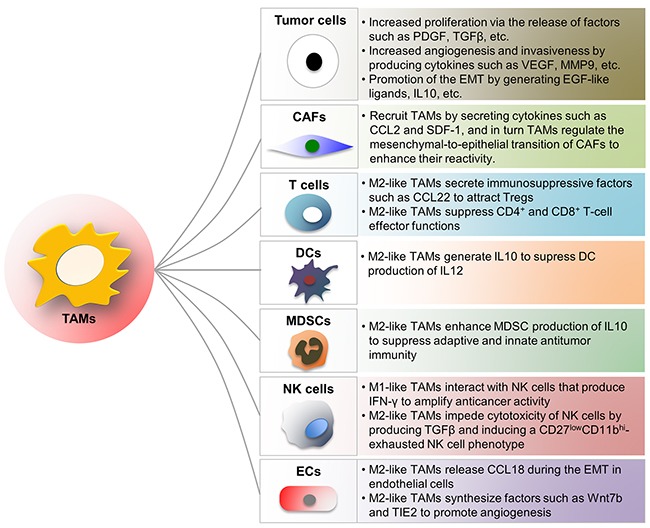
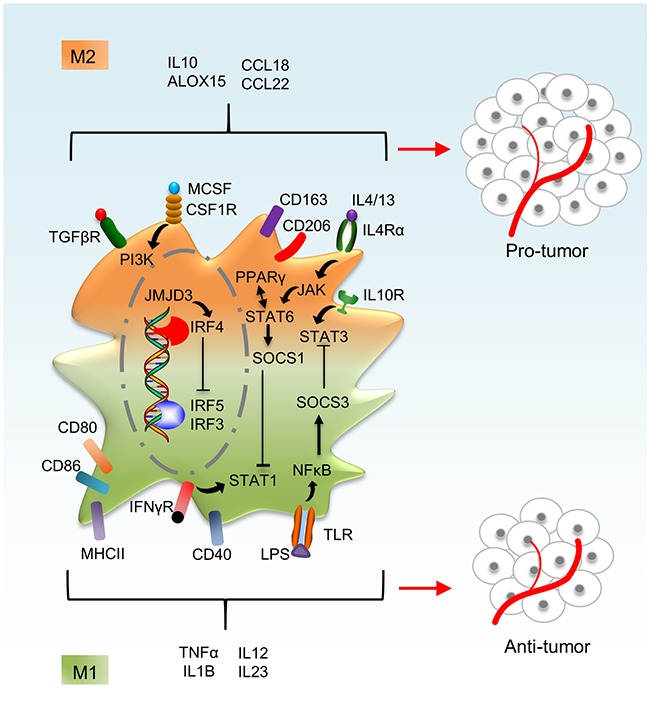
Cancer research in recent decades has highlighted the potential influence of the tumor microenvironment on the progression and metastasis of most known cancer types. Within the established microenvironment, tumor-associated macrophages (TAMs) are one of the most abundant and crucial non-neoplastic cell types. The polarization of macrophages into tumor-suppressive M1 or tumor-promoting M2 types is a fundamental event in the establishment of the tumor microenvironment. Although ample evidence indicates that TAMs are primarily M2 polarized, the mechanisms responsible for the regulation and maintenance of M1 and M2 polarization imbalance remain unclear. The manipulation of this critical axis through three main approaches may provide new strategies for cancer therapy - (I) specific interference with M2-like TAM survival or inhibiting their signaling cascades, (II) repression of macrophage recruitment to tumors, and (III) repolarization of tumor-promoting M2-like TAMs to a tumoricidal M1-like phenotype. This review summarizes current strategies for cancer intervention via manipulation of macrophage polarization, with particular focus on composition of the tumor microenvironment and its influence on cancer progression and metastasis. It is clear that additional fundamental and preclinical research is required to confirm the efficacy and practicality of this novel and promising strategy for treating cancer.
近几十年来,癌症研究突出了肿瘤微环境对大多数已知癌症类型进展和转移的潜在影响。在既定的微环境中,肿瘤相关巨噬细胞(TAM)是最丰富且关键的非肿瘤细胞类型之一。巨噬细胞极化为肿瘤抑制性M1型或肿瘤促进性M2型是建立肿瘤微环境的一个基本事件。尽管有充分证据表明TAM主要呈M2极化,但负责调节和维持M1和M2极化失衡的机制仍不清楚。通过三种主要方法对这一关键轴进行调控可能为癌症治疗提供新策略——(I)特异性干扰M2样TAM的存活或抑制其信号级联反应,(II)抑制巨噬细胞向肿瘤的募集,以及(III)将肿瘤促进性M2样TAM重新极化为杀肿瘤性M1样表型。本综述总结了通过调控巨噬细胞极化进行癌症干预的当前策略,特别关注肿瘤微环境的组成及其对癌症进展和转移的影响。显然,需要更多的基础研究和临床前研究来证实这种治疗癌症的新颖且有前景的策略的有效性和实用性。