Kim Hie Lim, Iwase Mineyo, Igawa Takeshi, Nishioka Tasuku, Kaneko Satoko, Katsura Yukako, Takahata Naoyuki, Satta Yoko
Center for the Promotion of Integrated Sciences, The Graduate University for Advanced Studies (SOKENDAI), Hayama, Kanagawa 240-0193, Japan.
Int J Evol Biol. 2012;2012:917678. doi: 10.1155/2012/917678. Epub 2012 Jun 19.
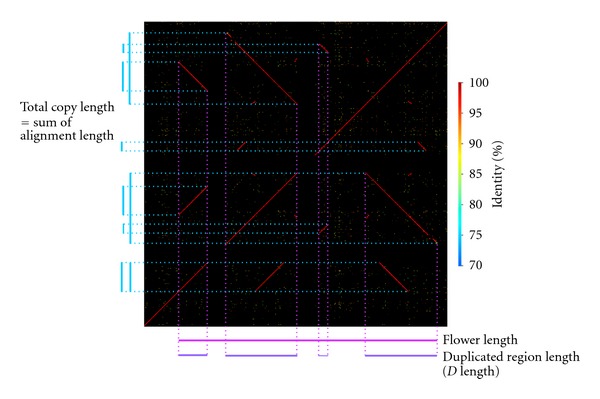
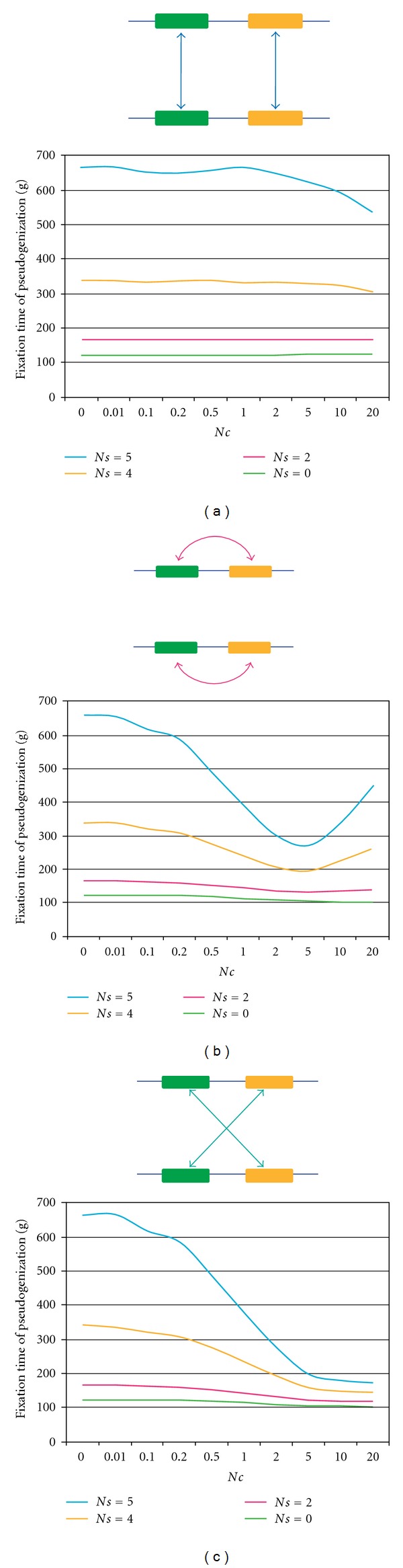
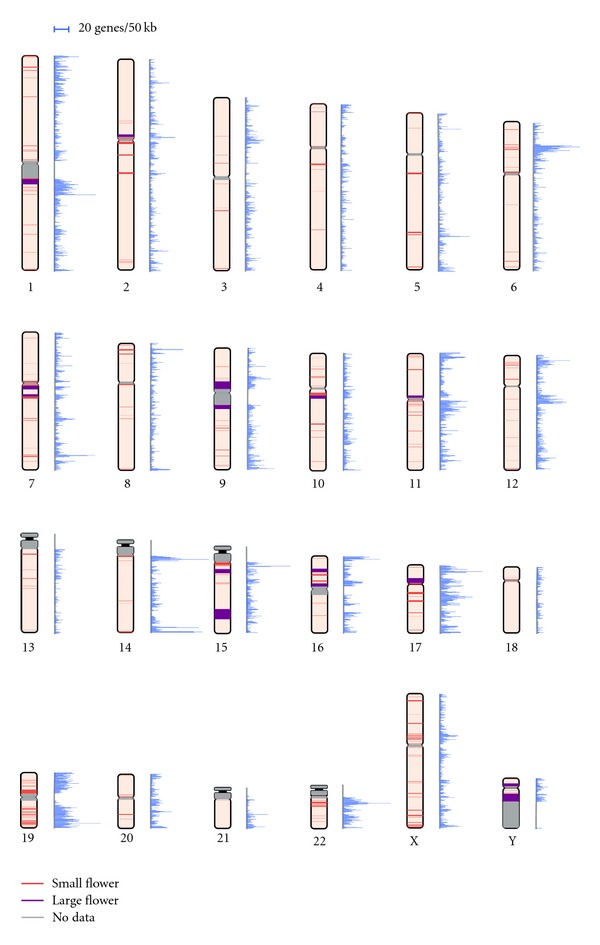
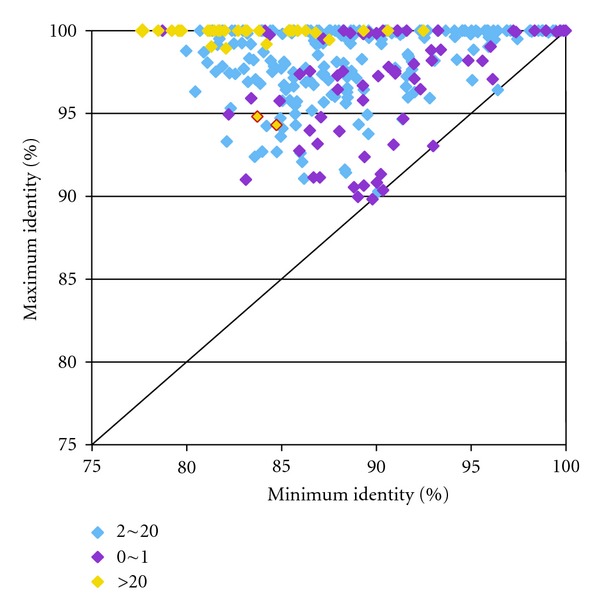
We report the results of an extensive investigation of genomic structures in the human genome, with a particular focus on relatively large repeats (>50 kb) in adjacent chromosomal regions. We named such structures "Flowers" because the pattern observed on dot plots resembles a flower. We detected a total of 291 Flowers in the human genome. They were predominantly located in euchromatic regions. Flowers are gene-rich compared to the average gene density of the genome. Genes involved in systems receiving environmental information, such as immunity and detoxification, were overrepresented in Flowers. Within a Flower, the mean number of duplication units was approximately four. The maximum and minimum identities between homologs in a Flower showed different distributions; the maximum identity was often concentrated to 100% identity, while the minimum identity was evenly distributed in the range of 78% to 100%. Using a gene conversion detection test, we found frequent and/or recent gene conversion events within the tested Flowers. Interestingly, many of those converted regions contained protein-coding genes. Computer simulation studies suggest that one role of such frequent gene conversions is the elongation of the life span of gene families in a Flower by the resurrection of pseudogenes.
我们报告了一项对人类基因组中基因组结构进行广泛研究的结果,特别关注相邻染色体区域中相对较大的重复序列(>50 kb)。我们将此类结构命名为“花”,因为在点阵图上观察到的模式类似于花朵。我们在人类基因组中总共检测到291个“花”。它们主要位于常染色质区域。与基因组的平均基因密度相比,“花”富含基因。参与接收环境信息的系统(如免疫和解毒)的基因在“花”中过度富集。在一个“花”内,重复单元的平均数约为四个。“花”中同源物之间的最大和最小同一性呈现不同的分布;最大同一性通常集中在100%同一性,而最小同一性在78%至100%的范围内均匀分布。使用基因转换检测试验,我们发现在测试的“花”内存在频繁和/或近期的基因转换事件。有趣的是,许多这些转换区域包含蛋白质编码基因。计算机模拟研究表明,这种频繁基因转换的一个作用是通过假基因的复活来延长“花”中基因家族的寿命。