Child and Family Center, University of Oregon, 195 West 12th Avenue, Eugene, OR 97401-3408, USA.
Dev Psychopathol. 2012 Aug;24(3):1139-55. doi: 10.1017/S0954579412000582.
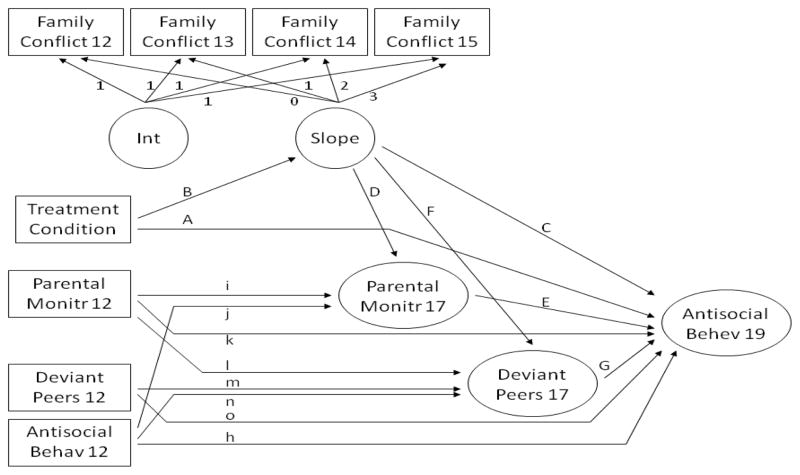
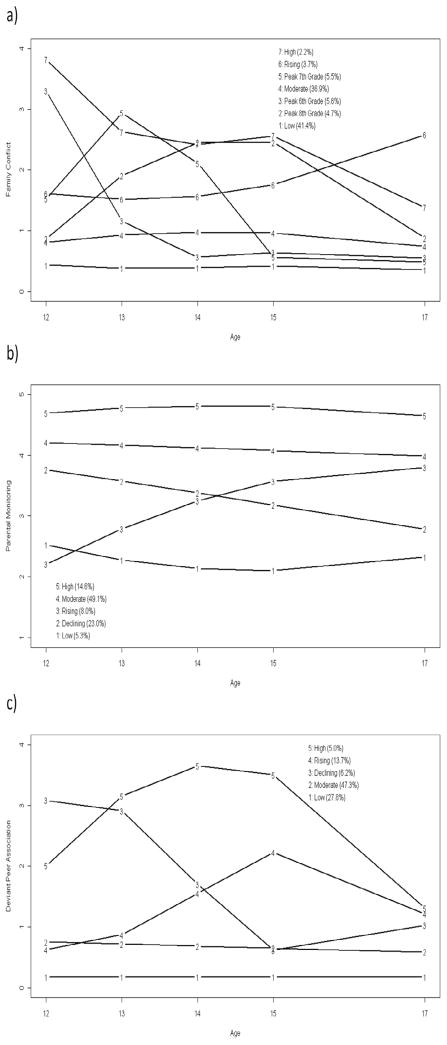
This study used an experimental, longitudinal field trial involving random assignment to the Family Check-Up (FCU) to explore the social ecology of adolescent antisocial behavior. A sample of 998 youths and their families was followed from early to late adolescence (age 12 to 18-19). In the intervention condition, 115 families (23%) elected to receive the FCU. In general, random assignment to the FCU in middle school was associated with reductions in late adolescence antisocial behavior (age 18-19). Variable-centered analyses revealed that the effects were mediated by reductions in family conflict from early to middle adolescence (age 12-15). The link between family conflict and antisocial behavior in turn was mediated by association with deviant peers at age 17; parental monitoring at age 17 was also influential but did not attain the status of a mediator. Person-oriented analyses suggested that the FCU was associated with declining trajectories of family conflict and rising trajectories of parental monitoring but was not associated with trajectories of deviant peer association. A dual-trajectory analysis indicated that the pathways to adolescent antisocial behavior were myriad and varied, suggesting new directions for developmental and intervention research.
本研究采用实验性、纵向现场试验,涉及将家庭检查(FCU)随机分配,以探索青少年反社会行为的社会生态。从早期到晚期青春期(12 至 18-19 岁),对 998 名青少年及其家庭进行了抽样跟踪。在干预条件下,有 115 个家庭(23%)选择接受 FCU。一般来说,中学时期随机分配到 FCU 与晚期青春期反社会行为(18-19 岁)的减少有关。变量中心分析显示,这种影响是通过减少从早期到中期青春期(12-15 岁)的家庭冲突来介导的。家庭冲突与反社会行为之间的联系又通过与 17 岁时的偏差同伴的关联来介导;17 岁时的父母监督也有影响,但没有达到中介的地位。个体导向分析表明,FCU 与家庭冲突的下降轨迹和父母监督的上升轨迹有关,但与偏差同伴的关联轨迹无关。双轨迹分析表明,青少年反社会行为的途径多种多样,这为发展和干预研究提供了新的方向。