Department of Clinical Sciences of Companion Animals, Utrecht University, Faculty of Veterinary Medicine, Utrecht, The Netherlands.
BMC Vet Res. 2012 Jul 11;8:112. doi: 10.1186/1746-6148-8-112.
An inherited basis for congenital extrahepatic portosystemic shunts (EHPSS) has been demonstrated in several small dog breeds. If in general both portocaval and porto-azygous shunts occur in breeds predisposed to portosystemic shunts then this could indicate a common genetic background. This study was performed to determine the distribution of extrahepatic portocaval and porto-azygous shunts in purebred dog populations.
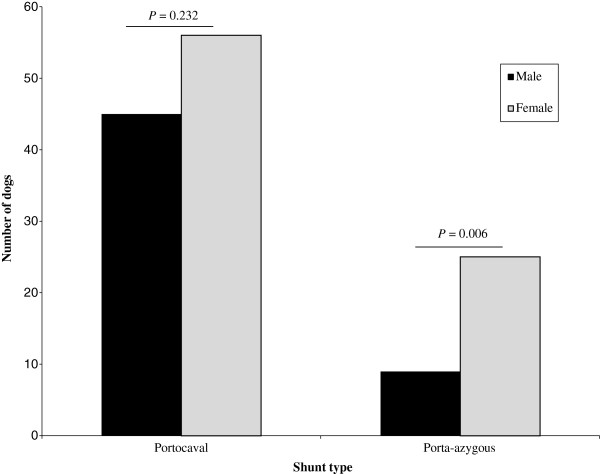
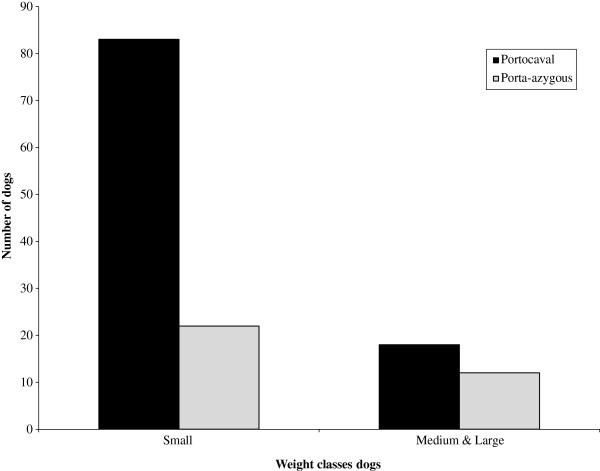
Data of 135 client owned dogs diagnosed with EHPSS at the Faculty of Veterinary Medicine of Utrecht University from 2001 - 2010 were retrospectively analyzed. The correlation between shunt localization, sex, age, dog size and breed were studied. The study group consisted of 54 males and 81 females from 24 breeds. Twenty-five percent of dogs had porto-azygous shunts and 75% had portocaval shunts. Of the dogs with porto-azygous shunts only 27% was male (P = 0.006). No significant sex difference was detected in dogs with a portocaval shunt. Both phenotypes were present in almost all breeds represented with more than six cases. Small dogs are mostly diagnosed with portocaval shunts (79%) whereas both types are detected. The age at diagnosis in dogs with porto-azygous shunts was significantly higher than that of dogs with portocaval shunts (P < 0.001).
The remarkable similarity of phenotypic variation in many dog breeds may indicate common underlying genes responsible for EHPSS across breeds. The subtype of EHPSS could be determined by a minor genetic component or modulating factors during embryonic development.
在几个小型犬种中已经证明了先天性肝外门体分流(EHPSS)的遗传基础。如果一般来说,在易发生门体分流的品种中,同时存在门腔分流和门奇分流,那么这可能表明存在共同的遗传背景。本研究旨在确定纯种犬群体中肝外门腔和门奇分流的分布。
回顾性分析了 2001 年至 2010 年乌得勒支大学兽医学院诊断为 EHPSS 的 135 只客户拥有的狗的数据。研究了分流定位、性别、年龄、犬体型和品种之间的相关性。研究组由 24 个品种的 54 只雄性和 81 只雌性组成。25%的狗有门奇分流,75%的狗有门腔分流。门奇分流的狗中只有 27%是雄性(P=0.006)。门腔分流的狗中未发现性别差异。几乎所有代表病例超过 6 例的品种都存在这两种表型。小型犬主要被诊断为门腔分流(79%),而两种类型都有发现。门奇分流犬的诊断年龄明显高于门腔分流犬(P<0.001)。
许多犬种的表型变异惊人地相似,这可能表明 EHPSS 在不同品种中存在共同的潜在基因。EHPSS 的亚型可能由胚胎发育过程中的次要遗传成分或调节因素决定。