Smoking Research Group, Department of Psychology, University of Pittsburgh, 130 N. Bellefield Avenue, Suite 510, Pittsburgh, PA 15213, USA.
Drug Alcohol Depend. 2012 Dec 1;126(3):362-8. doi: 10.1016/j.drugalcdep.2012.05.037. Epub 2012 Jul 9.
Non-daily or intermittent smoking is becoming common, but little is known about smoking patterns of intermittent smokers (ITS). This study assesses differences in the profile of smoking motives of non-daily, ITS and daily smokers (DS).
Participants were 218 DS and 252 ITS (152 converted ITS [CITS], who previously smoked daily, and 80 native ITS [NITS] who did not), not currently quitting, recruited by advertisement. ITS were defined as smoking 4-27 days per month; DS as smoking daily, 5-30 cigarettes per day. Participants completed the Wisconsin Inventory of Smoking Dependence Motives (WISDM), yielding scores for 13 different motives. The within-profile standard deviation expressed profile scatter (differentiation among motives), and profile shape was assessed on scores standardized for within-profile mean and standard deviation.
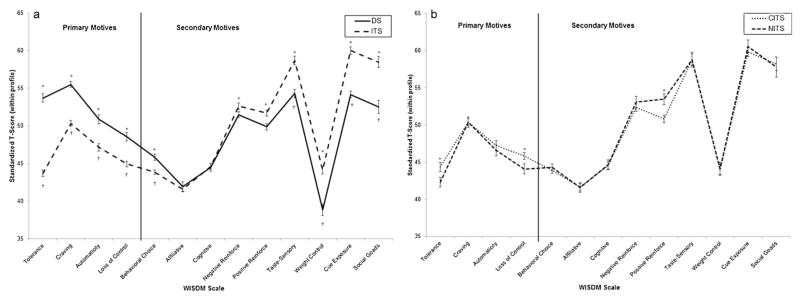
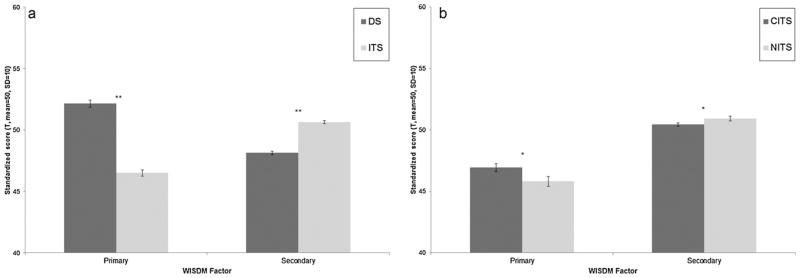
There was no difference between ITS and DS on profile scatter. ITS and DS differed in the shape of the standardized score profile, with DS scoring higher on Tolerance, Craving, Automaticity, Loss of Control and Behavioral Choice motives, and ITS scoring higher on Cue Exposure, Weight Control, and Positive Reinforcement motives. CITS did not differ from NITS in profile scatter or profile shape.
ITS differ from DS in the relative importance of motives, with ITS emphasizing motives associated with acute, situational smoking, and DS emphasizing dependence-related motives. Among ITS, history of daily smoking did not influence the profile of motives.
非每日或间歇性吸烟变得越来越普遍,但对于间歇性吸烟者(ITS)的吸烟模式知之甚少。本研究评估了非每日吸烟、ITS 和每日吸烟者(DS)的吸烟动机特征的差异。
通过广告招募了 218 名 DS 和 252 名 ITS(152 名以前每天吸烟的转换性 ITS [CITS]和 80 名非每日吸烟的原生 ITS [NITS]),他们目前没有戒烟。ITS 定义为每月吸烟 4-27 天;DS 定义为每天吸烟,每天吸烟 5-30 支。参与者完成了威斯康星州吸烟依赖动机量表(WISDM),得出了 13 种不同动机的分数。标准化后的平均和标准差内的内部分散度表示轮廓分散度(动机之间的差异),并评估了标准化分数轮廓的轮廓形状。
ITS 和 DS 在轮廓分散度上没有差异。ITS 和 DS 在标准化分数轮廓的形状上存在差异,DS 在耐受性、渴望、自动性、失去控制和行为选择动机上得分较高,而 ITS 在线索暴露、体重控制和正性强化动机上得分较高。CITS 在轮廓分散度或轮廓形状上与 NITS 没有差异。
ITS 与 DS 在动机的相对重要性上存在差异,ITS 强调与急性、情境性吸烟相关的动机,而 DS 强调与依赖相关的动机。在 ITS 中,每日吸烟的历史并没有影响动机的分布。