Wiese Michael D, Schnabl Matthew, O'Doherty Catherine, Spargo Llewellyn D, Sorich Michael J, Cleland Leslie G, Proudman Susanna M
Arthritis Res Ther. 2012 Jul 12;14(4):R163. doi: 10.1186/ar3911.
Rational selection of disease modifying anti-rheumatic drugs in the treatment of rheumatoid arthritis (RA) has many potential advantages, including rapid disease control, reduced long-term disability and reduced overall cost to the healthcare system. Inter-individual genetic differences are particularly attractive as markers to predict efficacy and toxicity, as they can be determined rapidly prior to drug selection. The aims of this study, therefore, were to investigate the association between differences in genes associated with the metabolism, clearance and efficacy of leflunomide with its cessation in a group of rheumatoid arthritis patients who were treated with an intensive contemporary, treat-to-target approach.
This retrospective cohort study identified all individuals who received leflunomide and were enrolled in the Early Arthritis inception cohort at the Royal Adelaide Hospital between 2001 and July 2011. Inclusion criteria were age (>18) and a diagnosis of rheumatoid arthritis. Patients were excluded if a DNA sample was not available, if they withdrew from the cohort or if clinical data were insufficient. Subjects were followed for 12 months or until either another disease modifying antirheumatic drug was added or leflunomide was ceased. The following single nucleotide polymorphisms (SNPs) were determined: CYP2C192 (rs4244285), CYP2C1917 (rs12248560), ABCG2 421C>A (rs2231142), CYP1A2*1F (rs762551) and DHODH 19C>A (rs3213422). The effects of variables on cessation were assessed with Cox Proportional Hazard models.
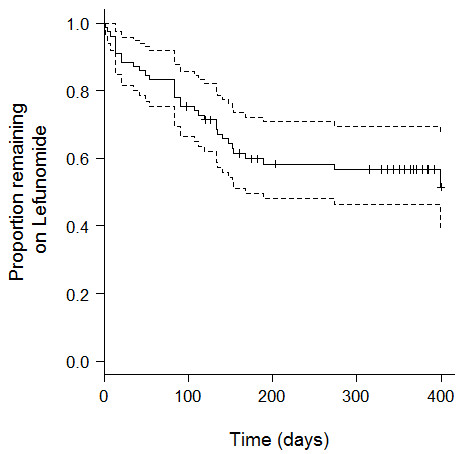
Thirty-three of 78 (42.3%) patients ceased leflunomide due to side effects. A linear trend between cytochrome P450 2C19 (CYP2C19) phenotype and leflunomide cessation was observed, with poor and intermediate metabolizers ceasing more frequently (adjusted Hazard Ratio = 0.432 for each incremental change in phenotype, 95% CI 0.237 to 0.790, P = 0.006). Previously observed associations between cytochrome P450 1A2 (CYP1A2) and dihydro-orotate dehydrogenase (DHODH) genotype and toxicity were not apparent, but there was a trend for ATP-binding cassette sub-family G member 2 (ABCG2) genotype to be associated with cessation due to diarrhea.
CYP2C19 phenotype was associated with cessation due to toxicity, and since CYP2C19 intermediate and poor metabolizers have lower teriflunomide concentrations, it is likely that they have a particularly poor risk:benefit ratio when using this drug.
在类风湿关节炎(RA)治疗中合理选择改善病情抗风湿药物有诸多潜在益处,包括快速控制病情、减少长期残疾以及降低医疗系统的总体成本。个体间的基因差异作为预测疗效和毒性的标志物特别有吸引力,因为在药物选择前可快速确定。因此,本研究的目的是在一组采用强化现代达标治疗方法的类风湿关节炎患者中,调查与来氟米特代谢、清除及疗效相关的基因差异与其停药之间的关联。
这项回顾性队列研究确定了2001年至2011年7月期间在皇家阿德莱德医院接受来氟米特治疗并纳入早期关节炎起始队列的所有个体。纳入标准为年龄大于18岁且诊断为类风湿关节炎。如果没有DNA样本、退出队列或临床数据不足,则排除患者。对受试者随访12个月,或直至添加另一种改善病情抗风湿药物或停用了来氟米特。确定了以下单核苷酸多态性(SNP):CYP2C192(rs4244285)、CYP2C1917(rs12248560)、ABCG2 421C>A(rs2231142)、CYP1A2*1F(rs762551)和DHODH 19C>A(rs3213422)。使用Cox比例风险模型评估变量对停药的影响。
78例患者中有33例(42.3%)因副作用停用来氟米特。观察到细胞色素P450 2C19(CYP2C19)表型与来氟米特停药之间存在线性趋势,慢代谢型和中间代谢型停药更频繁(表型每增加一个单位,调整后风险比 = 0.432,95%置信区间0.237至0.790,P = 0.006)。先前观察到的细胞色素P450 1A2(CYP1A2)和二氢乳清酸脱氢酶(DHODH)基因型与毒性之间的关联并不明显,但ATP结合盒亚家族G成员2(ABCG2)基因型有因腹泻导致停药的趋势。
CYP2C19表型与因毒性导致的停药有关,由于CYP2C19中间代谢型和慢代谢型的托法替布浓度较低,使用该药时他们的风险效益比可能特别差。