Department of Internal Medicine, Metabolic Diseases Institute, Division of Endocrinology, University of Cincinnati, Cincinnati, OH, USA.
Diabetes. 2012 Nov;61(11):2734-42. doi: 10.2337/db11-1621. Epub 2012 Jul 10.
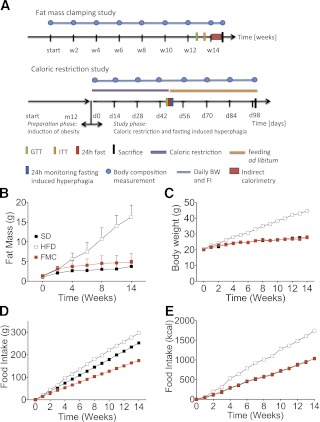
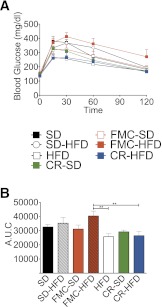
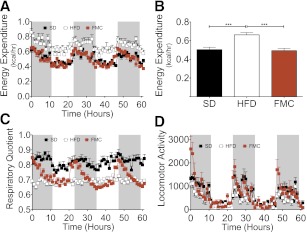
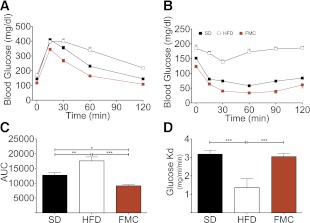
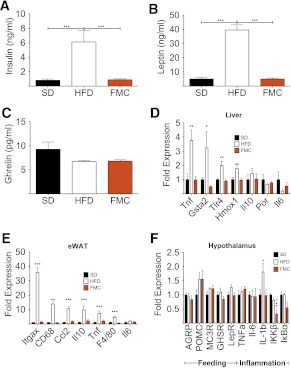
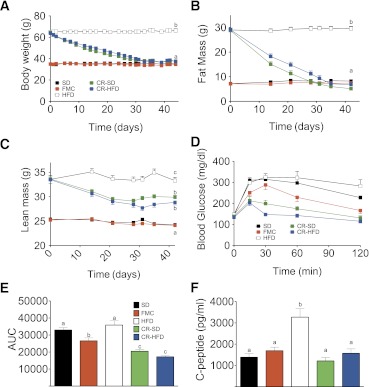
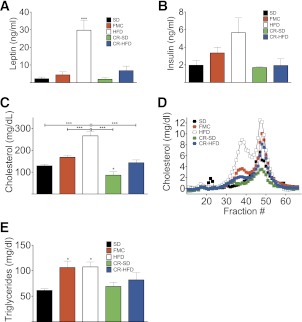
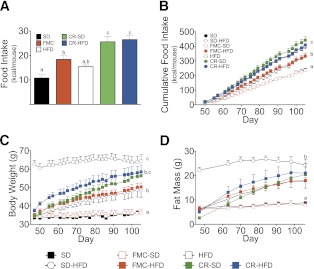
Although obesity rates are rapidly rising, caloric restriction remains one of the few safe therapies. Here we tested the hypothesis that obesity-associated disorders are caused by increased adipose tissue as opposed to excess dietary lipids. Fat mass (FM) of lean C57B6 mice fed a high-fat diet (HFD; FMC mice) was "clamped" to match the FM of mice maintained on a low-fat diet (standard diet [SD] mice). FMC mice displayed improved glucose and insulin tolerance as compared with ad libitum HFD mice (P < 0.001) or SD mice (P < 0.05). These improvements were associated with fewer signs of inflammation, consistent with the less-impaired metabolism. In follow-up studies, diet-induced obese mice were food restricted for 5 weeks to achieve FM levels identical with those of age-matched SD mice. Previously, obese mice exhibited improved glucose and insulin tolerance but showed markedly increased fasting-induced hyperphagia (P < 0.001). When mice were given ad libitum access to the HFD, the hyperphagia of these mice led to accelerated body weight gain as compared with otherwise matched controls without a history of obesity. These results suggest that although caloric restriction on a HFD provides metabolic benefits, maintaining those benefits may require lifelong continuation, at least in individuals with a history of obesity.
尽管肥胖率迅速上升,但热量限制仍然是少数安全的治疗方法之一。在这里,我们检验了这样一个假设,即肥胖相关疾病是由脂肪组织增加引起的,而不是过量的饮食脂质。给予高脂肪饮食(HFD;FMC 小鼠)的瘦 C57B6 小鼠的脂肪质量(FM)被“固定”到与低脂饮食(标准饮食[SD]小鼠)维持的 FM 相匹配。与自由进食 HFD 小鼠(P < 0.001)或 SD 小鼠(P < 0.05)相比,FMC 小鼠表现出改善的葡萄糖和胰岛素耐量。这些改善与炎症迹象减少有关,这与代谢受损较少一致。在后续研究中,饮食诱导肥胖的小鼠被限制进食 5 周,以达到与年龄匹配的 SD 小鼠相同的 FM 水平。以前,肥胖小鼠表现出改善的葡萄糖和胰岛素耐量,但表现出明显增加的空腹诱导性多食(P < 0.001)。当这些小鼠自由进食 HFD 时,与没有肥胖史的对照组相比,它们的多食导致体重加速增加。这些结果表明,尽管 HFD 上的热量限制提供了代谢益处,但维持这些益处可能需要终身持续,至少对有肥胖史的个体而言是这样。