Choveau Frank S, Abderemane-Ali Fayal, Coyan Fabien C, Es-Salah-Lamoureux Zeineb, Baró Isabelle, Loussouarn Gildas
UMR 1087, Institut National de la Santé et de la Recherche Médicale Nantes, France.
Front Pharmacol. 2012 Jul 5;3:125. doi: 10.3389/fphar.2012.00125. eCollection 2012.
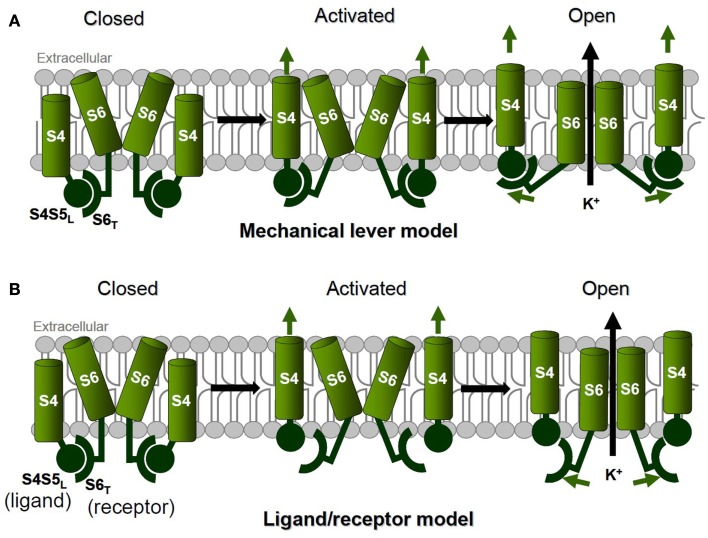
Voltage-gated potassium (Kv) channels are tetramers, each subunit presenting six transmembrane segments (S1-S6), with each S1-S4 segments forming a voltage-sensing domain (VSD) and the four S5-S6 forming both the conduction pathway and its gate. S4 segments control the opening of the intracellular activation gate in response to changes in membrane potential. Crystal structures of several voltage-gated ion channels in combination with biophysical and mutagenesis studies highlighted the critical role of the S4-S5 linker (S4S5(L)) and of the S6 C-terminal part (S6(T)) in the coupling between the VSD and the activation gate. Several mechanisms have been proposed to describe the coupling at a molecular scale. This review summarizes the mechanisms suggested for various voltage-gated ion channels, including a mechanism that we described for KCNQ1, in which S4S5(L) is acting like a ligand binding to S6(T) to stabilize the channel in a closed state. As discussed in this review, this mechanism may explain the reverse response to depolarization in HCN-like channels. As opposed to S4S5(L), the phosphoinositide, phosphatidylinositol 4,5-bisphosphate (PIP(2)), stabilizes KCNQ1 channel in an open state. Many other ion channels (not only voltage-gated) require PIP(2) to function properly, confirming its crucial importance as an ion channel cofactor. This is highlighted in cases in which an altered regulation of ion channels by PIP(2) leads to channelopathies, as observed for KCNQ1. This review summarizes the state of the art on the two regulatory mechanisms that are critical for KCNQ1 and other voltage-gated channels function (PIP(2) and S4S5(L)), and assesses their potential physiological and pathophysiological roles.
电压门控钾(Kv)通道是四聚体,每个亚基有六个跨膜片段(S1-S6),每个S1-S4片段形成一个电压感应结构域(VSD),四个S5-S6片段共同构成传导通路及其门控结构。S4片段响应膜电位变化控制细胞内激活门的开放。几种电压门控离子通道的晶体结构结合生物物理和诱变研究突出了S4-S5连接子(S4S5(L))和S6 C末端部分(S6(T))在VSD与激活门之间耦合中的关键作用。已经提出了几种机制来描述分子水平上的耦合。本综述总结了针对各种电压门控离子通道提出的机制,包括我们描述的KCNQ1的机制,其中S4S5(L)就像一个与S6(T)结合的配体,使通道稳定在关闭状态。如本综述所讨论的,这种机制可能解释了HCN样通道中对去极化的反向反应。与S4S5(L)相反,磷酸肌醇磷脂酰肌醇4,