Norwich Medical School, University of East Anglia, Norwich, Norfolk, United Kingdom.
PLoS One. 2012;7(7):e40210. doi: 10.1371/journal.pone.0040210. Epub 2012 Jul 6.
To estimate the prevalence of low health literacy, and evaluate the impact of low health literacy on outcomes in patients with chronic musculoskeletal conditions.
We searched Embase, Pubmed, PsycInfo, and CINAHL in January 2011 for relevant studies, restricted to English-language articles.
Studies were included if they measured health literacy and/or reported on the link between outcomes and health literacy levels in patients with osteoporosis, osteoarthritis, or rheumatoid arthritis. We assessed risk of bias from participant selection, methods of measuring health literacy and functional outcomes, missing data, and potential for confounding.
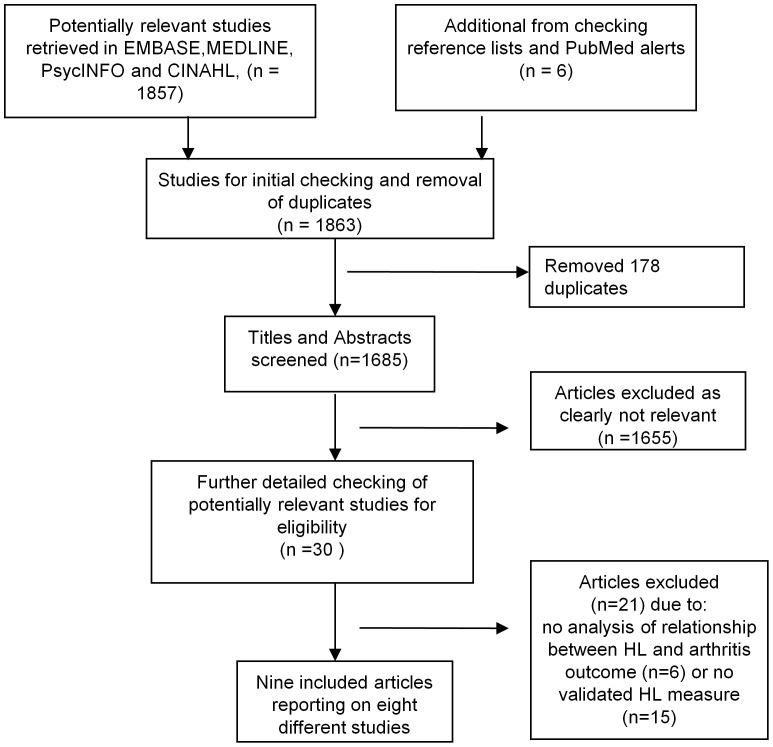
We reviewed 1863 citations and judged 8 studies to be relevant. Most were cross-sectional in nature, and five were based in the United States. Diversity in measurements, participant characteristics, and settings meant that results had to be synthesized narratively. Prevalence of low health literacy varied from 7% to 42%. Of the five studies that reported on musculoskeletal outcomes, only one showed an association (unadjusted) between low health literacy and greater pain and limitations in physical functioning. However, other studies, including those with multivariate analyses, found no significant relationship between health literacy and measures of pain or disease specific questionnaires. One clinical trial found short-term improvements in the mental health of patients with musculoskeletal conditions after an intervention to improve health literacy.
Most of the studies were cross-sectional in nature, which precludes interpretation of a causal relationship. The sample sizes may not have been sufficiently large to enable detection of significant associations.
The current evidence does not show a consistent association between low health literacy and poorer functional outcomes in patients with chronic musculoskeletal conditions. In the absence of a definite link, efforts to develop interventions to improve health literacy would not necessarily improve health service or patient-related outcomes.
评估慢性肌肉骨骼疾病患者低健康素养的流行率,并评估低健康素养对患者结局的影响。
我们于 2011 年 1 月检索了 Embase、Pubmed、PsycInfo 和 CINAHL,以获取相关研究,仅限于英文文章。
如果研究测量了健康素养,并/或报告了骨质疏松症、骨关节炎或类风湿关节炎患者结局与健康素养水平之间的关系,则纳入研究。我们评估了参与者选择、健康素养和功能结局测量方法、缺失数据和潜在混杂因素的偏倚风险。
我们回顾了 1863 篇引文,并判断了 8 项相关研究。大多数研究为横断面研究,5 项研究在美国进行。由于测量方法、参与者特征和研究场所的多样性,必须进行叙述性综合。低健康素养的流行率从 7%到 42%不等。在报告肌肉骨骼结局的 5 项研究中,只有 1 项研究(未经调整)显示低健康素养与更严重的疼痛和身体功能受限之间存在关联。然而,其他研究,包括多变量分析,均未发现健康素养与疼痛或疾病特异性问卷测量之间存在显著关系。一项临床试验发现,对改善健康素养的干预措施可在短期改善肌肉骨骼疾病患者的心理健康。
大多数研究为横断面研究,这限制了对因果关系的解释。样本量可能不足以检测到显著的关联。
目前的证据并未显示慢性肌肉骨骼疾病患者低健康素养与较差的功能结局之间存在一致关联。在缺乏明确联系的情况下,努力开发改善健康素养的干预措施不一定会改善卫生服务或患者相关结局。