Centre of Excellence for Nutrition, Faculty of Health Sciences, Building G16, North- West University, Potchefstroom Campus, Potchefstroom, South Africa.
Department of Nutrition and Dietetics, School of Biomedical and Allied Health Sciences, College of Health Sciences, University of Ghana, Accra, Ghana.
Respir Res. 2020 Aug 26;21(1):223. doi: 10.1186/s12931-020-01488-9.
The potential role of adjunctive anti-inflammatory therapy to enhance tuberculosis (TB) treatment has recently received increasing interest. There is, therefore, a need to broadly examine current host-directed therapies (HDTs) that could accelerate treatment response and improve TB outcomes.
This systematic review and meta-analysis included randomised controlled trials of vitamin D and other HDT agents in patients receiving antibiotic treatment for pulmonary TB. Sputum smear conversion rate at 4-8 weeks was the primary outcome. Secondary outcomes included blood indices associated with infectivity and inflammation, chest radiology and incidence of adverse events.
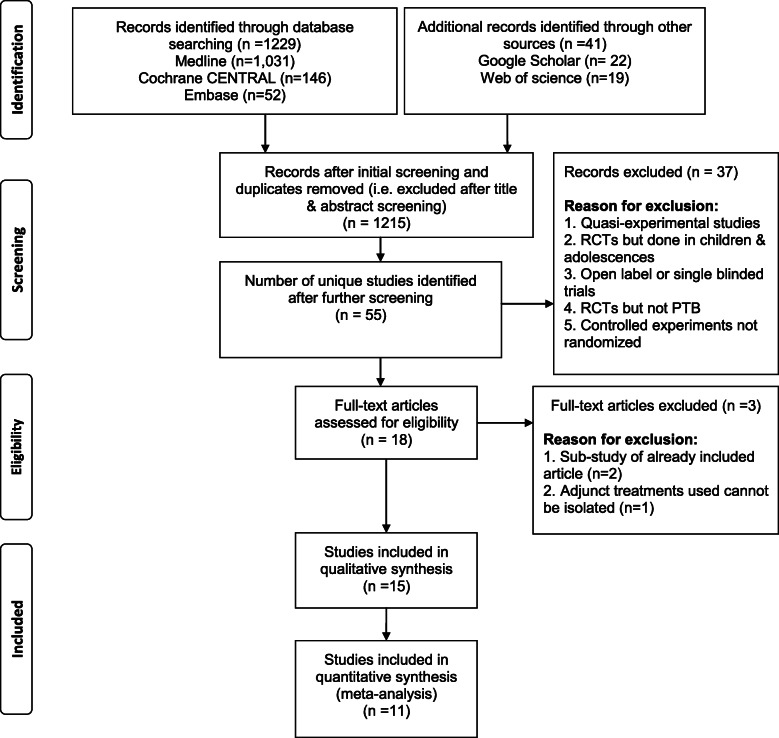
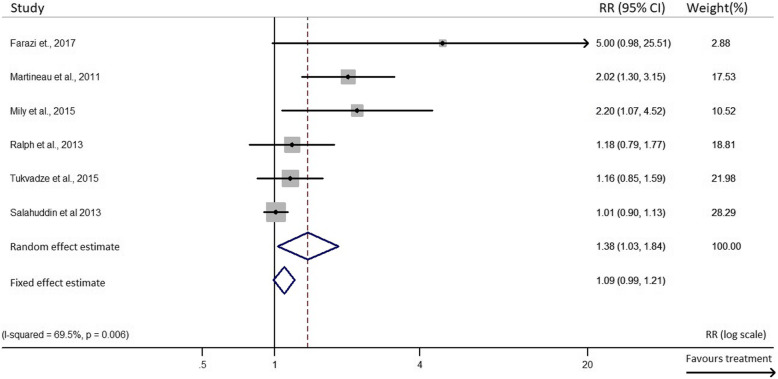
Fifty-five studies were screened for eligibility after the initial search, which yielded more than 1000 records. Of the 2540 participants in the 15 trials included in the meta-analysis, 1898 (74.7%) were male, and the age at entry ranged from 18 to 70 years. There was a 38% significantly (RR 1.38, 95% CI = 1.03-1.84) increased sputum smear negativity in patients administered with vitamin D in addition to standard TB treatment than those receiving only the TB treatment. Patients treated with other HDT anti-inflammatory agents in addition to TB treatment also had a 29% significantly increased sputum smear conversion rate (RR 1.29, 95% CI = 1.09-1.563). Lymphocyte to monocyte ratio was significantly higher in the vitamin D treatment groups compared to the controls (3.52 vs 2.70, 95% CI for difference 0.16-1.11, p = 0.009) and (adjusted mean difference 0.4, 95% CI 0.2 -- 0.6; p = 0.001); whilst tumour necrosis factor-alpha (TNF-α) showed a trend towards a reduction in prednisolone (p < 0.001) and pentoxifylline (p = 0.27) treatment groups. Vitamin D and N-acetylcysteine also accelerated radiographic resolution in treatment compared to placebo at 8 weeks. No differences were observed in the occurrence of adverse events among all HDT treatments.
Vitamin D and other anti-inflammatory HDT medications used as adjunct TB treatment may be well tolerated and effective. They significantly improved sputum smear conversion rate and chest radiological appearance, and also exhibited an inflammation resolution effect.
辅助抗炎治疗以增强结核病 (TB) 治疗的潜力最近受到了越来越多的关注。因此,需要广泛研究可能加速治疗反应并改善 TB 结局的当前宿主定向治疗 (HDT)。
本系统评价和荟萃分析纳入了维生素 D 和其他 HDT 药物治疗接受抗生素治疗的肺结核患者的随机对照试验。主要结局是 4-8 周时的痰涂片转化率。次要结局包括与传染性和炎症相关的血液指标、胸部影像学和不良事件发生率。
最初搜索后筛选出 55 项符合条件的研究,产生了 1000 多条记录。在纳入荟萃分析的 15 项试验的 2540 名参与者中,1898 名(74.7%)为男性,入组年龄为 18 至 70 岁。与仅接受 TB 治疗的患者相比,接受维生素 D 联合标准 TB 治疗的患者痰涂片阴性率显著增加 38%(RR 1.38,95%CI 1.03-1.84)。除了 TB 治疗外,还接受其他 HDT 抗炎药物治疗的患者痰涂片转化率也显著增加了 29%(RR 1.29,95%CI 1.09-1.563)。与对照组相比,维生素 D 治疗组的淋巴细胞与单核细胞比值明显更高(3.52 比 2.70,95%CI 差值为 0.16-1.11,p=0.009),(调整平均差值 0.4,95%CI 0.2--0.6;p=0.001);而肿瘤坏死因子-α (TNF-α) 在泼尼松龙(p<0.001)和己酮可可碱(p=0.27)治疗组中呈下降趋势。与安慰剂相比,维生素 D 和 N-乙酰半胱氨酸在 8 周时也加速了放射学缓解。所有 HDT 治疗中均未观察到不良事件的发生差异。
作为辅助 TB 治疗的维生素 D 和其他抗炎性 HDT 药物可能具有良好的耐受性和疗效。它们显著提高了痰涂片转化率和胸部影像学表现,并表现出炎症缓解作用。