MRC Cognition and Brain Sciences Unit, 15 Chaucer Road, Cambridge, CB2 7EF, UK.
Psychon Bull Rev. 2012 Oct;19(5):864-70. doi: 10.3758/s13423-012-0225-y.
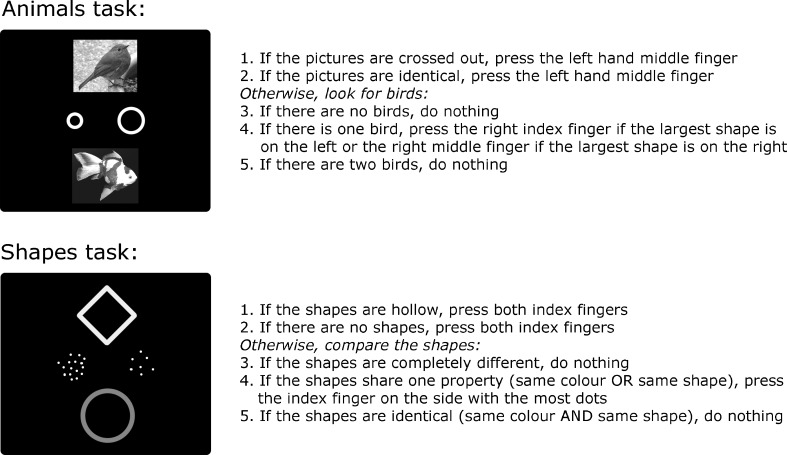
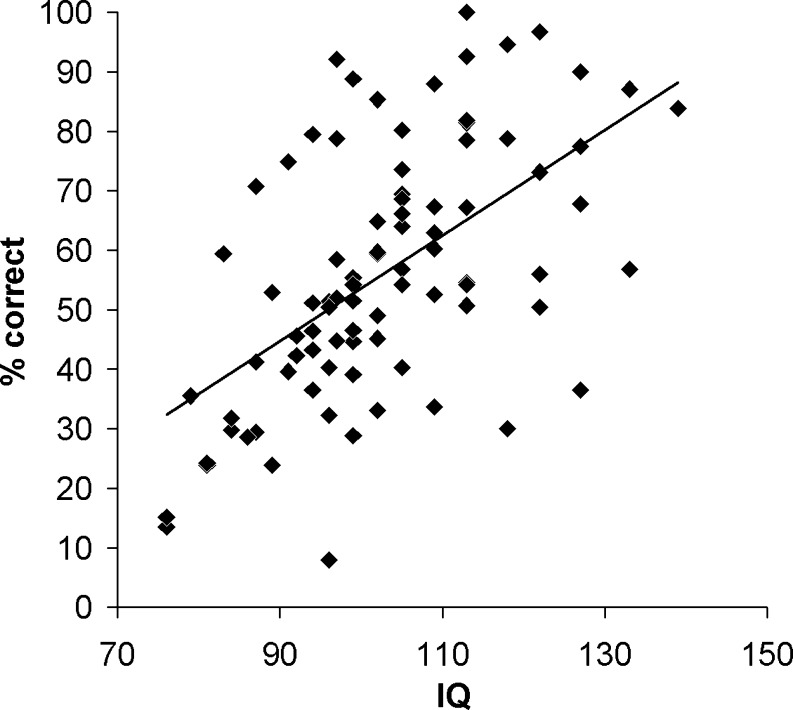
Many varieties of working memory have been linked to fluid intelligence. In Duncan et al. (Journal of Experimental Psychology:General 137:131-148, 2008), we described limited working memory for new task rules: When rules are complex, some may fail in their control of behavior, though they are often still available for explicit recall. Unlike other kinds of working memory, load is determined in this case not by real-time performance demands, but by the total complexity of the task instructions. Here, we show that the correlation with fluid intelligence is stronger for this aspect of working memory than for several other, more traditional varieties-including simple and complex spans and a test of visual short-term memory. Any task, we propose, requires construction of a mental control program that aids in segregating and assembling multiple task parts and their controlling rules. Fluid intelligence is linked closely to the efficiency of constructing such programs, especially when behavior is complex and novel.
许多不同类型的工作记忆都与流体智力有关。在 Duncan 等人的研究中(《实验心理学杂志:一般心理学》137:131-148, 2008),我们描述了新任务规则的工作记忆有限:当规则复杂时,有些人可能无法控制自己的行为,尽管他们通常仍然可以明确地回忆起这些规则。与其他类型的工作记忆不同,在这种情况下,负荷不是由实时性能需求决定的,而是由任务指令的总复杂性决定的。在这里,我们表明,与几种其他更传统的工作记忆类型(包括简单和复杂跨度以及视觉短期记忆测试)相比,这种工作记忆方面与流体智力的相关性更强。我们提出,任何任务都需要构建一个心理控制程序,以帮助分离和组合多个任务部分及其控制规则。流体智力与构建此类程序的效率密切相关,尤其是在行为复杂和新颖的情况下。