Department of Molecular Genetics, Institute of Biomedical Science, Kansai Medical University, Moriguchi, Osaka, Japan.
Front Immunol. 2012 Jul 12;3:200. doi: 10.3389/fimmu.2012.00200. eCollection 2012.
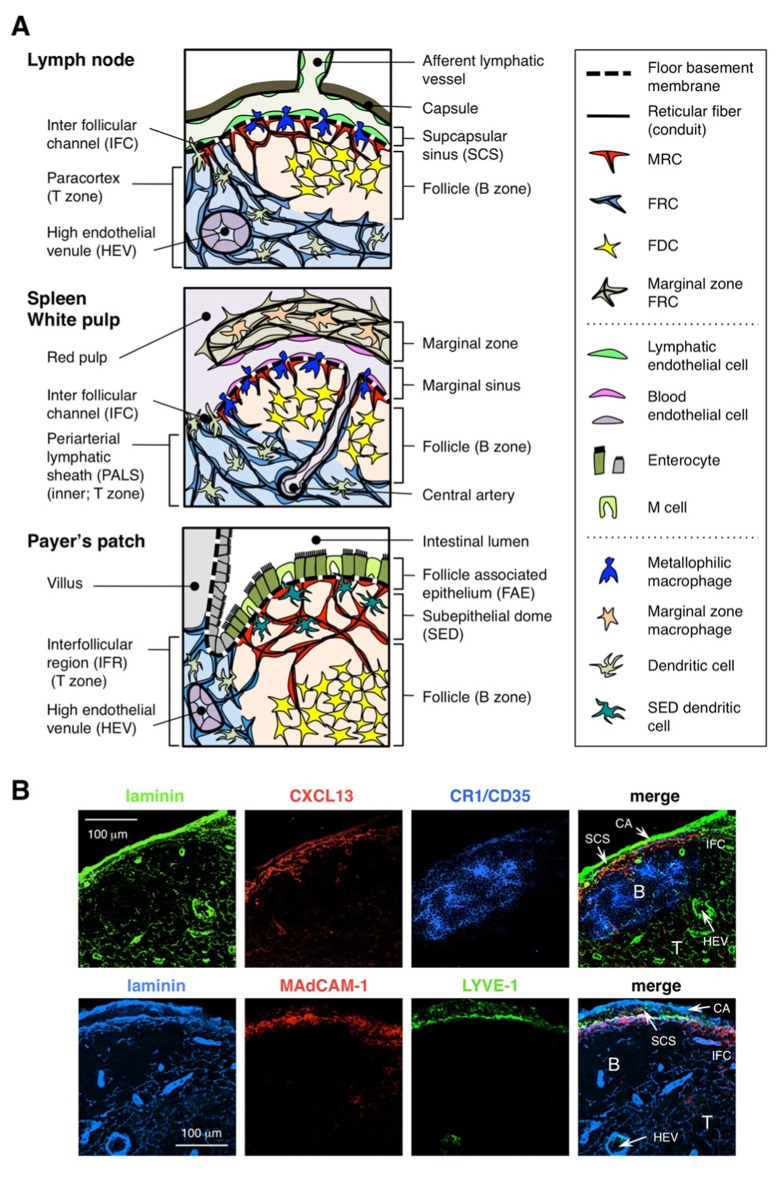
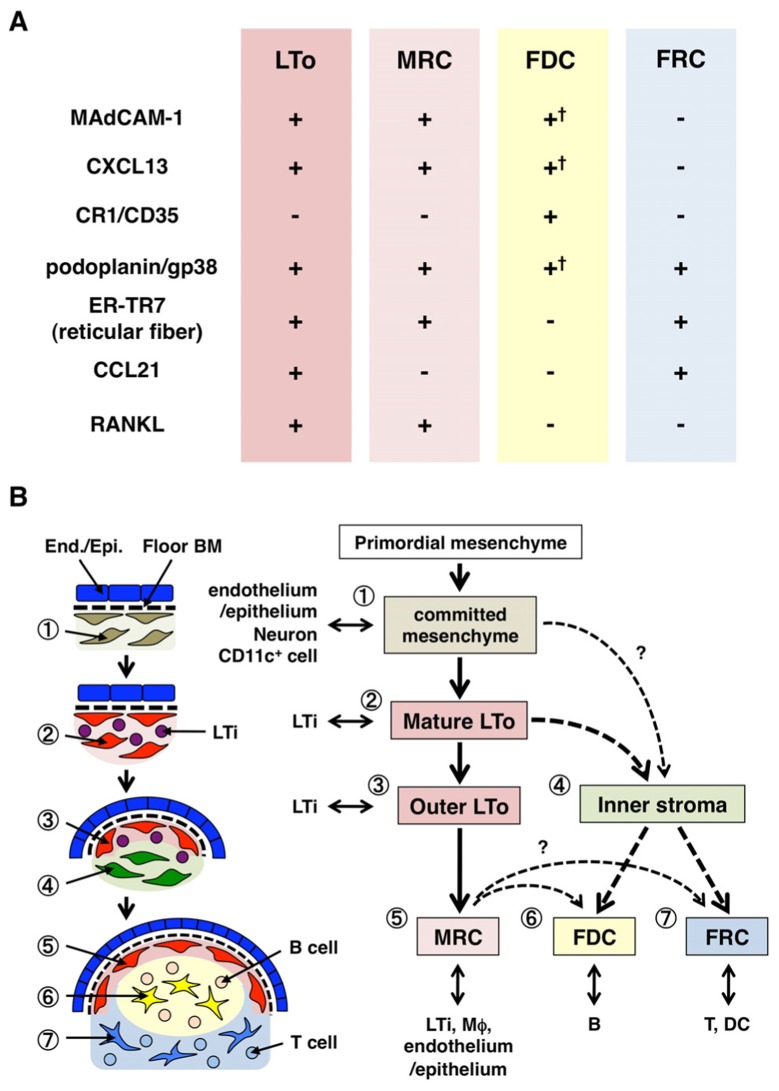
The architecture of secondary lymphoid organs (SLOs) is supported by several non-hematopoietic stromal cells. Currently it is established that two distinct stromal subsets, follicular dendritic cells and fibroblastic reticular cells, play crucial roles in the formation of tissue compartments within SLOs, i.e., the follicle and T zone, respectively. Although stromal cells in the anlagen are essential for SLO development, the relationship between these primordial cells and the subsets in adulthood remains poorly understood. In addition, the roles of stromal cells in the entry of antigens into the compartments through some tissue structures peculiar to SLOs remain unclear. A recently identified stromal subset, marginal reticular cells (MRCs), covers the margin of SLOs that are primarily located in the outer edge of follicles and construct a unique reticulum. MRCs are closely associated with specialized endothelial or epithelial structures for antigen transport. The similarities in marker expression profiles and successive localization during development suggest that MRCs directly descend from organizer stromal cells in the anlagen. Therefore, MRCs are thought to be a crucial stromal component for the organization and function of SLOs.
次级淋巴器官 (SLO) 的结构由几种非造血基质细胞支持。目前已经确定,两个不同的基质细胞亚群,滤泡树突状细胞和纤维母细胞网状细胞,分别在 SLO 内组织隔室的形成中发挥关键作用,即滤泡和 T 区。尽管发育中的基质细胞对于 SLO 的发育至关重要,但这些原始细胞与成年后的亚群之间的关系仍知之甚少。此外,基质细胞在通过 SLO 特有的一些组织结构将抗原进入隔室中的作用仍不清楚。最近鉴定的一个基质细胞亚群,边缘网状细胞 (MRCs),覆盖 SLO 的边缘,主要位于滤泡的外边缘,并构建独特的网状结构。MRCs 与专门用于抗原运输的内皮或上皮结构密切相关。在发育过程中标记表达谱和连续定位的相似性表明,MRCs 直接来源于原基中的组织者基质细胞。因此,MRCs 被认为是 SLO 组织和功能的关键基质成分。