Biomedical Sciences Research Center "Alexander Fleming", 16672 Vari, Greece.
Department of Physiology, Medical School, National and Kapodistrian University of Athens, 11527 Athens, Greece.
Sci Rep. 2016 Sep 8;6:33027. doi: 10.1038/srep33027.
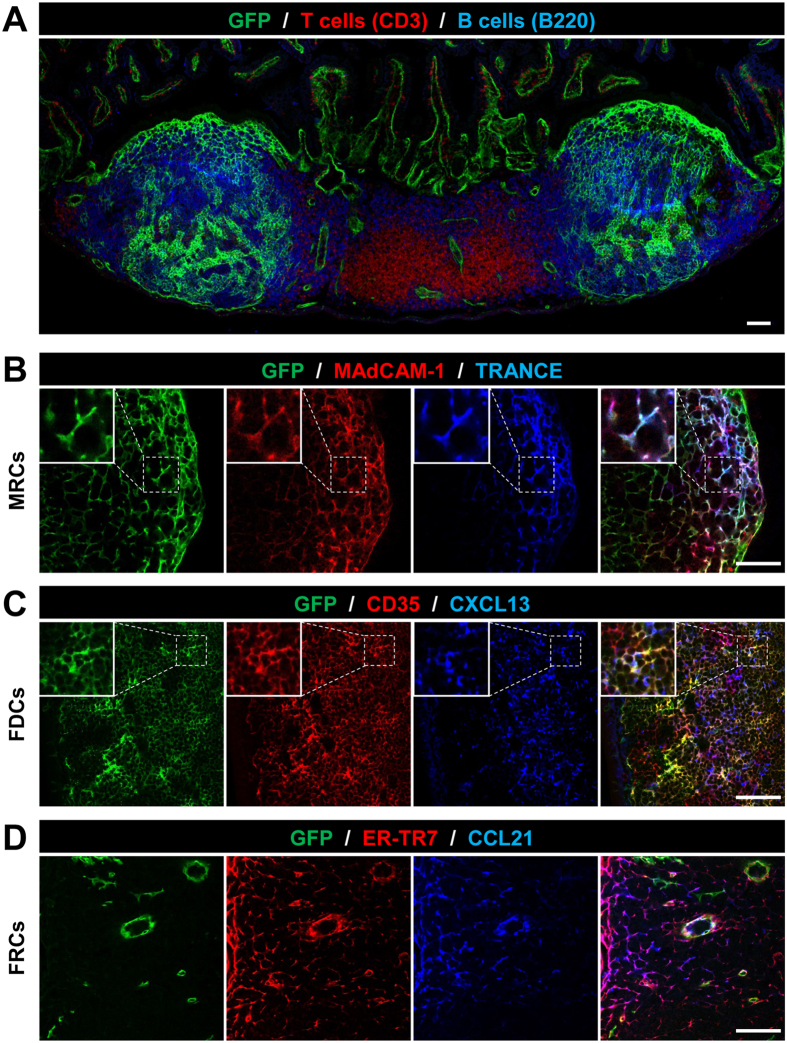
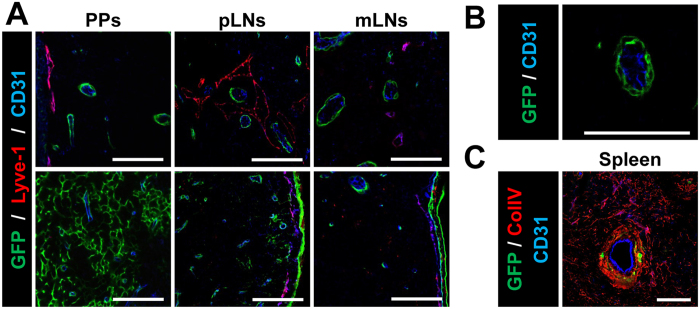
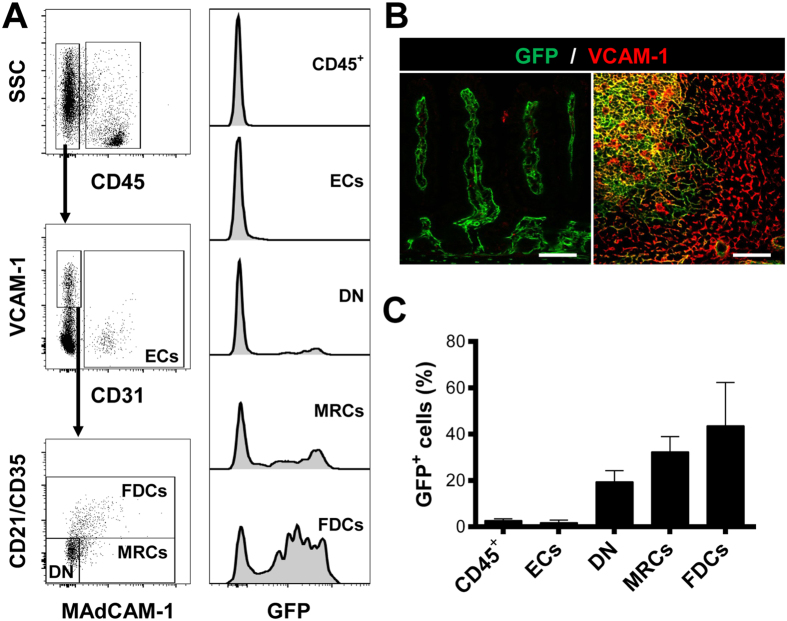
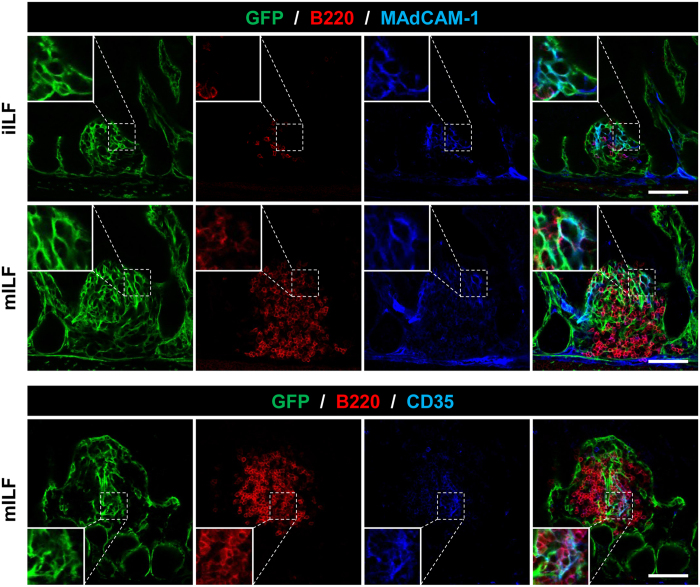
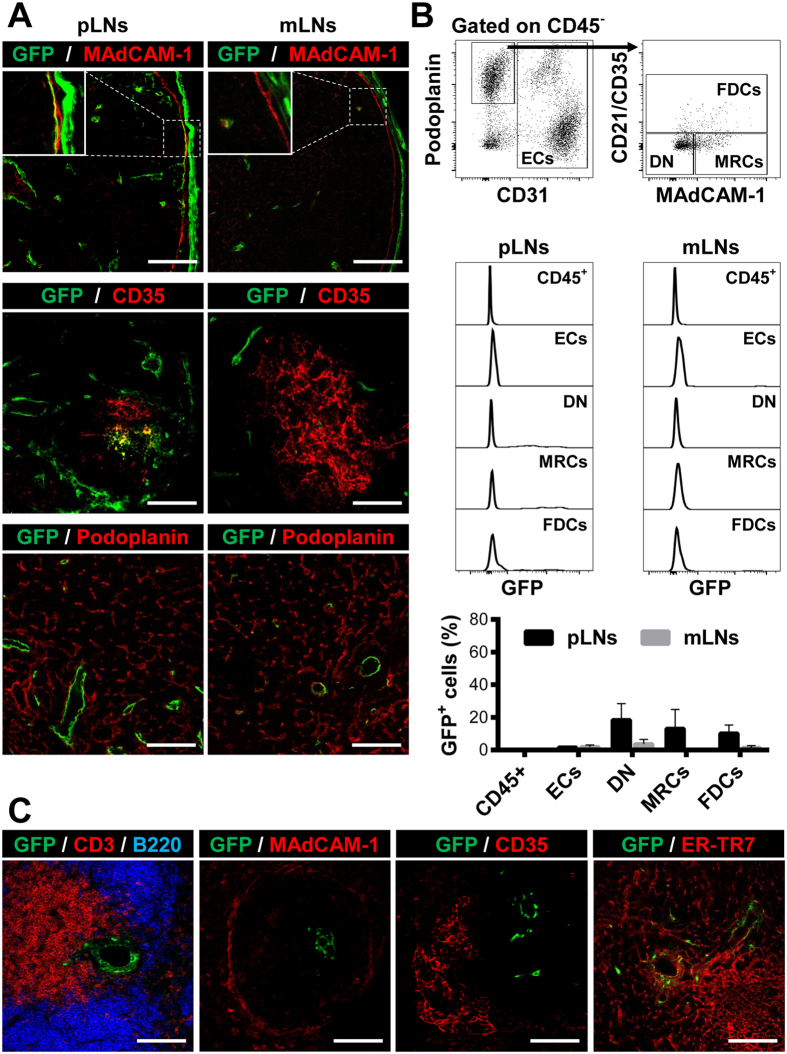
Stromal cells in secondary lymphoid organs (SLOs) are non-hematopoietic cells involved in the regulation of adaptive immune responses. Three major stromal populations have been identified in adult SLOs: fibroblastic reticular cells (FRCs), follicular dendritic cells (FDCs) and marginal reticular cells (MRCs). The properties of these individual populations are not clearly defined, mainly due to the lack of appropriate genetic tools, especially for MRCs. Here, we analyzed stromal cell targeting in SLOs from a transgenic mouse strain that expresses Cre recombinase under the CollagenVI promoter, using lineage tracing approaches. We show that these mice target specifically MRCs and FDCs, but not FRCs in Peyer's patches and isolated lymphoid follicles in the intestine. In contrast, stromal cells in lymph nodes and the spleen do not express the transgene, which renders ColVI-cre mice ideal for the specific targeting of stromal cells in the gut-associated lymphoid tissue (GALT). This funding further supports the hypothesis of organ-specific stromal precursors in SLOs. Interestingly, in all tissues analyzed, there was also high specificity for perivascular cells, which have been proposed to act as FDC precursors. Taken together, ColVI-Cre mice are a useful new tool for the dissection of MRC- and FDC-specific functions and plasticity in the GALT.
次级淋巴器官(SLO)中的基质细胞是非造血细胞,参与调节适应性免疫反应。在成年 SLO 中已经鉴定出三种主要的基质细胞群体:纤维母细胞网状细胞(FRCs)、滤泡树突状细胞(FDCs)和边缘网状细胞(MRCs)。这些单个群体的特性尚未明确界定,主要是由于缺乏适当的遗传工具,尤其是对于 MRCs。在这里,我们使用谱系追踪方法分析了在胶原 VI 启动子下表达 Cre 重组酶的转基因小鼠品系的 SLO 中的基质细胞靶向。我们表明,这些小鼠特异性靶向 MRCs 和 FDCs,但不靶向肠道中的派尔集合淋巴结和孤立淋巴滤泡中的 FRCs。相比之下,淋巴结和脾脏中的基质细胞不表达转基因,这使得 ColVI-cre 小鼠成为专门靶向肠道相关淋巴组织(GALT)中基质细胞的理想工具。这项资助进一步支持了 SLO 中器官特异性基质前体细胞的假说。有趣的是,在所有分析的组织中,对血管周围细胞也具有高度特异性,这些细胞被提议作为 FDC 前体。总之,ColVI-Cre 小鼠是一种用于解析 GALT 中 MRC 和 FDC 特异性功能和可塑性的有用新工具。