Department of Physics, George Washington University, Washington, DC, United States of America.
PLoS One. 2012;7(7):e39793. doi: 10.1371/journal.pone.0039793. Epub 2012 Jul 11.
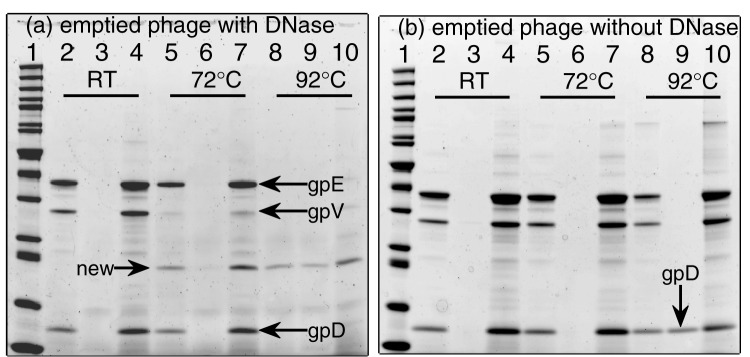
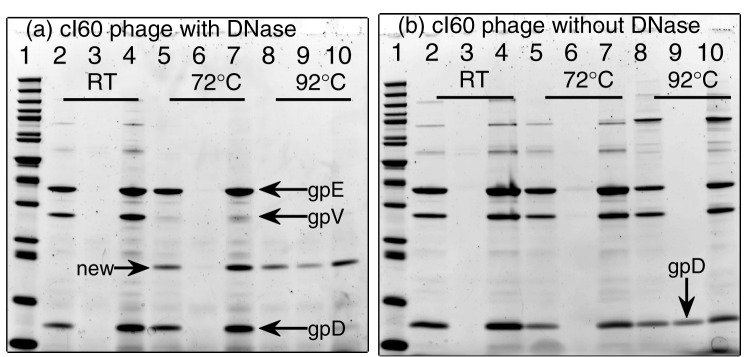
Successive structural changes of bacteriophage λ upon heating were characterized with quantitative experimental methods. In the commonly used Tris-Mg buffer, differential scanning calorimetry measurements first established that the protein capsid of λ phage melts at 87 °C and its genomic DNA melts at 91 °C. Interestingly, prior to the capsid melting, λDNA was found to escape out of the capsid and subject to DNase digestion above ~68 °C, as concluded from light scattering, UV absorption, and electron microscopy studies. Further investigations indicated distinct temperature-dependent behaviors of the three phage proteins. Around 68 °C, disruption of the tail first occurs and leads to the escape of λ DNA; above the capsid melting temperature of 87 °C, the auxiliary protein gpD of the phage head remains soluble in solution and resists centrifugal sedimentation, whereas the major capsid protein gpE is easily precipitated and likely exists as aggregates.
采用定量实验方法研究了噬菌体 λ 在加热过程中的连续结构变化。在常用的 Tris-Mg 缓冲液中,差示扫描量热法测量首先确定噬菌体 λ 的蛋白质外壳在 87°C 时熔化,其基因组 DNA 在 91°C 时熔化。有趣的是,在外壳熔化之前,发现 λDNA 从外壳中逸出,并在高于约 68°C 时受到 DNase 的消化,这是从光散射、紫外吸收和电子显微镜研究中得出的结论。进一步的研究表明,三种噬菌体蛋白具有明显的温度依赖性行为。在 68°C 左右,尾部首先发生破坏,导致 λDNA 逸出;高于 87°C 的外壳熔化温度时,噬菌体头部的辅助蛋白 gpD 仍溶解在溶液中,抵抗离心沉降,而主要外壳蛋白 gpE 则容易沉淀,可能存在聚集。