Division of Pediatric Pulmonology, Department of Pediatrics, University of Miami, Miami, Florida, United States of America.
PLoS One. 2012;7(7):e40383. doi: 10.1371/journal.pone.0040383. Epub 2012 Jul 16.
To examine the relation between mouse allergen exposure and asthma in Puerto Rican children.
Mus m 1, Der p 1, Bla g 2, and Fel d 1 allergens were measured in dust samples from homes of Puerto Rican children with (cases) and without (controls) asthma in Hartford, CT (n = 449) and San Juan (SJ), Puerto Rico (n = 678). Linear or logistic regression was used for the multivariate analysis of mouse allergen (Mus m 1) and lung function (FEV(1) and FEV(1)/FVC) and allergy (total IgE and skin test reactivity (STR) to ≥1 allergen) measures.
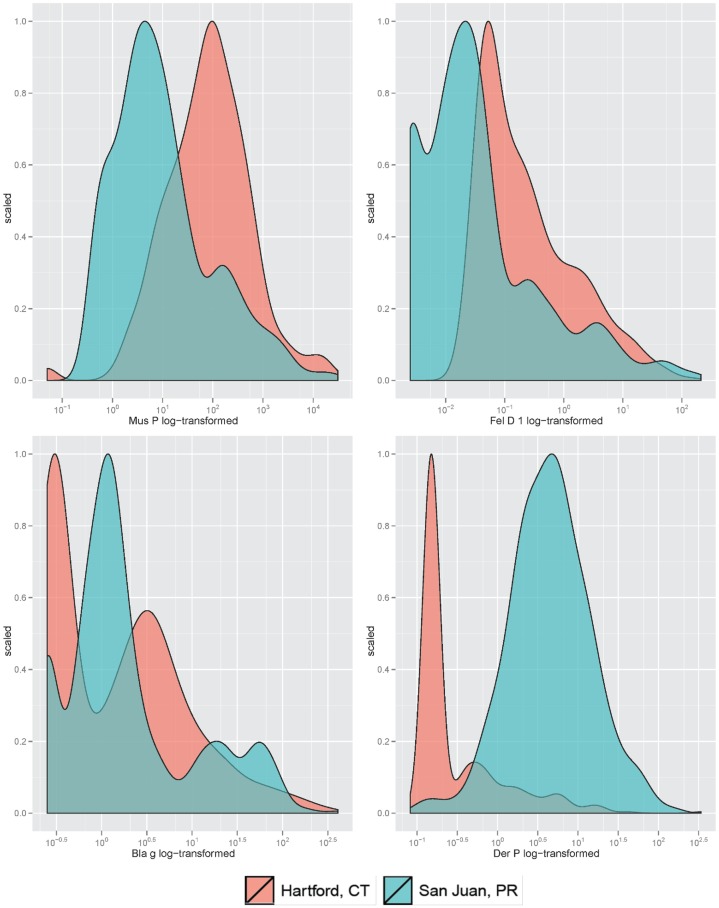
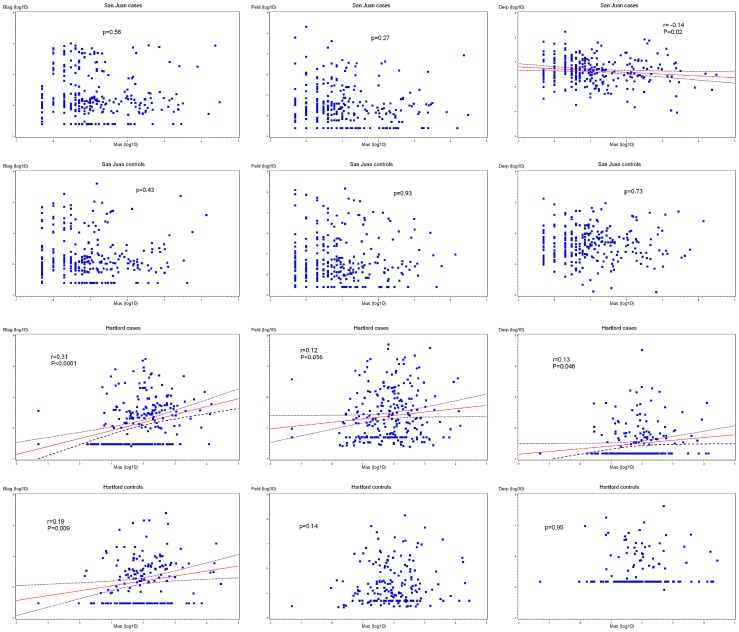
Homes in SJ had lower mouse allergen levels than those in Hartford. In multivariate analyses, mouse allergen was associated with higher FEV(1) in cases in Hartford (+70.6 ml, 95% confidence interval (CI) = 8.6-132.7 ml, P = 0.03) and SJ (+45.1 ml, 95% CI = -0.5 to 90.6 ml, P = 0.05). In multivariate analyses of controls, mouse allergen was inversely associated with STR to ≥1 allergen in non-sensitized children (odds ratio [OR] for each log-unit increment in Mus m 1 = 0.7, 95% CI = 0.5-0.9, P<0.01). In a multivariate analysis including all children at both study sites, each log-increment in mouse allergen was positively associated with FEV(1) (+28.3 ml, 95% CI = 1.4-55.2 ml, P = 0.04) and inversely associated with STR to ≥1 allergen (OR for each log-unit increment in Mus m 1 = 0.8, 95% CI = 0.6-0.9, P<0.01).
Mouse allergen is associated with a higher FEV(1) and lower odds of STR to ≥1 allergen in Puerto Rican children. This may be explained by the allergen itself or correlated microbial exposures.
研究波多黎各儿童的鼠过敏原暴露与哮喘之间的关系。
在康涅狄格州哈特福德(n = 449)和波多黎各圣胡安(SJ)(n = 678),对患有哮喘(病例)和未患哮喘(对照)的波多黎各儿童家中的灰尘样本进行了 Mus m 1、Der p 1、Bla g 2 和 Fel d 1 过敏原的测量。使用线性或逻辑回归对鼠过敏原(Mus m 1)和肺功能(FEV1 和 FEV1/FVC)以及过敏(总 IgE 和皮肤试验反应(STR)≥1 种过敏原)进行了多变量分析。
SJ 家中的鼠过敏原水平低于哈特福德。在多变量分析中,鼠过敏原与哈特福德病例组的 FEV1 升高有关(+70.6 ml,95%置信区间(CI)为 8.6-132.7 ml,P = 0.03)和 SJ(+45.1 ml,95%CI 为-0.5 至 90.6 ml,P = 0.05)。在对照组的多变量分析中,鼠过敏原与非致敏儿童的 STR 呈负相关(每增加一个 Mus m 1 的对数单位,比值比(OR)为 0.7,95%CI 为 0.5-0.9,P<0.01)。在包括两个研究地点所有儿童的多变量分析中,鼠过敏原每增加一个对数单位与 FEV1 呈正相关(+28.3 ml,95%CI 为 1.4-55.2 ml,P = 0.04),与 STR 呈负相关≥1 种过敏原(每增加一个 Mus m 1 的对数单位,OR 为 0.8,95%CI 为 0.6-0.9,P<0.01)。
鼠过敏原与波多黎各儿童的 FEV1 较高和 STR 对≥1 种过敏原的可能性降低有关。这可能是由于过敏原本身或相关的微生物暴露所致。